



Capital Gains Tax Calculator for Rental Property
Estimate the tax you'll owe when you sell a rental property. Enter your sale price, what you paid, improvements and depreciation to see your gain split into depreciation recapture and long-term capital gain at current IRS rates, plus net investment income tax and state tax.

How to calculate capital gains tax on a rental property
Your gain is what you get from the sale minus your adjusted basis. The part that comes from depreciation, never more than the gain itself, is taxed at up to 25%, and the rest at long-term capital gains rates.
Work out your adjusted basis
Add the purchase price, buying costs and capital improvements. Then subtract the depreciation allowed or allowable: what you claimed, plus any you were entitled to but missed.
Subtract it from your net sale price
Take selling costs off the sale price. Whatever is left above your adjusted basis is your gain.
Split the gain and apply the rates
The depreciation part, never more than the gain itself, is taxed at your income tax rate, up to 25%. The rest is taxed at 0%, 15% or 20% depending on your income, with 3.8% NIIT on top for higher earners.
Worked example (2026 sale)
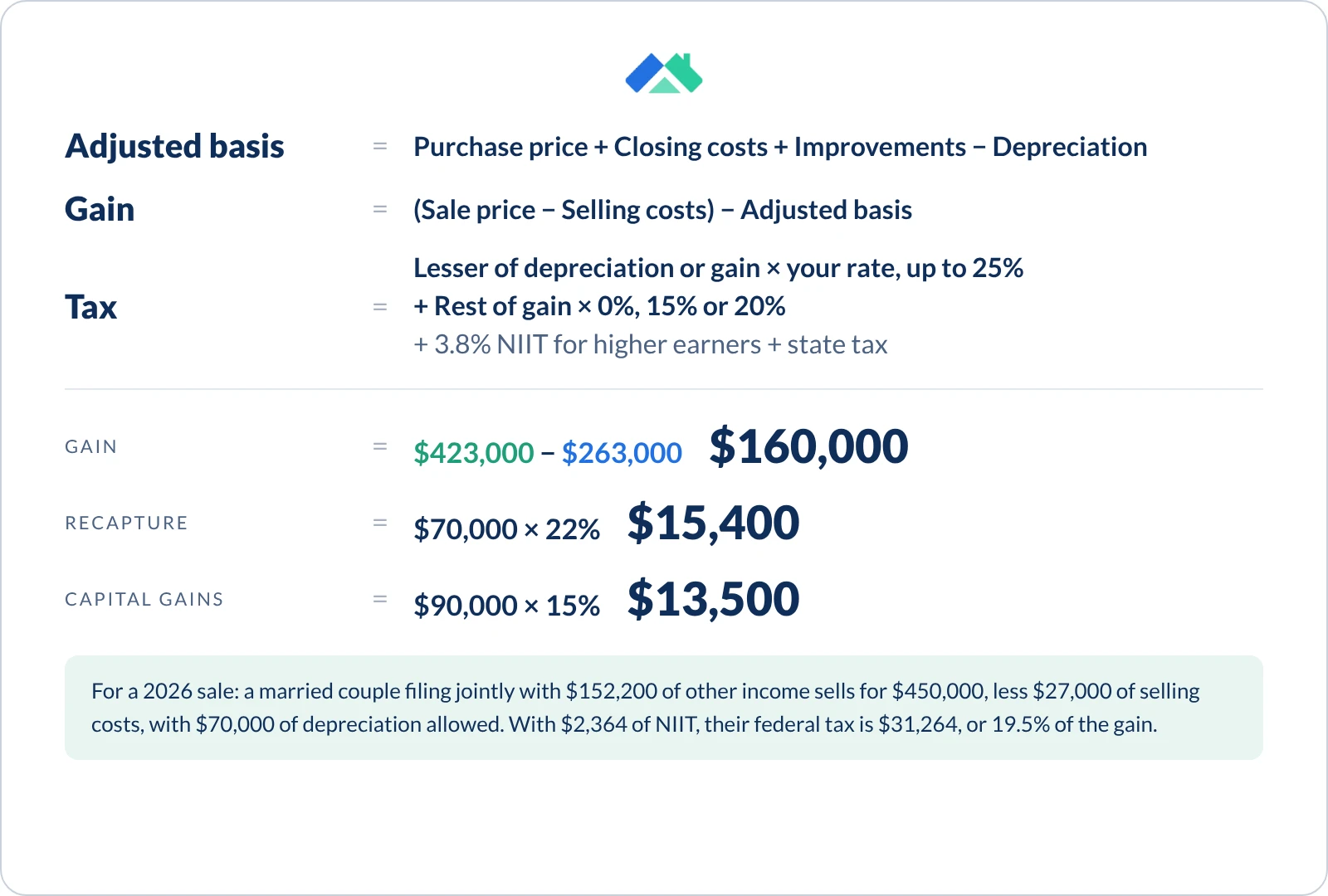
For a 2026 sale: a married couple filing jointly sells a rental for $450,000 with $27,000 of selling costs. They bought it for $300,000 with $8,000 of closing costs, spent $25,000 on improvements and had $70,000 of depreciation allowed. Their other income is $152,200, which is $120,000 after the $32,200 standard deduction for 2026.
Adjusted basis = $333,000 - $70,000 = $263,000
Gain = $423,000 - $263,000 = $160,000
Recapture = $70,000 × 22% = $15,400. It sits in their 22% bracket, below the 25% cap
Capital gains = $90,000 × 15% = $13,500
NIIT = 3.8% × $62,200, the amount by which their $312,200 of income plus gain passes the $250,000 threshold = $2,364
That's $31,264 of federal tax, or 19.5% of the gain. A 5% state rate adds $8,000.
Other calculators you might be interested in

Rental Property Depreciation Calculator
Work out your yearly deduction and the depreciation allowed to date.

IRR Calculator
See the yearly return on a rental from purchase through to sale.

Income Tax Calculator
Estimate the federal tax on your rental income, deductions included.

Manage up to 3 rental properties for free!
Sign up and get PRO free for 14 days. When the trial ends, keep tracking rent, expenses and reports for up to 3 properties, free forever with Landlord Studio GO.
By continuing you agree to our Terms & Conditions. · Already have an account? Log in
What drives your tax bill when you sell
Capital Gains Tax Calculator for Rental Property
Every dollar of depreciation lowers your basis, so it raises your gain when you sell. That part is taxed at your income tax rate, capped at 25%, even if you never claimed the deduction.
Your income sets the rate on the rest
Long-term gains are stacked on top of your other income. Gains that land in the 0% band owe no regular federal income tax, so selling in a lower-income year, or splitting a sale across two years, can cost far less.

Why should you use our capital gains tax calculator?
- Uses the current IRS brackets for your filing status
- Splits your gain into depreciation recapture and long-term capital gain
- Adds the 3.8% net investment income tax and your state rate
- Shows the cash you walk away with after paying off the mortgage
- Free, fast and no sign-up
FAQs
How is capital gains tax calculated on a rental property?

Subtract your adjusted basis from the sale price minus selling costs. Adjusted basis is what you paid, plus buying costs and improvements, minus the depreciation allowed or allowable. The part of the gain that comes from that depreciation, up to the total gain, is taxed at your income tax rate up to 25%, and the rest is generally taxed at long-term capital gains rates if you owned the property for more than a year, subject to section 1231 rules.
What is the capital gains tax rate on rental property?
Long-term gains are taxed at 0%, 15% or 20%, depending on your taxable income and filing status. The depreciation part of the gain is taxed at up to 25%. Higher earners may also owe the 3.8% net investment income tax, and most states add their own income tax. A gain on property held a year or less is taxed as ordinary income.
Does the home sale exclusion apply to a rental property?
Generally only if you owned the home and lived in it as your main home for at least two of the five years before the sale, and you haven't used the exclusion in the two years before. A partial exclusion can apply if you fall short because of a job move, health or other unforeseen circumstances. Since 2009, time it was a rental before you lived in it generally reduces the exclusion, but time after you moved out, within the five-year window, usually doesn't. Gain from depreciation allowed or allowable after May 6, 1997 can't be excluded.
Do I pay capital gains tax if I reinvest the money?
Yes, unless you use a 1031 exchange. Buying another property with the proceeds doesn't defer tax by itself. In a typical delayed exchange, you identify a replacement within 45 days of the sale and receive it by the earlier of 180 days or your tax return due date, including extensions. Most sellers use a qualified intermediary so they never receive the cash. A qualifying exchange may defer the gain, depreciation recapture included, but cash or other non-like-kind property you receive can still be taxed.
Do I pay state capital gains tax on a rental property?
Usually. Most states tax capital gains as regular income, while states with no income tax, such as Florida and Texas, don't tax them. If the property is in a different state from where you live, you generally owe tax to the state where the property is, and your home state may give you a credit for it. Our calculator applies the flat rate you enter as an estimate. It doesn't model state brackets, basis differences, exclusions or credits.