



Rental Property Depreciation Calculator
Work out how much you can deduct for depreciation on a rental property each year. Enter what you paid, the land value and when it was ready to rent to see your annual deduction, your full 27.5-year schedule and an estimate of the federal tax impact when you sell.

How to manually calculate rental property depreciation
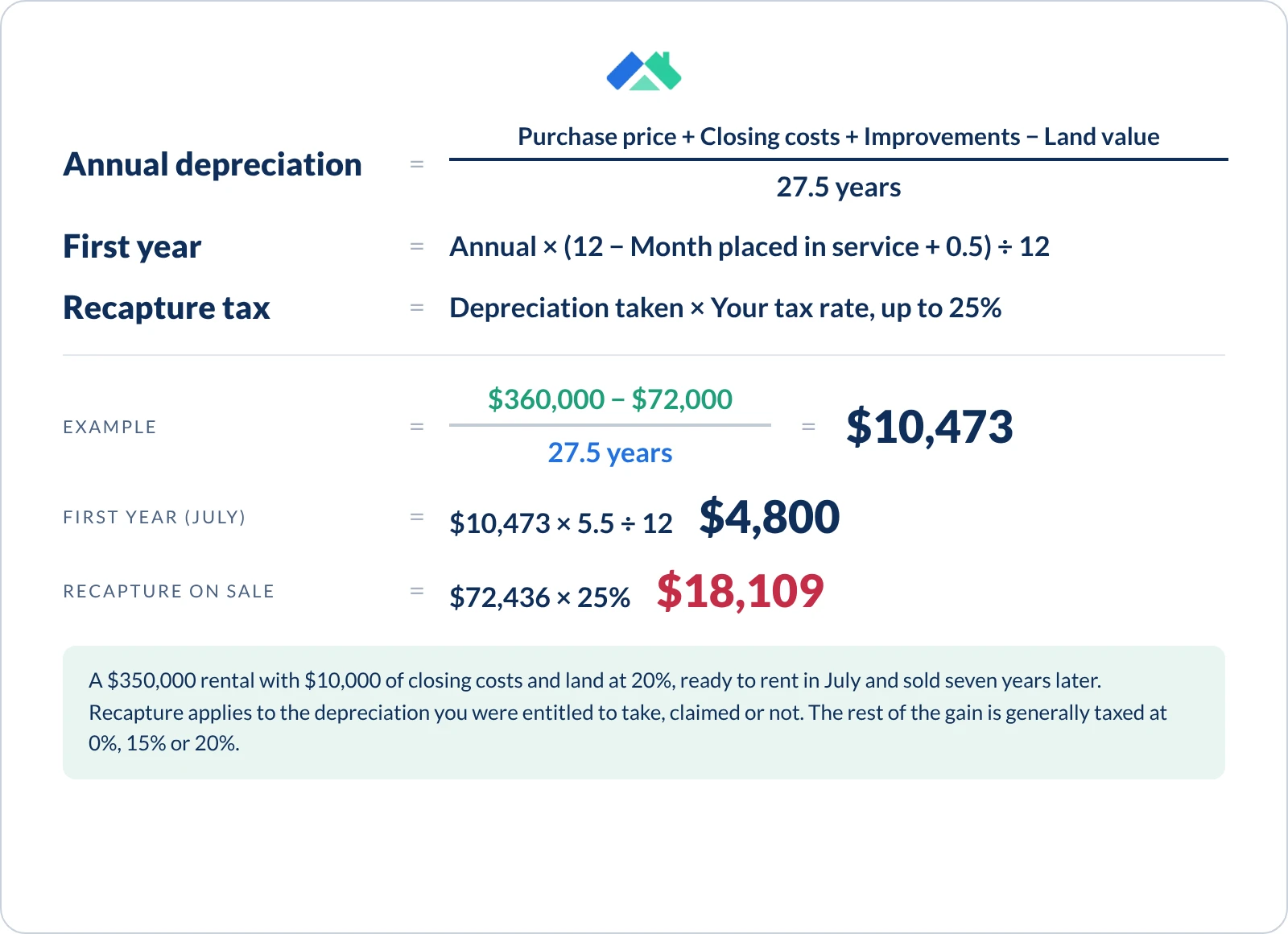
Under the General Depreciation System, residential rental property is depreciated in equal amounts over 27.5 years. Take the building's cost, leave out the land and divide by 27.5. The first and last years are prorated by month.
Find your depreciable basis
Add the purchase price and the closing costs you can capitalize, like title insurance and recording fees. Take out the share that belongs to the land, then add qualifying building improvements placed in service with the building.
Divide by 27.5
That's your deduction for every full year, or 3.636% of the depreciable basis.
Prorate the first year
The IRS treats the property as placed in service halfway through its month. Multiply the annual figure by (12 - month + 0.5) ÷ 12, so a July start gets 5.5 months.
Worked example
A rental bought for $350,000 with $10,000 of closing costs. The county assessor puts the land at 20% of the value, and it was ready to rent in July.
Depreciable basis = $360,000 - $72,000 land = $288,000
Annual depreciation = $288,000 ÷ 27.5 = $10,473
First year = $10,473 × 5.5 ÷ 12 = $4,800
Seven years later the landlord sells in June for $450,000, with $27,000 of selling costs. By then they've taken $72,436 of depreciation.
Gain = $423,000 - ($360,000 - $72,436) = $135,436
Recapture at the 32% bracket, capped at 25% = $72,436 × 25% = $18,109. Capital gains = $63,000 × 15% = $9,450
That's an estimated $27,559 of federal tax at the selected rates, before any net investment income tax, and $18,109 of it comes from depreciation.
Other calculators you might be interested in

Income Tax Calculator
Estimate the federal tax on your rental income, deductions included.

IRR Calculator
See the yearly return on a rental from purchase through to sale.

Cap Rate Calculator
Turn your NOI into a cap rate to compare properties before financing.

Manage up to 3 rental properties for free!
Sign up and get PRO free for 14 days. When the trial ends, keep tracking rent, expenses and reports for up to 3 properties, free forever with Landlord Studio GO.
By continuing you agree to our Terms & Conditions. · Already have an account? Log in
What depreciation does for your tax bill
Rental Property Depreciation Calculator
Depreciation lets you deduct the cost of the building, not the land, over 27.5 years on Schedule E. On a $288,000 building that's about $10,470 a year off your taxable rental income, even in years the property goes up in value.
You pay some of it back when you sell
When you sell, the depreciation you took - or could have taken - is taxed at up to 25%. That's depreciation recapture. Plan for it before you list.

Why should you use our depreciation calculator?
- Separates land from building, so you only depreciate what the IRS allows
- Applies the mid-month convention to your first and last year
- Builds your full 27.5-year schedule, year by year
- Estimates the federal tax impact of a sale at the rates you pick
- Free, fast and no sign-up
FAQs
How do you calculate depreciation on a rental property?

Under the General Depreciation System, divide the building's depreciable basis by 27.5. The basis is what you paid plus capitalized closing costs and improvements, minus the value of the land. In the first year you only count the months from the middle of the month you placed it in service, so a July start gets 5.5 months. A $288,000 building gives $10,473 a year and $4,800 in a July first year.
How do I separate the land value from the building?
Split your cost using fair market values at the time you bought. Many landlords use their county property tax assessment: if the assessor values the land at 20% of the total, 20% of your purchase price and closing costs is land. An appraisal works too. Keep a record of how you got the figure, because land can't be depreciated and the IRS can question the split.
What is depreciation recapture on a rental property?
When you sell a rental for a gain, the part of the gain that comes from depreciation is called unrecaptured section 1250 gain. It's taxed at your ordinary income rate, capped at 25%. The rest is generally taxed at long-term capital gains rates of 0%, 15% or 20%, subject to section 1231 rules, and higher earners may owe the 3.8% net investment income tax on top.
Do I owe depreciation recapture if I never claimed depreciation?
Yes. The IRS reduces your basis by the depreciation allowed or allowable, whichever is greater, so recapture is worked out on the depreciation you were entitled to take, claimed or not. If you missed it, the fix depends on your situation: often a change in accounting method on Form 3115, but sometimes an amended return, so check with a tax professional.
Can I avoid depreciation recapture?
You can often defer it. A qualifying 1031 exchange into another investment property may defer the gain, recapture included, but cash or other non-like-kind property you receive can still be taxed. Heirs who inherit a rental generally get a basis stepped up to market value, which removes the recapture. If you sell for less than your adjusted basis, there's no gain and no recapture to pay.