



Income Tax Calculator
Work out the federal income tax on your rental property using the 2026 IRS brackets - including depreciation, deductible expenses and the passive loss allowance.

How to manually calculate tax on your rental income
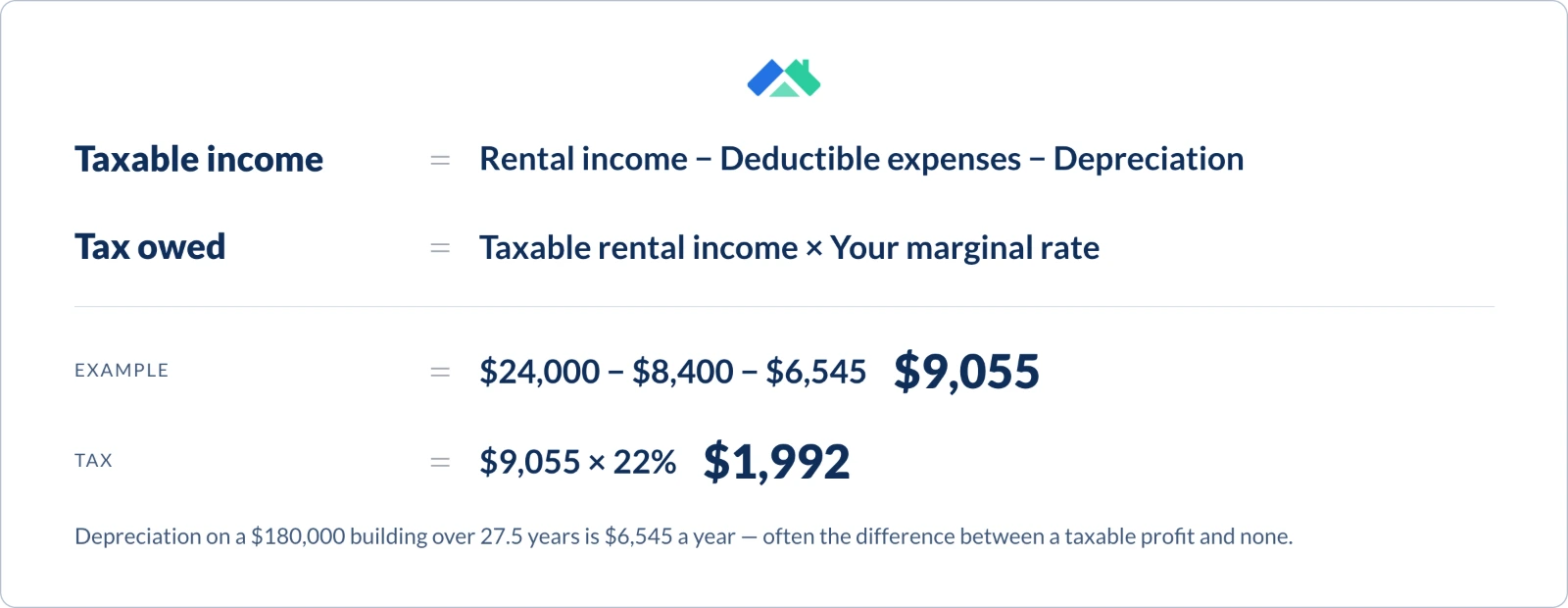
Taxable income is rent minus deductible expenses minus depreciation, taxed at your marginal rate. Depreciation is the deduction most landlords underclaim.
Total your rental income
All rent received in the year, plus fees and any forfeited deposits.
Subtract deductible expenses and depreciation
Depreciation is the building value, excluding land, divided over 27.5 years.
Apply your marginal rate
Rental profit stacks on your other income, so it's taxed at your top bracket.
Worked example
$33,000 of rent, $11,500 of deductible expenses, and a $220,000 building depreciated over 27.5 years.
Taxable income = $33,000 − $11,500 − $8,000 = $13,500
Tax owed = $13,500 × 24% = $3,240

Other calculators you might be interested in

Rental Yield Calculator
Gross and net yield, cash flow and cash-on-cash return on a rental property.

Net Operating Income Calculator
Calculate net operating income before financing, the starting point for deal analysis.

Free Mileage Calculator
Log property trips, apply the IRS standard mileage rate, and download a tax-ready expense pack.

Manage up to 3 rental properties for free!
Sign up and get PRO free for 14 days. When the trial ends, keep tracking rent, expenses and reports for up to 3 properties, free forever with Landlord Studio GO.
By continuing you agree to our Terms & Conditions. · Already have an account? Log in
What actually reduces your rental tax
Income Tax Calculator
Depreciation lets you deduct the building's value over 27.5 years - roughly 3.636% a year - without spending anything. It's usually the largest deduction a landlord has, and it often turns a cash-flow-positive property into a paper loss.
You can only depreciate the building, never the land.
A loss doesn't always cut your tax bill
Rental losses are passive, so they don't automatically offset your wages. The $25,000 active participation allowance is the exception - but it phases out from $100,000 of modified AGI and is gone entirely at $150,000.
Anything you can't use is suspended and carried forward.

Why should you use our rental income tax calculator?
- Uses the official 2026 IRS brackets and standard deduction
- Calculates 27.5-year depreciation from your building value automatically
- Applies the $25,000 passive loss allowance and its MAGI phase-out
- Shows your marginal rate and what the rental actually adds to your tax bill
- Free, fast and no sign-up
FAQs
How is rental income taxed?

Rental income is taxed as ordinary income at your marginal federal rate, so it stacks on top of your wages rather than being taxed separately. The 2026 rates run 10%, 12%, 22%, 24%, 32%, 35% and 37%.
What you're taxed on is the profit - rent received minus operating expenses, mortgage interest and depreciation - not the rent you collect.
What rental expenses can I deduct?
Include property taxes, insurance, property management, repairs and maintenance, utilities you pay, HOA dues, advertising, travel and professional fees. Mortgage interest is deductible on Schedule E, and there is no SALT cap on rental property taxes.
Repairs are deducted in the year you pay them. Improvements are capitalized and depreciated instead - that distinction is one of the most common audit issues.
How does rental property depreciation work?
Depreciation lets you deduct the cost of the building over 27.5 years using the General Depreciation System - about 3.636% a year. It's usually the largest deduction a landlord has, and it doesn't require spending anything.
Two things people get wrong: you can only depreciate the building, not the land it sits on, and in the first and last years the deduction is prorated using the IRS mid-month convention rather than counted as a full year.
Do I need to file Schedule E?
Yes, if your net rental income is above the filing threshold, or if you want to claim a loss. Rental income and expenses are reported on Schedule E (Form 1040), one column per property.
Depreciation is calculated on Form 4562 in the first year. Keep records for at least three years after filing - longer if you're depreciating a property, since you'll need the original cost basis when you eventually sell.
Can I deduct a rental loss against my salary?
Rental losses are passive by default, so they generally can't offset your wages. The exception is the $25,000 active participation allowance, which lets you deduct up to $25,000 of rental loss against other income.
It phases out at 50 cents per dollar once your modified AGI passes $100,000, and disappears entirely at $150,000. Anything you can't use is suspended and carried forward until you have passive income or sell the property.