



Prorated Rent Calculator
Work out how much prorated rent to charge when a tenant moves in or out partway through the month, plus the deposit and up-front costs due at move-in.

How to manually calculate prorated rent
Divide the monthly rent by the days in that month to get a daily rate, then multiply by the days the tenant actually occupies.
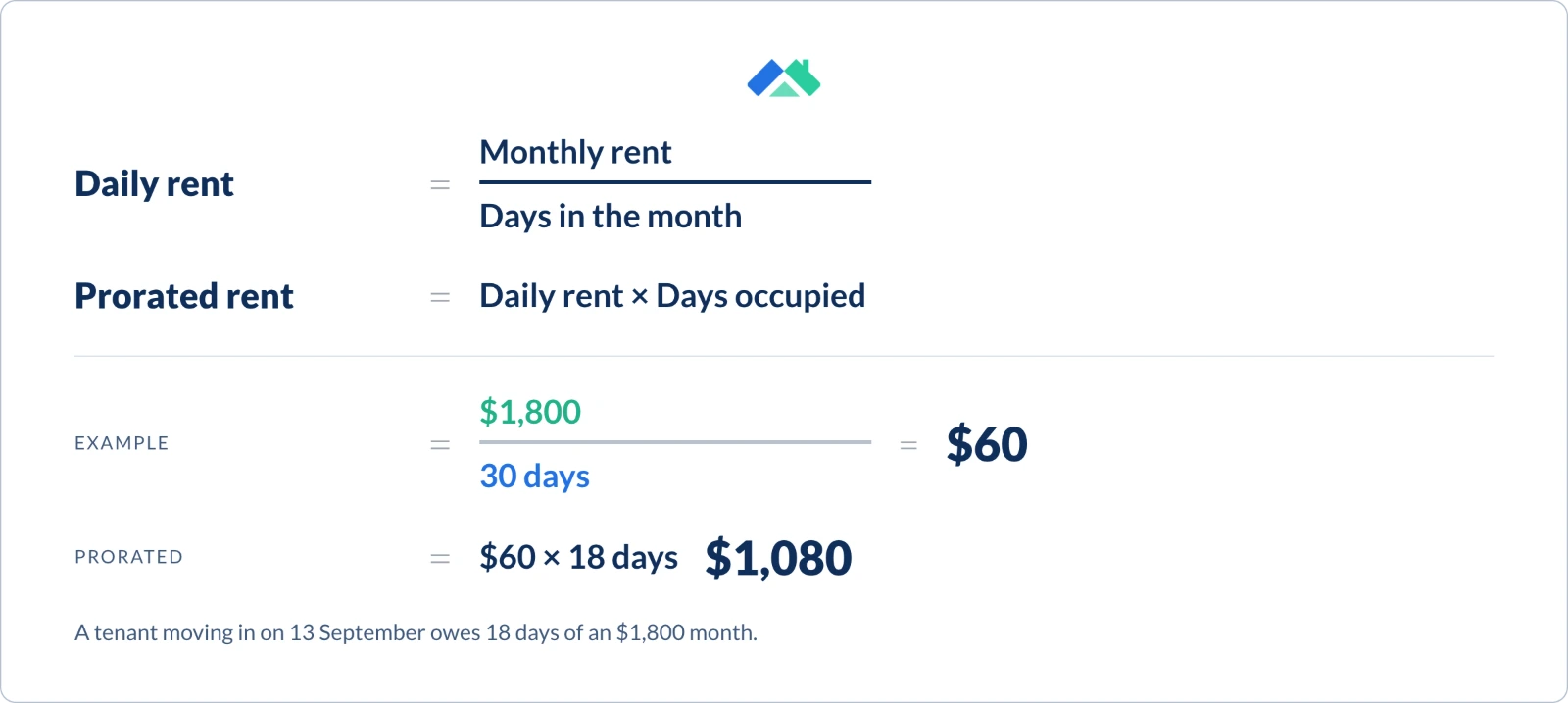
Work out the daily rent
Divide by the actual days in that month. Some leases use a flat 30, so check which yours specifies.
Count the days occupied
Include the move-in day itself, through to the end of the month.
Multiply and put it in writing
Show the calculation on the first invoice so there's no dispute later.
Worked example
Rent is $2,325 a month and the tenant moves in on October 20.
Daily rent = $2,325 ÷ 31 = $75
Prorated rent = $75 × 12 days = $900

Other calculators you might be interested in

Late Fees Calculator
Work out the late fee your lease allows, with grace period handling and tenant templates.

Rental Estimator
Find out what your property could rent for, using Zillow, HUD and Census data.

Vacancy Rate Calculator
See your true vacancy rate, what it costs, and how you compare to the local market.

Manage up to 3 rental properties for free!
Sign up and get PRO free for 14 days. When the trial ends, keep tracking rent, expenses and reports for up to 3 properties, free forever with Landlord Studio GO.
By continuing you agree to our Terms & Conditions. · Already have an account? Log in
How proration works
Prorated Rent Calculator
This calculator divides the monthly rent by the actual number of days in that month, so the daily rate in February differs from March. Some leases use a flat 30-day month or divide annual rent by 365 instead.
Whichever method you use, state it in the lease and apply it consistently.
Move-in and move-out count differently
On move-in the tenant is charged from the move-in day through the end of the month. On move-out it runs from the 1st through the move-out day, inclusive.
Getting the inclusive day wrong is the most common proration error.

Why should you use our prorated rent calculator?
- Handles move-in and move-out, which count days differently
- Uses the actual days in the month, not a rounded 30
- Adds the security deposit and other up-front costs for a move-in total
- Shows the daily rate and days charged, so you can show your working
- Free, fast and no sign-up
FAQs
What is prorated rent?

Prorated rent is a part-month charge for a tenant who moves in or out partway through a month. They pay only for the nights they actually have the property, rather than a full month's rent.
It is normal practice on move-in and, in many leases, on move-out too.
How do you calculate prorated rent?
The common method is to divide the monthly rent by the actual number of days in that month, then multiply by the days the tenant occupies it.
On move-in that means the move-in day through the end of the month. On move-out it means the 1st through the move-out day, inclusive. On a $1,500 rent in a 30-day month, moving in on the 16th gives 15 days at $50 a day, so $750.
Does it matter how many days are in the month?
Yes - and it changes the answer. Dividing by the actual days in the month means the daily rate differs between February and March. Some leases instead use a flat 30-day month or divide the annual rent by 365.
A few states specify a method, and some courts have favoured the actual-days approach. Whichever you use, apply it consistently and state it in the lease.
Is the security deposit included in prorated rent?
The security deposit is separate from rent, but it is usually collected at the same time, so the move-in figure a tenant actually pays is prorated rent plus deposit plus any other up-front costs such as pet fees or an application fee.
Deposit limits and how quickly you must return the deposit are set by state law, so check your state's rules.