



Rental Increase Estimator
Estimate the market rent for a US rental property using Zillow, HUD and Census data - then see how your asking rent compares to the typical rent in the same ZIP code.

How to manually work out your rent gap
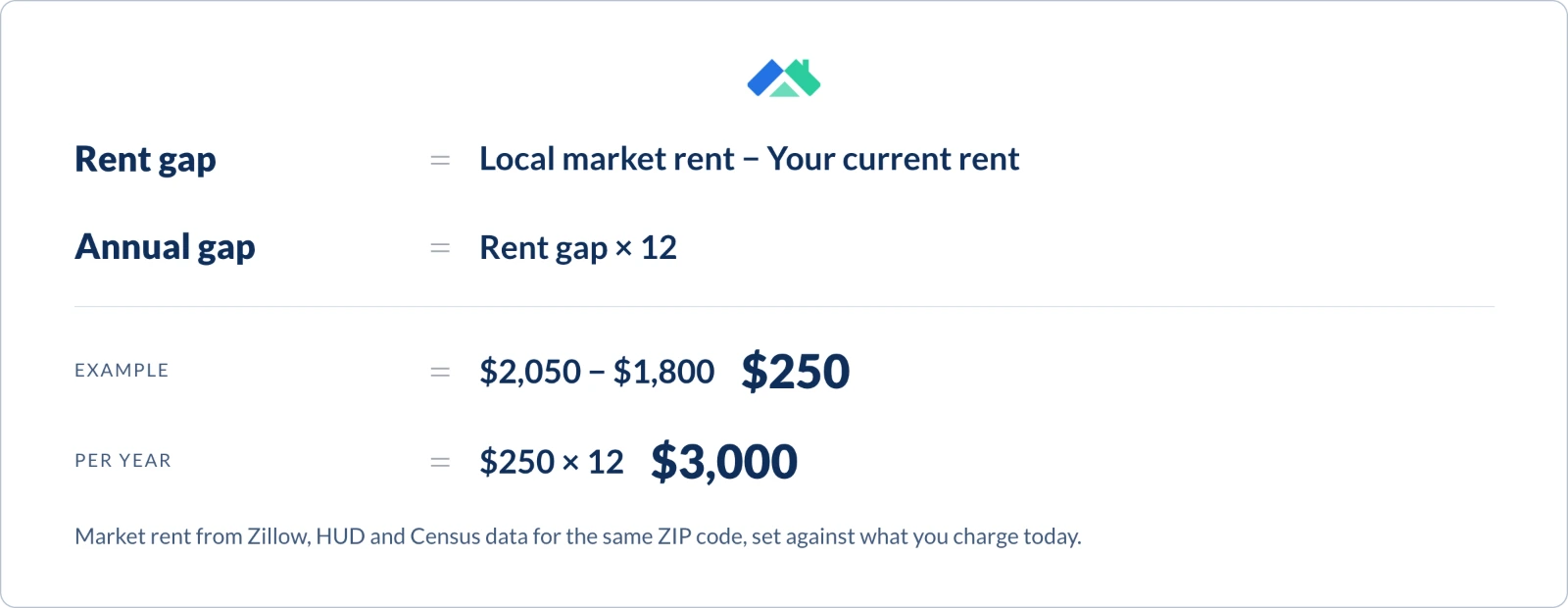
Your rent gap is the local market rent minus what you charge today. Multiply by 12 and you have the annual cost of leaving it alone.
Find the local market rent
Use Zillow, HUD and Census data for the same ZIP code and property size, not asking prices.
Compare against your current rent
The difference is your gap, per month.
Multiply by 12
That's what an under-market rent costs you a year, before you weigh it against turnover risk.
Worked example
Market rent in the ZIP code is $1,875 and the tenant currently pays $1,650.
Rent gap = $1,875 − $1,650 = $225
Annual gap = $225 × 12 = $2,700

Other calculators you might be interested in

Vacancy Rate Calculator
See your true vacancy rate, what it costs, and how you compare to the local market.

Rental Yield Calculator
Gross and net yield, cash flow and cash-on-cash return on a rental property.

Late Fees Calculator
Work out the late fee your lease allows, with grace period handling and tenant templates.

Manage up to 3 rental properties for free!
Sign up and get PRO free for 14 days. When the trial ends, keep tracking rent, expenses and reports for up to 3 properties, free forever with Landlord Studio GO.
By continuing you agree to our Terms & Conditions. · Already have an account? Log in
Setting the right rent
Rental Increase Estimator
Pricing above the local range is the most common cause of a slow let. A unit listed 5% over market can sit empty for weeks, and that vacancy usually costs more than the extra rent would have earned.
Built on public market data
The estimate is built on Zillow's Observed Rent Index at ZIP level, with HUD Fair Market Rents and US Census median gross rent for context - all free public data, published on a lag.
Treat it as a starting point, not a valuation.

Why should you use our rental estimator?
- Gives a conservative, typical and upper-market range, not one flat number
- Compares your current asking rent against the typical rent in your ZIP
- Adds a quick yield snapshot if you're researching a purchase
- Produces a printable rent report for your records
- Free, fast and no sign-up to get an estimate
FAQs
How do I work out what to charge for rent?

Start with the typical market rent for your ZIP code, then adjust for what makes your unit different - bedroom count, condition, and features like in-unit laundry, parking or a fenced yard.
Pricing above the local range is the most common cause of a slow let. A unit listed 5% over market can sit empty for weeks, which usually costs more than the extra rent would have earned.
What data is the rent estimate based on?
This estimator uses Zillow's Observed Rent Index at ZIP level for the headline figure, with HUD Fair Market Rents and US Census median gross rent as additional context.
All three are free public data sources published on a lag, so treat the result as a starting point rather than a valuation. For a binding figure, speak to a licensed broker or appraiser in your state.
How much can I raise the rent?
Rent control and rent stabilization exist in a handful of states and cities, and where they apply they cap how much you can raise rent and how often. Several states also require specific written notice before an increase takes effect.
Check your state and city rules before raising rent - a market estimate tells you what the unit is worth, not what you are legally allowed to charge.