



Cash-on-Cash Return Calculator
See how hard your cash works in a rental property. Enter the price, your down payment, the rent and your real running costs to get your cash-on-cash return, annual cash flow and cap rate.

How to calculate cash-on-cash return
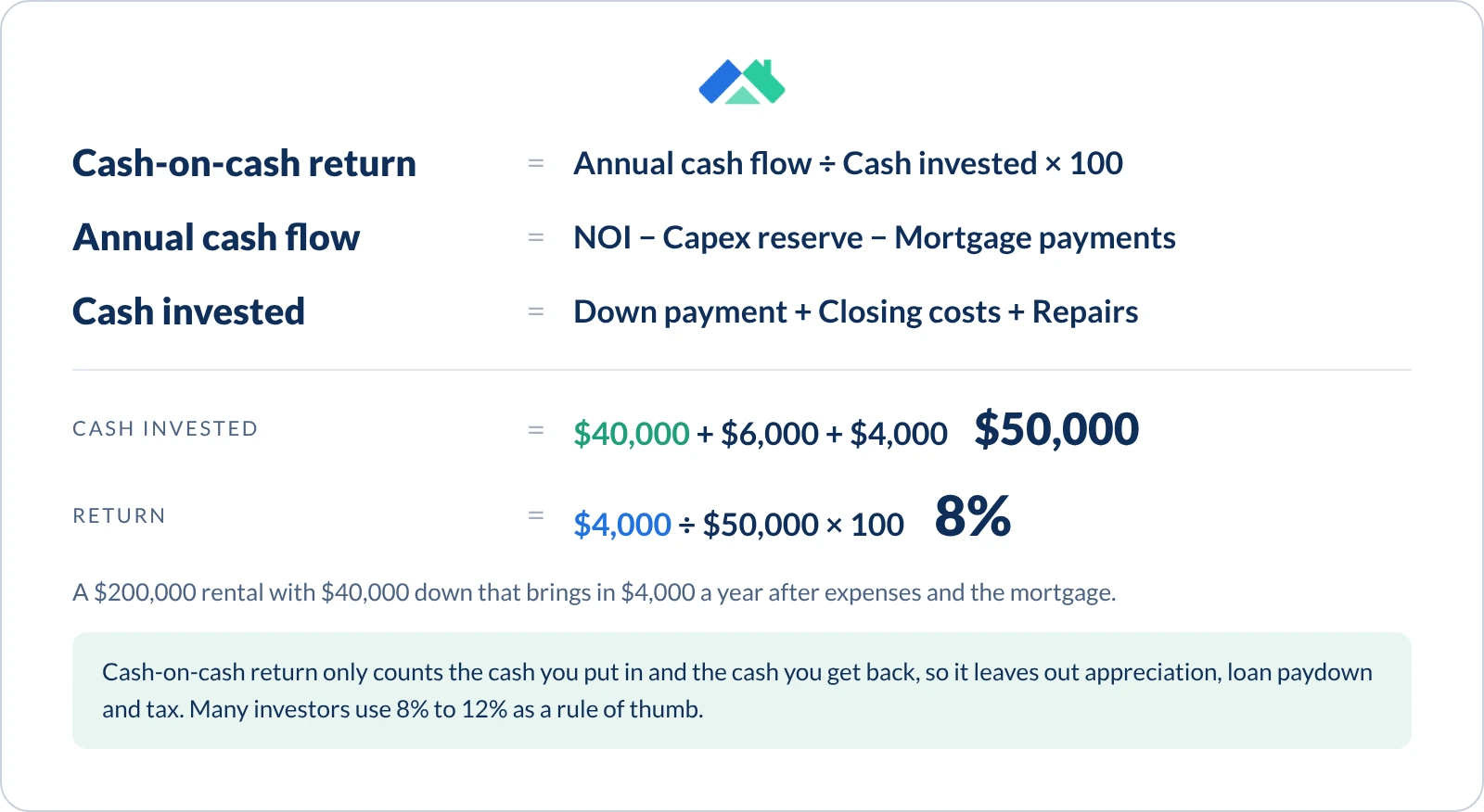
Divide the year's pre-tax cash flow by the total cash you put into the deal, then multiply by 100.
Work out annual cash flow
Take the year's rent, subtract vacancy and operating expenses to get NOI, then subtract your capital expenditure reserve and 12 months of mortgage payments.
Add up your cash invested
Down payment, closing costs and any repairs or setup you paid before the first tenant moved in.
Divide and convert to a percentage
Cash flow divided by cash invested, times 100.
Worked example
A $200,000 rental with $40,000 down, $6,000 of closing costs and $4,000 of repairs. It brings in $4,000 a year after expenses and the mortgage.
Cash invested = $40,000 + $6,000 + $4,000 = $50,000
Cash-on-cash return = $4,000 ÷ $50,000 × 100 = 8%
Other calculators you might be interested in

Cap Rate Calculator
Turn your NOI into a cap rate to compare properties before financing.

Mortgage Calculator
Estimate the monthly payment on a rental property loan before you buy.

BRRRR Investment Calculator
See how much of your cash stays in a buy, rehab, rent, refinance deal.

Manage up to 3 rental properties for free!
Sign up and get PRO free for 14 days. When the trial ends, keep tracking rent, expenses and reports for up to 3 properties, free forever with Landlord Studio GO.
By continuing you agree to our Terms & Conditions. · Already have an account? Log in
What cash-on-cash return tells you
Cash-on-Cash Return Calculator
Cap rate ignores how you paid for the property. Cash-on-cash return measures the year's cash flow, after the mortgage, against your down payment, closing costs and repairs.
It's the number that changes when you change the loan.
A first-year, pre-tax snapshot
It deducts your full mortgage payment but doesn't count the equity you build by paying the loan down, and it leaves out appreciation and depreciation, so a low figure isn't the whole story.
Use it next to cap rate and total return before you decide.

Why use our cash-on-cash return calculator?
- Includes the costs landlords forget: vacancy, repairs and a capital expenditure reserve
- Works with a mortgage or an all-cash purchase
- Shows cap rate and monthly cash flow alongside the return
- Breaks every number down line by line so you can check it
- Free, with no sign-up
FAQs
How do you calculate cash-on-cash return?

Divide your annual pre-tax cash flow by the total cash you invested, then multiply by 100.
Cash flow is rent minus vacancy, operating expenses, any capital expenditure reserve and mortgage payments. Cash invested is your down payment, closing costs and any upfront repairs.
What is a good cash-on-cash return?
Many investors use 8% to 12% as a rule of thumb. It's a starting point, not a verdict: what's acceptable depends on your market, your financing and whether you expect the property to rise in value.
Above 12% is strong, but check you haven't set vacancy, repairs or capital expenditure too low.
What's the difference between cash-on-cash return and cap rate?
Cap rate is net operating income divided by the purchase price, as if you paid cash. Cash-on-cash return is cash flow after the mortgage divided by the cash you actually put in.
The same property can have a 6% cap rate and a much higher or lower cash-on-cash return depending on the loan.
Does cash-on-cash return include appreciation or tax?
No. It's a pre-tax, first-year measure of the cash the property puts in your pocket. It deducts your full mortgage payments but doesn't count the equity you build by paying down the loan, and it leaves out appreciation, depreciation and income tax.
Total return and IRR can include appreciation and equity gains, and reflect taxes and depreciation only if you model those cash flows.
Can cash-on-cash return be negative?
Yes. If rent doesn't cover the expenses and the mortgage, cash flow is negative and so is the return.
That's a sign to look at the price, the down payment, the rent or the loan terms before you buy.