



BRRRR Investment Calculator
Analyse a Buy, Rehab, Rent, Refinance, Repeat deal end to end - see how much cash you pull back out, your monthly cash flow, and whether the numbers pass a lender's underwriting.

How to manually analyse a BRRRR deal
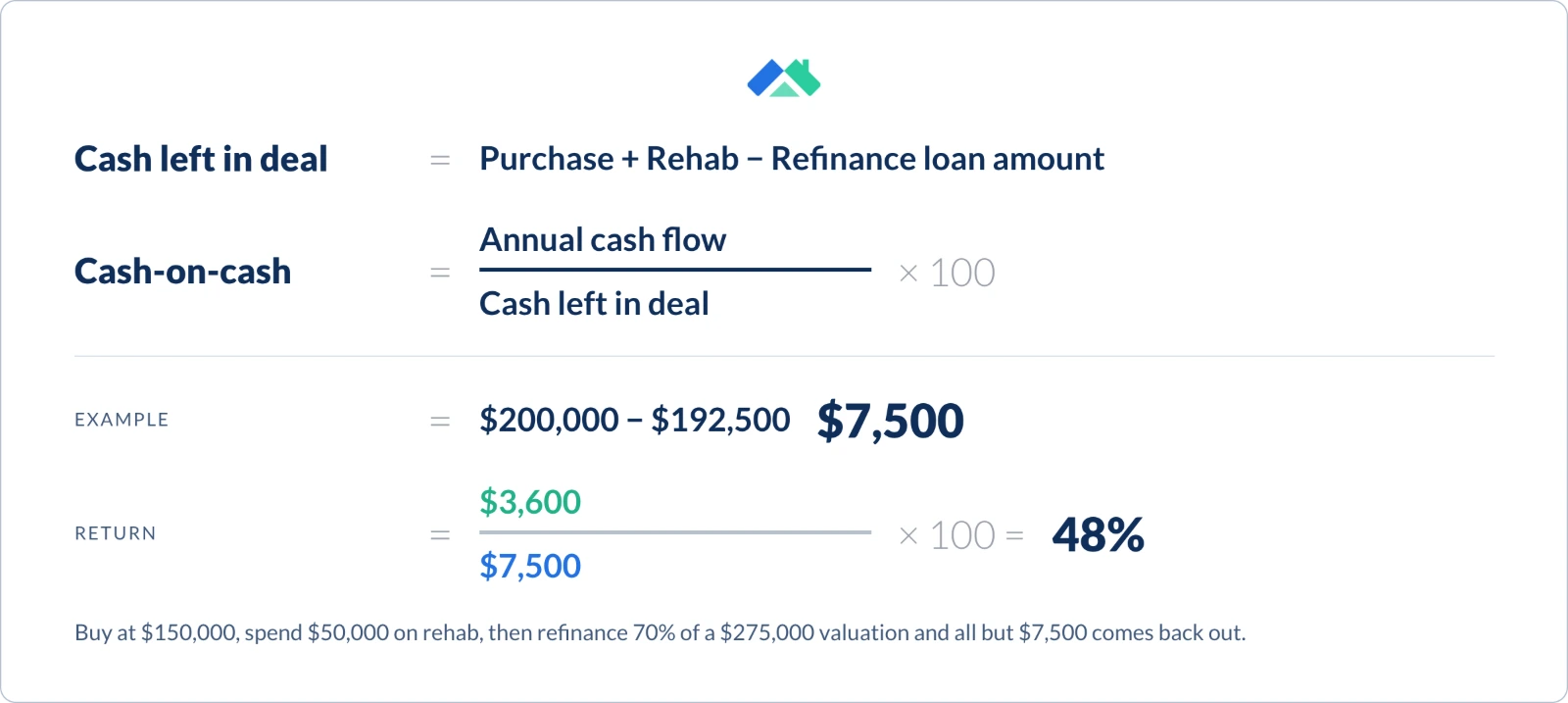
Your cash left in the deal is what you spent to buy and rehab, minus what the refinance gives back. Cash-on-cash return is annual cash flow divided by that figure - the less you leave in, the higher it goes.
Add up your total cash in
Purchase price plus rehab costs, plus closing and holding costs.
Work out the refinance proceeds
Lenders typically lend 70-75% of the new appraised value, not what you paid.
Divide annual cash flow by what's left
That's your cash-on-cash return. Pull everything back out and the return is effectively infinite.
Worked example
Buy at $175,000, spend $45,000 on rehab, then refinance 75% of a $270,000 appraisal.
Cash left in deal = $220,000 − $202,500 = $17,500
Cash-on-cash = ($4,800 ÷ $17,500) × 100 = 27%

Other calculators you might be interested in

70% Rule Calculator
Screen a deal in seconds with the 70% rule before running the full BRRRR numbers.

Cap Rate Calculator
Work out the cap rate on a rental property to compare deals on an unleveraged basis.

Net Operating Income Calculator
Calculate net operating income before financing, the starting point for deal analysis.

Manage up to 3 rental properties for free!
Sign up and get PRO free for 14 days. When the trial ends, keep tracking rent, expenses and reports for up to 3 properties, free forever with Landlord Studio GO.
By continuing you agree to our Terms & Conditions. · Already have an account? Log in
Making a BRRRR deal work
BRRRR Investment Calculator
Everything downstream depends on the after-repair value - your loan size, the cash you pull out, your return. The lender's appraiser may not agree with your estimate.
Use recent comparable sales of finished properties, then stress-test the deal 10% below it.
Underwritten the way a lender will
A BRRRR only repeats if the refinance actually clears. This calculator gives you the DSCR alongside your returns, so you can see whether the rent covers the debt by the margin a lender wants - usually 1.20 to 1.25.

Why should you use our BRRRR calculator?
- Models the whole cycle - purchase, rehab, holding costs, refinance and rent
- Shows exactly how much cash you leave in the deal after the refinance
- Gives you the DSCR a lender will underwrite against
- Produces a downloadable deal report you can take to a lender or partner
- Free, fast and no sign-up to calculate
FAQs
What is the BRRRR method?

BRRRR stands for Buy, Rehab, Rent, Refinance, Repeat. You buy a property below market value, renovate it to raise the appraised value, rent it out, then refinance against the higher value to pull most of your original cash back out - and use that cash on the next deal.
Done well, you end up owning a cash-flowing rental with very little of your own money left in it.
How much cash can I pull out in a BRRRR refinance?
Your refinance loan is the after-repair value multiplied by the lender's cash-out LTV, typically 70-75%. Subtract closing costs to get net proceeds, then subtract those proceeds from your all-in cost.
What's left is your cash left in the deal, and it's the figure cash-on-cash return is measured against. A perfect BRRRR leaves close to zero in.
What DSCR do lenders want on a rental refinance?
Debt Service Coverage Ratio is net operating income divided by annual mortgage payments. Lenders use it to check the property covers its own debt.
Most investor lenders want at least 1.20 to 1.25. Below 1.0 the rent doesn't cover the mortgage, and the refinance is unlikely to be approved on the terms you've modelled.
What is the biggest risk in a BRRRR deal?
The after-repair value. Everything downstream - loan size, cash pulled out, cash-on-cash return - is calculated from it, and the lender's appraiser may not agree with your estimate.
Base the ARV on recent comparable sales of finished properties, not on listings or on what you hope. Then stress-test the deal at an ARV 10% lower and see whether it still works.