Welcome! Where would you like to log in?

Sign up and get
PRO free for 14 days
Once your PRO trial is over you can continue using Landlord Studio GO completely free.
By continuing you agree to our Terms & Conditions.

Visiting from the
United Kingdom?
Please visit our United Kingdom site for a better experience
Continue
14 Real Estate Investment Tips to Grow Your Portfolio
14 real estate investment tips to grow your portfolio, plan effectively, and use landlord tools to manage finances and maximize returns.
.webp)
Read summarized version with:


Building a real estate empire requires a combination of effective strategies and strong management skills. For landlords with small to medium-sized portfolios, expanding your holdings can be a powerful pathway to financial freedom and a secure future.
However, investing in real estate can often feel like walking a tightrope. Even the most experienced of investors know it requires a balancing act between the potential for passive income and the reality of market fluctuations.
This article aims to guide you through the complexities of real estate investing for beginners - and provide you with real estate investing tips that cover planning your first property investment to scaling your portfolio. And we explore how the right landlord software can help you manage your property efficiently and achieve success.
5 Real Estate Investment Tips for Making Your Plan
Before you go about buying a property, you need to first have a solid plan in place. This isn’t just about logistics like how you’re going to collect rent and find tenants or running the metrics like cap rates and cash flow projections - though they are important - it’s also about clarifying your long-term objectives, how involved you want to be, and the financial risks you’re ready to take on.
Tip 1: Define Your Long-Term Objective
How big do you want your portfolio to be? Are you aiming for steady rental income, long-term property appreciation, or a mix of both? Knowing your goal helps you decide on property types, locations, and the level of risk you’re comfortable with. For instance, multifamily units may offer higher returns but come with more management responsibilities, while single-family homes provide stability with less hands-on work.
Tip 2: Determine Your Level of Involvement
Decide how involved you want to be in managing your property. If you're hands-on and live near the property you might prepare to handle tenant concerns, maintenance, and daily operations yourself. You can use free property management software like Landlord Studio to make this as simple as possible
However, if you prefer a passive role, you might plan to hire a property manager to take care of day-to-day concerns like tenant screening, rent collection, and upkeep. Be aware though that this will require additional budget.
Tip 3: Assess Your Financial Risk and Resources
A financial plan is crucial to understanding how much risk you can take on. Account for:
- Start-up costs: Down payments, closing costs, and any initial property improvements.
- Ongoing expenses: Maintenance, insurance, mortgage payments, property taxes, and HOA fees if applicable. Learn more about real estate operating expenses.
- Emergency funds: Set aside reserves for unexpected costs like major repairs or sudden vacancies.
- Investment improvements: Budget for upgrades that enhance property value, such as energy-efficient appliances or landscaping.
Tip 4: Research the Location
A prime location can maximize profitability, while the wrong one can undercut your efforts. To assess a property's potential, analyze key metrics like property values, rental yields, and occupancy rates—rising home values suggest future appreciation, while high occupancy signals strong demand. Look for up-and-coming areas with new businesses, cultural hubs, or infrastructure projects, as early investments here often deliver high returns.
You should also, prioritize safety by reviewing crime statistics and gathering local insights, as high crime can deter tenants and increase insurance costs. Finally, properties near schools, healthcare, parks, shopping, and public transport tend to attract tenants and command higher rental values.
Related: 15 Best Places to Invest in Real Estate in 2024
Tip 5: Create a Strategy for Finding and Managing Tenants
Align your goals and resources with a clear tenant selection strategy:
- Marketing: Use online rental listings, professional photos, and virtual tours to attract high-quality tenants.
- Tenant management: Decide how you’ll screen applicants and establish a streamlined rent collection system to ensure consistent cash flow.
Planning ahead isn’t just a smart move—it’s a necessity for a smooth and profitable investment experience. With a solid strategy and financial blueprint, you can confidently navigate the road to real estate success.
.webp)
9 Top Real Estate Investment Tips to Grow Your Portfolio
These property investment tips are strategies that are tested and trusted by seasoned real estate investors that can help you multiple your holdings fast.
Tip 6: Reinvesting Your Profits and Cash Flow
One of the easiest ways to grow your real estate portfolio is by reinvesting your profits and cash flow. This strategy involves taking the income generated from your existing properties, whether through rent or appreciation, and using it to acquire new properties. The goal is to create a cycle where your profits fuel further growth.
Tip 7: Use the BRRRR Strategy (Buy, Rehab, Rent, Refinance, Repeat)
The BRRRR method is a popular approach for expanding a real estate portfolio, especially for those interested in fix-and-flip or rental properties. It involves buying a property, renovating it, renting it out, refinancing to extract equity, and then repeating the process with the profits.
This strategy can yield significant returns if you're identify undervalued properties and execute effective renovations.
Tip 8: House Hacking
House hacking is an innovative strategy where you live in a multi-unit property (like a duplex or triplex) while renting out the other units. This approach helps reduce living expenses and can even generate rental income that covers mortgage payments. If rental income exceeds expenses, you can create positive cash flow that can be reinvested into your portfolio.
Tip 9: Partnering with Other Investors
Collaborating with other real estate investors can greatly enhance your purchasing power while reducing financial risk. Pooling resources, knowledge, and networks allows you to acquire larger or more complex properties than you might manage alone.
However, this afternoon depends largely on finding the right partner; investors who share similar goals, risk tolerance, and strategies. Additionally, it's important to have an agreement detailing terms such as profit sharing, decision-making processes, and exit strategies in place to ensure a smooth partnership.
Tip 10: Use Hard Money Loans
Hard money loans are short-term loans secured by real estate. They are often used for fix-and-flip projects or as bridge financing for quick acquisitions. Hard money lenders typically focus more on the property's value than on the borrower's credit history.
Here's how it works:
- Find a Hard Money Lender: Locate lenders who specialize in hard money loans within your area.
- Present Your Investment Plan: Prepare a detailed plan outlining your acquisition and renovation strategy.
- Secure the Loan: Negotiate terms and secure funding from the lender.
- Complete Your Project: Use loan proceeds for acquisition and renovation before refinancing with a traditional lender.
The major drawback of this strategy is that hard money loans usually come with higher rates and fees than conventional financing. Additionally, these loans are typically short-term, creating pressure to complete projects quickly.
Related: Getting Financing for Your First Property
Tip 11: Exploring Seller Financing
Seller financing involves an arrangement where the seller provides financing directly to the buyer to purchase their property. Then, the buyer follows an agreed-upon payment plan with the seller to offset the financing. This option can be advantageous for buyers who may not qualify for traditional financing or prefer avoiding stringent hard money loan requirements.
However, it's important to note that not all sellers are open to offering financing options. Also, issues may arise if the seller lacks understanding of the legal or financial aspects of financing.
Tip 12: Investing in Real Estate Investment Trusts (REITs)
REITs are companies that own and operate income-producing real estate. They provide investors with an opportunity to participate in real estate markets without directly managing properties.
You can get started by purchasing REIT shares through a brokerage account and end dividends over the years. It's important to note that REITs companies are required to distribute at least 90% of their taxable income as dividends to shareholders. Additionally, they allow diversification across various types of properties and locations.
Tip 13: Defer Capital Gains With a 1031 Exchanges
A 1031 exchange enables you to defer capital gains taxes when selling one property by reinvesting proceeds into another like-kind property of equal or greater value. This strategy is beneficial for investors aiming to minimize tax burdens while maximizing returns.
How it works:
- Sell Your Property: Sell your existing property and identify a replacement property.
- Utilize a Qualified Intermediary: Engage an intermediary who will manage the exchange process.
- Identify Replacement Property: Locate an eligible replacement property within specified timeframes.
- Complete the Exchange: Finalize the purchase of the replacement property within typically required deadlines (usually 180 days).
Using this strategy requires careful planning and understanding of how 1031 exchanges work due to its complexity. Also, it's important to note that there are strict deadlines that must be adhered to during the exchange process.
Tip 14: Understanding Real Estate Investing Metrics
Metrics like cash flow, cap rate, ROI, and occupancy rates provide a clear picture of your property's financial health and profitability. Staying on top of these figures helps you identify opportunities, spot potential issues early, and make strategic adjustments that will ultimately help you achieve your long-term goals.
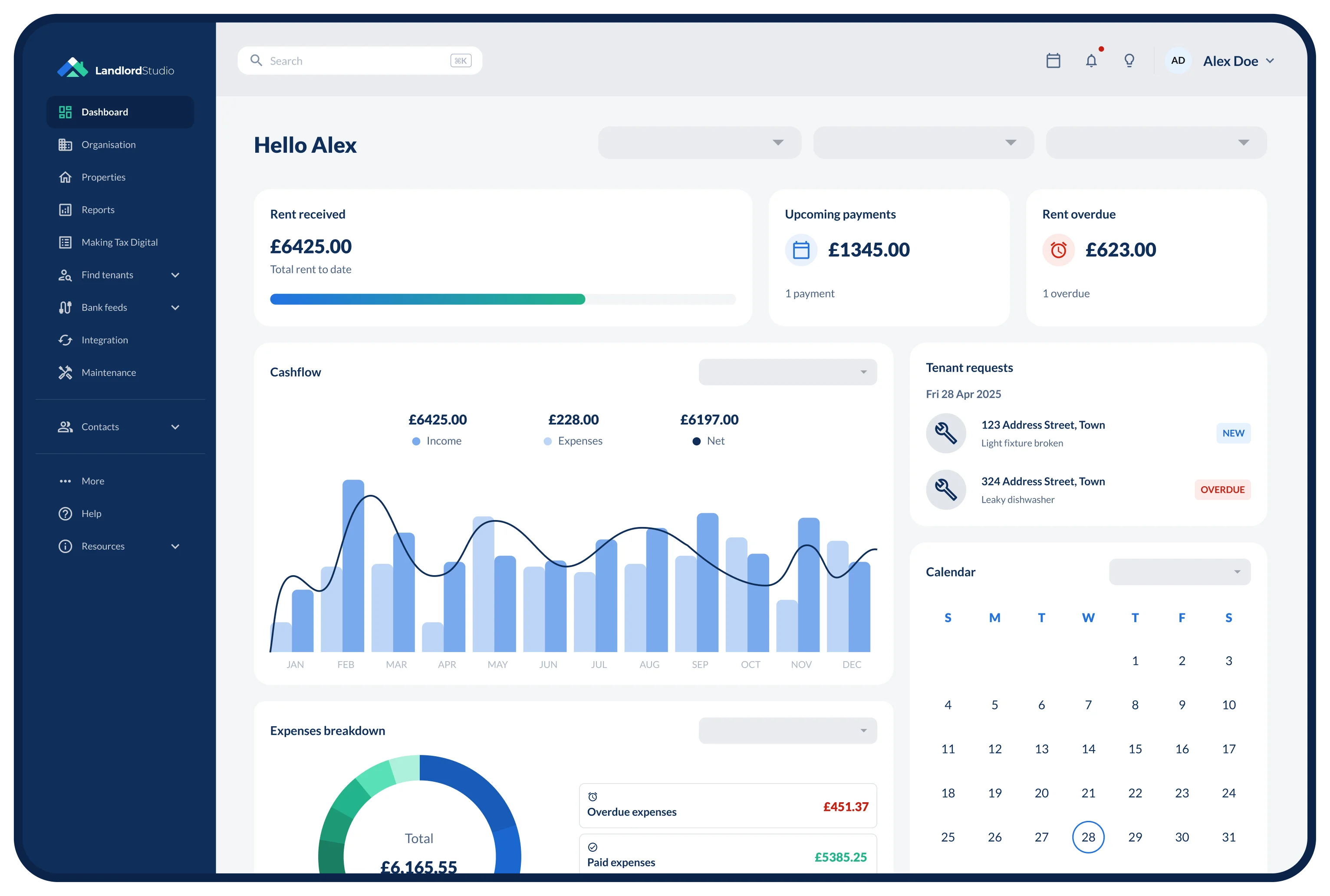
You can streamline your real estate financial management with property management and accounting software like Landlord Studio. Keep accurate, up-to-date financial records and leverage the powerful dashboard and reporting features to gain nuanced insights into your portfolio finances.
Save time, ensure compliance, and have complete confidence in your financial planning.
Bonus Tip: Manage Your Rental Property with Landlord Studio
.webp)
Whether you have one or dozens of units, managing a real estate portfolio can be overwhelming, you need to keep up with everything, from finding and managing tenants to collecting rent to expense tracking to filing your taxes.
The good news is that you can leverage property management software like Landlord Studio to help you manage your properties.
Key features that Landlord Studio offers include rental listings, tenant screening, income and expense tracking (with bank feeds, mileage tracker and an in-built receipt scanner), automated rent collection, maintenance management, and more. The cherry on top is that you can get access to its full features for as little as $12 per month—first three units are free.
So, what are you waiting for? Create your free account today and see how Landlord Studio can help you take your real estate investing to the next level.
Related Articles


About Landlord Studio

Landlord Studio is an easy to use property management and accounting software designed for landlords.
Find and screen tenants, collect rent online, track income and expenses, run reports, and more - all for free.
Create your FREE account with Landlord Studio today.

From finding tenants to filing taxes. Reduce vacancies and maximize your portfolio ROI with software designed for you.
Get started for free