





Read summarized version with:

ChatGPT

Gemini

Claude

Grok

Add as preferred on Google
The traditional 6% real estate commission has been fading over the years.
The NAR settlement that took effect in August 2024 finally ended the assumption that sellers automatically cover both sides of the fee - typically 5–6% of the sale price that was then split between the listing agent (representing the seller) and the buyer's agent (representing the buyer).
And yet, on a typical $400,000 sale, US homeowners still hand over roughly $22,000 in agent fees at closing.
For an investor closing two or three deals a year, that's not a one-time hit. It's a recurring tax on every transaction paid in real dollars that could have gone toward the next down payment.
Most guides on this topic are written by real estate agents, brokerages, or iBuyers who want to buy your house. That means we can give you the impartial version - commission is fully negotiable, you have more leverage than you think, and there are specific tactics investors should be using that homeowner guides never mention.
What real estate commissions actually look like in 2026
The "6% standard" was never a law - it was a market convention.
Here's where rates actually sit today, based on the most recent agent surveys:
- Total commission, national average: around 5.70% of sale price
- Listing-agent share: around 2.88%
- Buyer-agent share: around 2.82%
- Typical negotiable band: 4% to 6.5% total, 1.5% to 3.5% per side
So, on a median US home of around $400,000, the total commission lands near $22,800.
On a $300,000 property, it's roughly $17,100. On a $700,000 deal, you're staring at $40,000 leaving the closing table before you pay off the mortgage.
Rates are still negotiable, agents still want the deal, and the broker who tells you "this is just what we charge" is probably just testing whether you'll push back.
1. Buyer-agent compensation can no longer be advertised on the Multiple Listing Service
For decades, when a listing agent put a property on the Multiple Listing Service (the private database that real estate agents use to list properties for sale and share them with other agents), they also published exactly how much commission they were offering to the buyer's agent - usually 2.5–3%. That number was effectively a recruitment tool that told every buyer's agent in the market how much they'd earn if they brought their client to that property.
Critics argued this created two problems:
- It quietly inflated commissions (sellers rarely knew they could offer lower commissions and still attract buyer agents)
- It created a steering risk (some buyer agents allegedly nudged clients toward higher-commission listings).
Post-settlement, that number disappears from the MLS. Buyer-agent compensation now has to be negotiated separately, deal by deal, through one of three paths:
- The seller offers it as a concession in the listing materials (off-MLS)
- The buyer asks for it as part of their offer (e.g., "We'll pay $400,000 with a $12,000 seller credit toward our agent's fee")
- The buyer pays their agent directly out of pocket, on top of their down payment and closing costs
2. Buyers must sign a written representation agreement before touring any home
Before August 2024, a buyer could tour 20 homes with an agent and never formally commit to anything until they made an offer.
Now, agents are required to get a signed agreement up front that spells out exactly what services they'll provide, how long the relationship runs, and how they'll be compensated - including what the buyer owes them if the seller doesn't cover the fee.
The requirement is procedural, but it introduces a new negotiation point into the buying process - the terms of the buyer-agent agreement itself, which must be settled before touring begins.
Most buyers sign whatever the agent puts in front of them.
Investors who treat that document as negotiable (adjusting term length, exclusivity scope, compensation structure, and escape clauses routinely) save thousands across their next few transactions. We cover exactly what to negotiate further down the page.
Why investors have more leverage than homeowners
The typical homeowner sells once every 10 to 13 years. They negotiate commission once, in an emotionally loaded transaction, against an agent who does this for a living. The deck is stacked.
Investors are a different proposition entirely, and the smart ones know it. You bring:
- Repeat business: a homeowner is a one-shot client. You're a pipeline.
- Cleaner deals: no financing contingency on a cash purchase. Fewer inspection objections. Faster closes. Agents love this because their commission is more likely to actually fund.
- Both sides of the table: you list properties and buy them. That's two commissions you can dangle.
- A network: active landlords know other landlords. Agents pay real money for referrals.
- Less emotion: you're not picking the kitchen tile of your dream home. You're running numbers. That makes you a faster, easier client to work with.
None of that automatically translates into a lower commission - you have to actually use it.
6 negotiation angles investors should actually use

1. The volume play
If you're closing two or more deals a year, lead with that. "I'm planning to transact on three to five properties in the next 12 months. What does your rate look like if I commit my pipeline to you?"
Most agents will move from 2.5–3% per side to 2–2.25% for a credible volume commitment. The math works for them: three deals at 2% is more than one deal at 3%.
2. Bundle listing and buy-side
If you're selling one property and using the proceeds to buy another, offer both sides to the same agent and negotiate a blended rate.
A typical bundled deal might land at 4.5% total on the sale (instead of 5.5–6%) plus a reduced or rebated buy-side fee. You give them two commissions, and they give you a discount on each.
3. The cash-buyer discount
Cash deals are the easiest transactions an agent will ever do. No mortgage contingency, no appraisal drama, no underwriting timeline.
On the buy side, you should be asking for 1.5–2% (instead of the standard 2.5–3%) - or pushing for a flat fee.
The conversation is straightforward: "This is a cash deal closing in 21 days. What's your rate?"
4. Off-market deals
If you bring the deal - you found the seller, the property never hit the MLS, you just need an agent to handle the paperwork and transaction management (you are not paying full freight). The agent didn't market the property, didn't run open houses, and didn't field 30 buyer calls.
A reasonable rate for transaction coordination only is 1–1.5%, sometimes a flat fee of $2,500–$5,000.
5. Portfolio sales
Selling multiple properties at once?
Whether to one buyer or as a packaged listing, the per-property economics for the agent improve dramatically. Negotiate a sliding scale - maybe 5% on the first property, 4% on the second, 3% on the third. Or a flat total commission cap.
6. Dual agency (eyes open)
If the same agent represents both sides of a deal, they collect the full commission and have a clear incentive to discount. Some sellers split the savings 50/50 with the agent. The trade-off: dual agency creates a genuine conflict of interest - the agent can't advocate fully for both parties.
Several states ban it outright, and where it's allowed, you'll need to sign a written consent. Use this only when you're confident in your own ability to read the deal.
The buy-side negotiation no one talks about
Since August 2024, you can't tour a home with a buyer's agent until you've signed a written buyer-broker agreement. Most buyers sign whatever the agent puts in front of them. That's a mistake - those agreements are fully negotiable before you sign, and once you sign, you're locked in.
Specifically, look at:
- Term length: the default is often 6–12 months. Push for 30–90 days, especially for your first transaction with a new agent.
- Exclusivity scope: does the agreement cover all properties in a metro? Just specific neighborhoods? Just MLS-listed homes? Narrow the scope so you can pursue FSBO, off-market, or new-construction deals without owing this agent a commission.
- Compensation structure: the agreement will specify a percentage or flat fee. For active investors, push for a flat fee per closed transaction ($3,000–$6,000 is reasonable in many markets) rather than a percentage - your average deal size shouldn't dictate what your agent earns for the same workload.
- Who pays: the agreement should spell out whether you're responsible if the seller doesn't offer buyer-agent compensation. Negotiate a cap on your out-of-pocket exposure.
- Escape clause: include a termination right if the agent isn't performing - typically 14–30 days' notice without owing fees.
If an agent refuses to negotiate any of the above, that's useful information. There are plenty of agents who will.
What percentage should you actually target?
The honest answer: it depends on your deal, your market, and your leverage.
As a quick reference:
| Deal type | National average | Achievable target |
|---|---|---|
| Standard listing (single property, MLS) | 5.5–6% total | 4.5–5% |
| Cash buyer, single property | 2.5–3% buy side | 1.5–2% buy side |
| Off-market deal (you sourced it) | 2.5–3% | 1–1.5% or flat fee |
| Portfolio sale (3+ properties) | 5–6% per property | 3.5–4.5% blended |
| Bundled listing + purchase | 5.5% + 2.8% | 4.5% + 2% (or rebate) |
| High-end ($1M+) single listing | 5% | 3.5–4% |
These are starting points, not guarantees. The exact number depends on local market dynamics, the agent's pipeline, and how cleanly your deal closes.
Will a realtor sell a house for 1%?
Yes, in two scenarios. First, discount and flat-fee brokerages routinely list at 1–1.5% on the listing side (you typically still pay something to the buyer's agent separately).
Second, full-service agents will sometimes go to 1–1.5% on transaction coordination for an off-market deal where you've already sourced the buyer. They won't go to 1% on a standard listing that requires full marketing.
How can I avoid realtor fees entirely?
The main paths are: sell For Sale By Owner (FSBO) and handle marketing yourself; use a flat-fee MLS service ($200–$500 typically) to get listing exposure without an agent; sell directly to a cash buyer or iBuyer (you'll avoid commission but typically accept a below-market price); or do an off-market sale to another investor in your network. Each path trades convenience for savings.
Do I have to pay agent fees if I pull out of a sale?
Read your listing agreement carefully.
Most exclusive-right-to-sell contracts include a "protection period" clause: if a buyer the agent introduced you to closes within 30–180 days of you canceling, you may still owe full commission. Some agreements also require you to cover marketing costs incurred. If you're considering canceling, get the agreement reviewed before you act.
Can a realtor charge more than 3%?
There's no legal cap on commission rates anywhere in the US.
Some agents charge 3.5% or even 4% per side for luxury, niche, or high-touch transactions. Whether the rate is justified depends on the service, the market, and what you can negotiate.
The hidden tax math most articles miss
For investors, commission isn't just lost money - it has tax consequences that cushion the bite in ways that matter for your overall return:
On the buy side, commission you pay (whether directly or through a concession) is added to your cost basis in the property. That higher basis means more depreciation each year and, when you eventually sell, a smaller capital gain.
On the sell side, commission paid is treated as a selling expense that reduces the amount realized. That directly lowers your capital gains tax exposure. Our deeper guide on taxes when selling a rental property walks through the full math.
None of this means commission is "free." A dollar paid is still a dollar paid. But the after-tax cost of commission is often 20–35% lower than the headline number, depending on your tax bracket and depreciation strategy.
The catch? You only get this benefit if you've actually recorded commission as a capital expense against the specific property, separately from your operating expenses. If commission is buried in a generic "fees" bucket in your spreadsheet, you'll miss it at tax time.
When NOT to push too hard
A bad agent at 3% will cost you more than a great agent at 5.5%. Over-negotiated listings often end up under-marketed: fewer professional photos, no staging consult, weaker MLS description, less follow-through on showings. The result is a longer time on market, more price reductions, and a lower final sale price.
Don't push hard when:
- You're in a tight inventory market where listings sell in days regardless of marketing
- You've worked with this agent before and they consistently deliver above-asking
- The property needs serious marketing work (vacant land, distressed properties, niche commercial)
- You're new to investing and the agent's coaching has real value
The right metric isn't "lowest commission." It's the highest net proceeds after commission. If you'd like to find the right realtor for your next investment, we have a separate guide on that.
Track commission properly to capture the tax benefit
Every commission you pay - on either side of a deal needs to be recorded against the specific property, as a capital expense, with the closing statement (HUD-1 or Closing Disclosure).
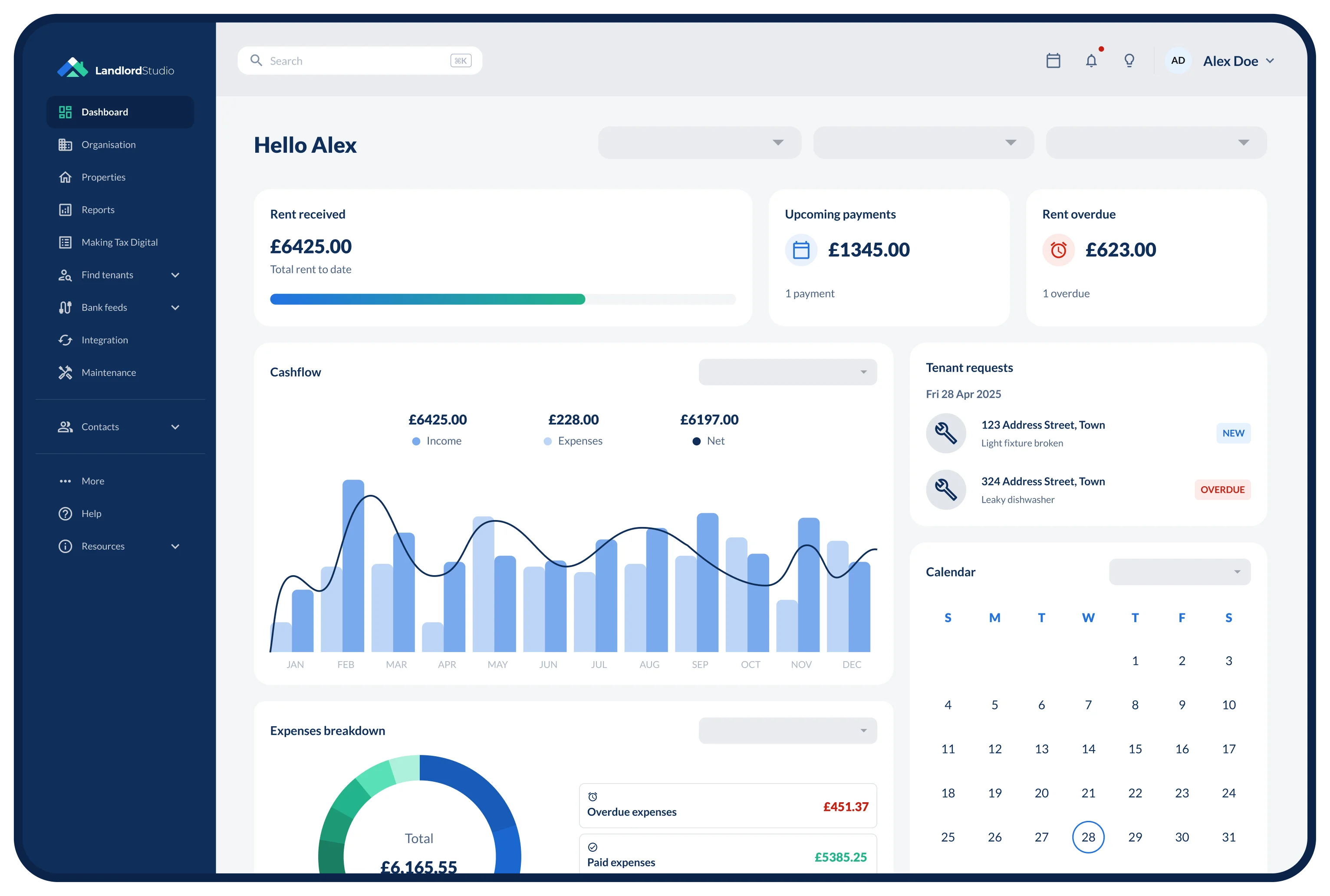
Landlord Studio's expense tracking lets you tag commission payments to a specific property and IRS category, store the closing statement, and export the totals straight into your Schedule E or accountant handoff at year end.
If you're currently tracking this in a spreadsheet, you're almost certainly losing some of the tax benefit. See our roundup of the best real estate accounting software if you want to compare options.