



How To Check For Evictions: Free Eviction Check
Knowing how to check for evictions is essential if you want to select a tenant who will stay long-term, pay rent on time, and look after your property.

.webp)
Read summarized version with:

ChatGPT

Gemini

Claude

Grok

Add as preferred on Google
Last updated: July 2026
To check a tenant's eviction history, search county or state court records, use a tenant-screening service that includes an eviction report, or review a background and credit report. Evictions are civil court records, so the most reliable source is the court that heard the case. A full tenant-screening report bundles eviction, credit, and background data into one FCRA-compliant check.
Evictions are costly, stressful, and expensive. And whilst there’s no way for a landlord to guarantee they won’t have to go through one, there are things landlords can do to reduce the risk. And one thing many landlords do is conduct eviction records searches on potential tenants.
According to TransUnion, landlords and property managers spend an average of $3,500 on eviction-related expenses. This is money that could have stayed in your pocket if a tenant hadn't broken the lease, failed to pay rent, or caused other issues.
Checking eviction history before renting to a new tenant is a crucial step in selecting tenants who will stay long-term, pay rent on time, and look after your property. Renting to individuals with a history of evictions can lead to more problems, so it's essential to know how to avoid this situation.
In this post, we explore where to find eviction records, how to check for evictions by getting an eviction report, and how to examine the eviction report so you can ensure you’re making the best possible tenant selection decision.
Contents: How To Check For Evictions
- Why Doing An Eviction Record Check Is Necessary
- What’s Included in an Eviction Check Report?
- How to Look Up Evictions
- Free vs Paid Eviction-Check Options
- Landlord Studio: Free Eviction Check
- For Tenants: How to Check if You Have an Eviction
- How to Understand Eviction Search Results
- Choose The Best Possible Tenant With Landlord Studio
- How to Look Up Evictions FAQs
Why Doing An Eviction Record Check Is Necessary
Before diving into the details of how to check eviction history, you might wonder why this check is so important. The answer is simple: people tend to have patterns of behavior. If a tenant has been evicted once, it indicates a possibility that they might face eviction again. Multiple evictions strongly suggest that they could be a challenging tenant to work with.
Nobody wants to go through an eviction, neither landlords or tenants. And so, evictions only occur in serious situations, such as when a tenant causes significant damage to the property or refuses to pay rent. If a potential tenant has a history of eviction, you need to really understand why before considering them for a tenancy. Failing to do so could put you and your business at risk.
What’s Included in an Eviction Check Report?
An eviction record search provides essential details about a tenant's past eviction history and the filing that was made. An eviction record typically includes the following information:
- The defendant or tenant’s full name
- The plaintiff or property owner’s name
- The property address and court jurisdiction
- The case number
- The dates when the eviction was filed
- The court where the eviction was filed
- The case status and outcome of the eviction proceedings
- Any judgment entered, including unpaid rent or fees owed
- A writ of possession, if one was issued ordering the tenant to vacate

How to Look Up Evictions
It’s all very well knowing what and why, you also need to know how to find eviction records. And you need to be aware of the various legalities surrounding data privacy and how you can use a tenant’s eviction check to make your final decision.
There are six common ways to check a tenant's eviction history. Each method opens with a one-line summary, then notes its cost and reliability:
- Search county or state court records. The most reliable source, because evictions are civil court records held by the court that heard the case. Cost: free to a small per-search or copy fee. Reliability: high for a single jurisdiction, but you must search every county a tenant has lived in.
- Use an online eviction database. Aggregates records across multiple jurisdictions in one search. Cost: paid, varies by provider. Reliability: faster but only as accurate as the provider's data — verify any hit against the court record.
- Order a tenant-screening service report. Bundles a national eviction search with credit and background data in one FCRA-compliant report. Cost: often passed to the applicant. Reliability: high and the most convenient for screening decisions.
- Review a credit report. Useful for financial signals but does not show the eviction filing itself; related unpaid rent or collections may appear. Cost: paid. Reliability: partial — use alongside an eviction search, not instead of one.
- Contact previous landlords. A reference can surface disputes a database might miss. Cost: free. Reliability: anecdotal and supplementary; slower to obtain.
- Ask on the rental application. Including an eviction-history question on your rental application prompts disclosure up front. Cost: free. Reliability: depends on honesty; always verify against records.
Method 1: Check Court Records
The most direct and thorough way to determine if a potential tenant has an eviction history is by checking court records. While every state, county, and area may have different courthouses, the process can be broken down into a few routine steps:
- Find Your State’s Website: Court records can be searched by state. Locate your state’s website as this will provide access to court records. Each state may have multiple websites for various home-related issues, so ensure you check each one.
- Search the Tenant’s Names: On the court records website, search the potential tenant’s names to find any eviction records. Be thorough and check more than just the main name provided on the application. Include:
- Birth name
- Nicknames
- Alternate names
- Names with or without initials
- Names before or after marriage/divorce
By checking every possible name combination, you can ensure no records are missed.
- Get Access to the Record: While full access to eviction case records may not be available in every state, you can often obtain a thorough briefing or full access in most states. It’s essential to view the eviction case to understand the context. Some evictions might be the result of wrongful actions by landlords, so it’s important to consider the meaning of each result.
If you cannot view the record online or visit the courthouse in person, call them to see if you can pay a fee to have a copy mailed to you.
Method 2: Use A Tenant Screening Service
Finding the right courthouse, checking every name the tenant might have used, and collecting full court information can be daunting. Additionally, you might not know all the states your potential tenant has lived in.
Tenant screening services (like Landlord Studio) simplify this process by including eviction checks as part of their report. These services conduct national eviction searches providing you with a comprehensive report at the end. They often include credit information as well as identity verifications, enabling you to make a well-informed decision about future tenants.
Free vs Paid Eviction-Check Options Compared
No single method is best for every situation. The free routes cost nothing but take time and cover one jurisdiction at a time; the paid routes are faster and broader, and a tenant-screening report is the only option built to be FCRA-compliant for a rental decision. Here is how the main methods compare on cost, coverage, speed, and FCRA-compliance for screening:
| Method | Cost | Coverage | Speed | FCRA-compliant? |
|---|---|---|---|---|
| County or state court records | Free to a small fee | A single jurisdiction | Manual, varies | Not on its own |
| Online eviction databases | Paid (varies) | Multi-jurisdiction | Fast | Depends on the provider |
| Tenant-screening service (e.g. via Landlord Studio) | Often applicant-paid | National and bundled with credit and background | Minutes | Yes |
| Credit report alone | Paid | Financial signals only, with no eviction filing | Fast | Partial |
| Previous-landlord reference | Free | Anecdotal | Slow | Supplementary only |
Landlord Studio: Free Eviction Check for Landlords
Screening tenants with Landlord Studio is free for landlords. There is no charge to create an account or to send a screening request, and the report fee (as little as $45) can be paid by either the landlord or the applicant. Using Landlord Studio you get a full eviction record check as part of the tenant screening report, alongside a credit check and criminal background check, so you have the information you need to make an informed, FCRA-compliant decision.
- Create your free Landlord Studio account
- Enter your property address (this is required by our screening provider TransUnion)
- Navigate to the screenings page under "Find Tenants" and start a new screening report
- Enter your tenants name and email address.
And that’s it!
Your tenants will then receive an email asking them to fill out their details. Once they’ve submitted and paid* you’ll receive the reports in the app and be notified by email. Simply log back in to review.
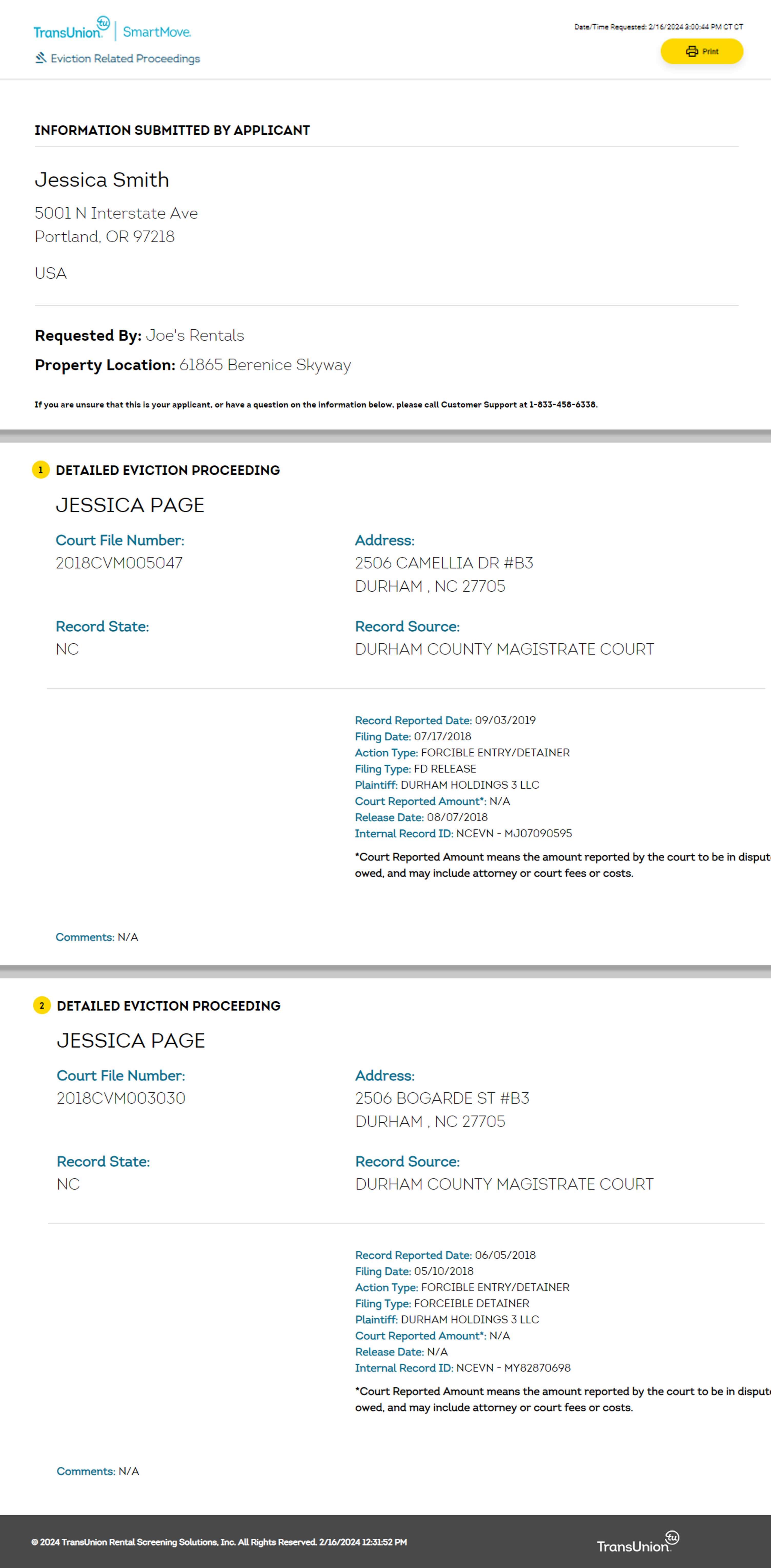
* Reports cost as little as $45 and can be paid for by the landlord or the tenant.
For Tenants: How to Check if You Have an Eviction on your Record
Are you a tenant searching for an apartment and wondering if you have an eviction on record that could impact your chances? Checking your eviction history is just as easy for you as it is for landlords.
You can use the same methods landlords use to find out if there's anything negative in your rental history:
- Check Court Records:
- Visit your state’s court records website.
- Search your full name, including any variations such as birth name, nicknames, alternate names, names with or without initials, and names before or after marriage/divorce.
- Review the results to see if any eviction records appear.
- Use a Tenant Screening Service:
- Find a service that does personal eviction record check reports (independent of credit checks)
- Use the service to check your record and see what the landlord will see.
By taking these steps, you can be proactive and understand how your records might appear to landlords, allowing you to address any issues upfront.
How to Understand Eviction Search Results
Interpreting eviction search results can be tricky, as the records may not provide the full context behind the eviction. However, understanding the final ruling on an eviction record can reveal the outcome of the court proceedings. It's important to note that an eviction filing doesn't always mean the tenant was forced to leave the property.
Common Dispositions: Civil New Filing, Judgment, Restitution of Premises
Civil New Filing: Indicates that the case was either canceled or dismissed. This can happen for various reasons, such as the tenant paying past due rent or reaching an agreement with the landlord outside of court.
Judgment: This means the court ruled in favor of the landlord. The tenant is ordered to pay the landlord for rent owed and/or any property damages.
Restitution of Premises: Often referred to as a default judgment, this occurs when the tenant fails to appear in court or respond to the eviction summons. It means the judge has ordered the tenant to vacate the property, returning full possession to the landlord through a writ of possession. The tenant must leave the property within a specified timeframe.
Cons of Running Your Own Eviction Check Search
If you decide to conduct your own eviction search, be cautious about the sources you use. Services offering automatically generated reports require extra scrutiny to ensure the records pertain to the correct person and can legally be used if you decide to deny a tenant based on the results.
Accuracy and Legality
Ensure the eviction record matches the applicant. Verify the applicant's first and last name and the property address. This is especially important for applicants with common names.
Remember that eviction records older than seven years cannot be used in tenant denial decisions. If you do deny an applicant based on a tenant-screening report, the FTC requires you to give the applicant an adverse-action notice with the screening company's contact details, tell them they can dispute the information, and provide a free copy of the report on request.
To avoid confusion and potential legal issues, it's recommended to use a service with an FCRA-certified screening report.
Choose The Best Tenants Possible With Landlord Studio

Renting out a rental property isn't just about finding someone willing to live in your rental; it's about finding tenants who will maintain a positive relationship with you and your property.
By not carefully selecting tenants and checking eviction records, you risk jeopardizing your entire business. All the information gathered in rental applications should supplement the thorough research done on each tenant - giving you a full picture of what they’re going to be like to rent to.
At Landlord Studio, we offer comprehensive tenant screening services that include eviction history, background checks, and credit scores. Our FCRA-certified screening reports ensure you receive accurate, up-to-date information, enabling you to make the best decision for your rental properties.
Create your free Landlord Studio account and screen your tenant prospects today.
You Might Also Like
- How To Evict A Tenant: The Landlords Guide To Fast Legal Evictions
- The Landlord's Guide To Tenant Screening
- Why Are Evictions So Costly? (and How to Avoid Them)
- When And How To Supply A Notice To Quit To Your Tenant
How to Look Up Evictions: FAQs
How do you check for evictions?
To check for evictions, search county or state court records where the case would have been filed, use a tenant-screening service that includes an eviction report, or review a background check. Court records are the most reliable source because evictions are civil court records.
How can I run a free eviction check on a tenant?
Public county court databases are often free to search, so you can look up a tenant's name directly with the court that would have heard the case. Some screening tools also pass the report cost to the applicant, so the check is effectively free for the landlord. Always confirm any free-database result against the official court record before acting on it.
Do evictions show up on a background check?
Often, but not always. Eviction data is not uniformly passed to every third-party screener, so a general background check may miss a filing. For a reliable result, use a tenant-screening report that includes a dedicated eviction search, and verify against court records.
Do evictions appear on a credit report?
The eviction filing itself usually does not appear on a credit report. However, related debts — such as unpaid rent sent to collections or a court judgment — can appear and stay for up to seven years under the FCRA. This is why landlords run a separate eviction-history check in addition to a credit report.
How long does an eviction stay on a tenant's record?
Eviction records can be included in a tenant-screening report for up to seven years from the filing date, after which they cannot legally be used in a screening decision. Court records themselves are generally public for around seven years, though the exact rules vary by state and some states, such as California, seal or expunge eviction records sooner.
Can a landlord deny a tenant for a past eviction?
Yes, a landlord can deny an applicant for a past eviction, provided the policy is applied consistently to all applicants and complies with state law and federal fair-housing rules. Some states require landlords to consider the circumstances of an eviction before denying, and records older than seven years cannot be used. Following the FTC's adverse-action process protects you if you deny an applicant based on a screening report.
Can You Still Get an Apartment with an Eviction?
Many landlords will still rent to tenants with an eviction, especially if there is a valid reason for the eviction or if it happened many years ago. If you have an eviction on your record, it's best to be upfront with landlords about it, explain why it happened, and how you will avoid similar situations in the future. It’s better for landlords to hear about the eviction directly from you rather than discovering it through their screening services.
How Far Back Can an Eviction Search Go?
Eviction records can be included in a report for up to seven years after the eviction was filed. Any records older than seven years cannot legally be included in the report.
About Landlord Studio

Landlord Studio is an easy to use property management and accounting software designed for landlords.
Find and screen tenants, collect rent online, track income and expenses, run reports, and more - all for free.
Stay Updated on Property Insights

Get weekly tips, tax updates, and landlord strategies straight to your inbox.
Inherited Tenants, Hidden Risks: A Due Diligence Guide for Buying Occupied Rentals
Join our webinar on buying tenant-occupied rentals. Discover the due diligence checklist, where occupied rentals leak money, and how to vet what you inherit.
Details:
Free
Hosted by:
Matt Hardy
Jennifer Ruelens
When:
August 26, 2026
10:00am PT / 1:00pm ET
Duration:
45 mins
Format:
Live Webinar
Guest:
Jennifer Ruelens, Property Manager, Investor & Founder with 20+ Years Experience in Real Estate
Co-host Matt Hardy, Head of Marketing at Landlord Studio