Welcome! Where would you like to log in?

Sign up and get
PRO free for 14 days
Once your PRO trial is over you can continue using Landlord Studio GO completely free.
By continuing you agree to our Terms & Conditions.

Visiting from the
United Kingdom?
Please visit our United Kingdom site for a better experience
Continue
12 Best Property Maintenance Software for Landlords
Compare the 12 best property maintenance software tools for US landlords, with a transparent methodology, scores, and pricing for each.

Read summarized version with:


Maintenance is the part of being a landlord that never picks a convenient moment, and handling it badly is one of the fastest ways to lose a good tenant.
The right software turns that scramble into a system. Tenants submit requests with photos, you keep them in one place instead of scattered across calls and texts, and you hold a clean record of what was fixed and what it cost. No lost messages. No "I told you about that weeks ago."
We screened the tools US landlords actually use and compared the 12 best below, scored against a consistent set of criteria. Here's how the list breaks down, how we assessed each one, and which tool fits which kind of landlord.
Why use property maintenance software?
You can run a single rental on text messages and a notebook. The trouble starts the moment you can't remember whether you booked the plumber, or a tenant claims they reported a problem weeks before you acted on it. Software fixes three things that cost landlords real money:
- A paper trail. Every request, photo, and repair cost is logged and time-stamped, which matters if a dispute or insurance claim ever comes up.
- Faster response times. Requests land in one place instead of scattered across calls, texts, and email, so nothing slips. Quick fixes are the single biggest driver of tenant renewals.
- Cleaner books. Repair costs captured at the source become deductible expenses against the right property, instead of a shoebox of receipts you reconstruct at tax time.
How we assessed these tools
No single tool is "best" for everyone - it depends on how many units you manage and whether you handle repairs yourself or hand them off. So rather than crown one winner, we scored each tool on what matters for managing tenant requests, then matched it to the landlord it suits.
We started with 30+ platforms landlords actually use and cut anything not built for a residential landlord managing tenant requests, including pure facilities CMMS tools (more below). That left 12. We pulled pricing and features from each provider, cross-checked them against current reviews, and scored each out of 10 on the things that matter when you're fielding tenant requests:
- Tenant request experience: how easily tenants submit a request, add photos, and track its status.
- Value for money: what you get for the price, including free tiers.
- Ease of use: how fast a self-managing landlord can set it up and run it.
- Platform breadth: whether it also handles rent, accounting, and screening.
We also flag how each tool handles repairs - whether it coordinates vendors itself, hands off to a service, or simply tracks the request for you to action — since that's the biggest difference between these tools.
Scores reflect fit for a landlord managing 1–50 units, and we don't take payment for placement.
How the tools compare
Each column is scored out of 10. We don't crown one overall winner — the best tool depends on your situation, so we've matched each to the landlord it suits.
| Best fit for | Tool | Tenant requests |
Value | Ease of use |
Breadth |
|---|---|---|---|---|---|
| All-in-one for self-managing landlords | Landlord Studio | 8 | 9 | 9 | 9 |
| Growing portfolios wanting automation | DoorLoop | 8 | 7 | 8 | 9 |
| Mobile-first landlords | RentRedi | 8 | 8 | 8 | 8 |
| Professional management companies | Buildium | 8 | 6 | 7 | 9 |
| Dedicated maintenance coordination | Property Meld | 9 | 7 | 7 | 4 |
| Customizable rent & fee automation | Innago | 7 | 10 | 7 | 7 |
| Deep, configurable feature set | TenantCloud | 7 | 9 | 7 | 8 |
| Large / enterprise portfolios | AppFolio | 8 | 4 | 6 | 10 |
| Outsourcing maintenance entirely | Latchel | 9 | 6 | 8 | 3 |
| Digital leasing & local rent data | Avail | 7 | 8 | 8 | 7 |
| Marketing rentals & finding tenants | TurboTenant | 7 | 9 | 8 | 7 |
| Hands-off / remote landlords | Hemlane | 7 | 6 | 7 | 7 |
Scores are our assessment for landlords managing 1–50 units, current as of June 2026.
Pricing at a glance
| Tool | Starting price (USD) | Free plan | Pricing model |
|---|---|---|---|
| Landlord Studio | Free up to 3 units; PRO from $12/mo | Yes | Per unit |
| DoorLoop | From ~$69/mo | No | Per unit, tiered |
| RentRedi | From ~$12/mo (annual) | No | Flat, unlimited units |
| Buildium | From ~$58/mo | No | Per unit, tiered |
| Property Meld | From ~$1.60/unit/mo ($160 min) | No | Per unit |
| Innago | $0 (tenant-paid fees) | Yes | Free to landlord |
| TenantCloud | Free tier; paid from ~$15/mo | Yes | Tiered |
| AppFolio | $298/mo minimum (50-unit min) | No | Per unit |
| Latchel | Custom / quote | No | Per unit / tenant-funded |
| Avail | Free tier; ~$9/unit/mo unlimited | Yes | Per unit |
| TurboTenant | Free; Premium ~$8.25/mo | Yes | Flat |
| Hemlane | From ~$2/unit + $28/mo | Limited | Per unit + base fee |
Pricing changes often — check each provider's site for current plans.
The 12 best property maintenance software tools
Landlord Studio - Best all-in-one for self-managing landlords
Price: Free up to 3 units (GO); PRO from $12/month billed annually, then $1 per extra unit.
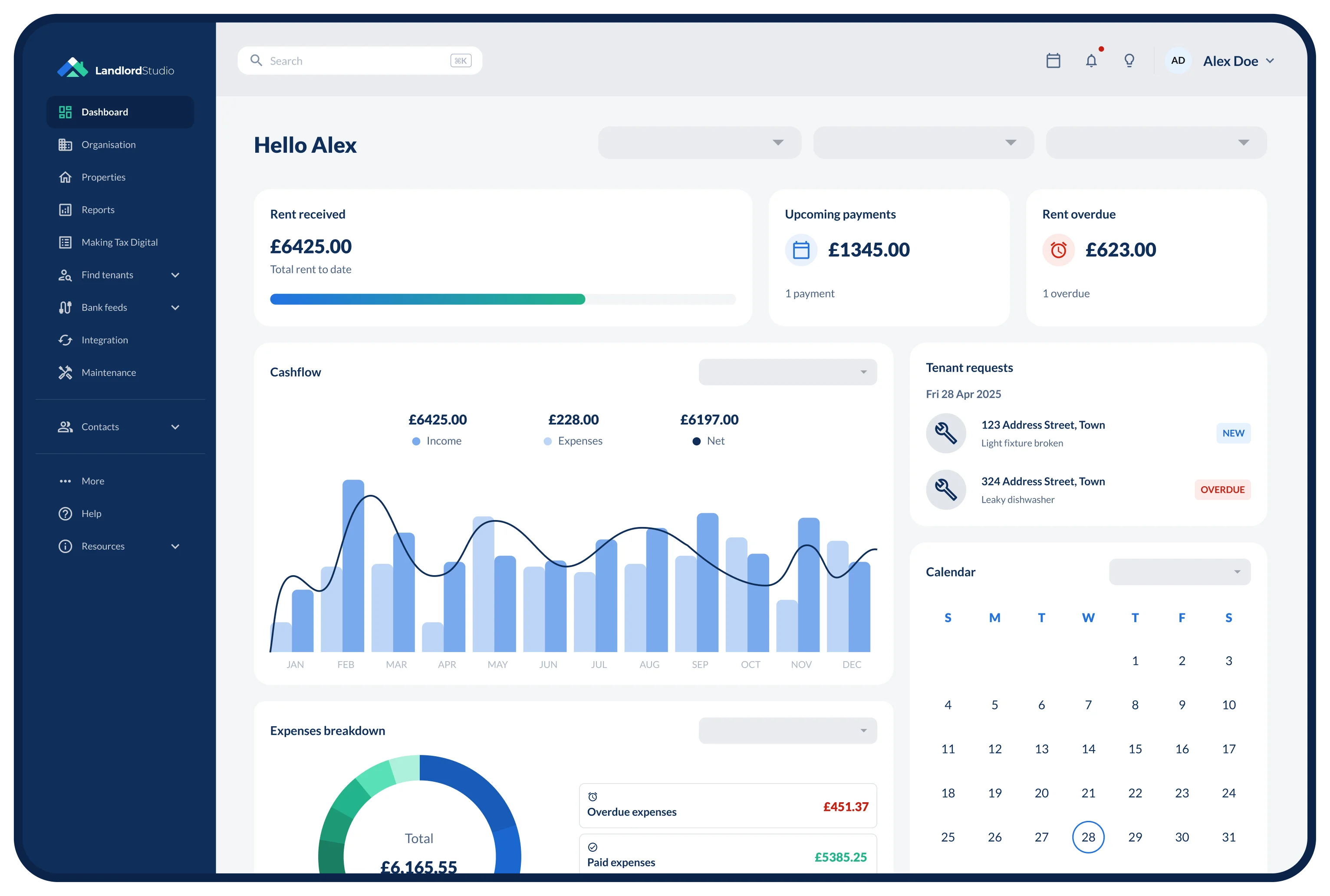
Landlord Studio is the strongest fit for landlords who self-manage and want tenant requests and their books in one place. Tenants log issues with photos through their portal, you track each request through to resolution, and the cost lands straight in your expense records - categorized against the right property and ready for tax time.
It isn't a vendor-dispatch or work-order automation tool. If coordinating contractors at volume is your main problem, Property Meld or Latchel will do more. But for the typical landlord who just wants requests and the resulting repairs and capital improvements handled alongside rent, screening, and accounting, nothing here is better value. Add a full mobile app and a free tier up to three units, and it covers the whole job rather than one slice of it.
- Pros: Maintenance requests and finances in one place; genuinely affordable; strong mobile app; free up to 3 units.
- Cons: No vendor dispatch or work-order automation; not built for managers running hundreds of units for third-party owners.
- Best for: Landlords with 1–50 units who want one tool for requests, rent, and taxes.
DoorLoop - for landlords that want automation
Price: From around $69/month (per unit, annual discounts available).
DoorLoop is a polished, full-featured platform with strong work order tools, vendor payments, accounting, and rent collection in one workflow. Its breadth and automation earn it high marks; the interface is clean enough that growing landlords don't need a training course.
- Pros: Deep automation, QuickBooks integration, modern interface.
- Cons: No free plan; more than a one- or two-property landlord needs.
- Best for: Landlords scaling past a handful of units who want everything in one system.
RentRedi - for mobile-first option
Price: From about $12/month on the annual plan (unlimited units), up to ~$29.95/month monthly.
RentRedi is built around its mobile apps and scores evenly across every criterion. All landlords get in-app maintenance tracking and tenant communication, and you can bolt on a premium maintenance service for 24/7 coordination and vendor dispatch when you'd rather not field the calls. If you're weighing it against our own platform, see our RentRedi vs Landlord Studio comparison.
- Pros: Excellent mobile experience, flat-rate pricing, optional done-for-you maintenance.
- Cons: No free landlord tier; full-service maintenance costs extra.
- Best for: Landlords who run their business mostly from their phone.
Buildium - for professional management companies
Price: From around $58/month (per unit, no minimum unit count).
Buildium is aimed at people who manage property as a full-time business, including those managing for other owners. Its strong work order tools sit alongside owner accounting, resident communication, and detailed reporting — exactly what a management company needs to look professional to its clients.
- Pros: Robust accounting, owner portals, strong reporting.
- Cons: Value score dips as it scales; more depth than a DIY landlord needs.
- Best for: Property management companies and larger self-managing portfolios.
Property Meld - for dedicated maintenance coordination
Price: From about $1.60 per unit/month, with a roughly $160/month minimum.
Property Meld does one thing better than anything else here: maintenance coordination. It automates scheduling between tenants, vendors, and managers, centralizes every conversation, and reports on response times. The trade-off is breadth — it's not an all-in-one, so it pairs best with separate accounting and rent collection.
- Pros: Best-in-class scheduling and vendor coordination; excellent reporting.
- Cons: No rent collection or accounting; the minimum makes it overkill for a few units.
- Best for: Higher-volume operators who want a specialist maintenance layer.
Innago - for customizable rent and fee automation
Price: $0 for landlords (tenants cover certain fees, like screening).
Innago gives landlords unusually granular control over money — custom charges, autopay rules, late fees, and bulk actions across units — alongside maintenance requests, screening, and rent collection. It's free for the landlord, with some costs shifted to tenants and lighter support than paid platforms.
- Pros: Fine-grained rent and fee controls; solid core features.
- Cons: Tenant-paid fees; lighter accounting depth.
- Best for: Landlords who want fine-grained control over rent and fee rules.
TenantCloud - for a deep, configurable feature set
Price: Free tier; paid plans from about $15/month.
TenantCloud packs an unusually deep, customizable feature set — a maintenance module (service requests, work orders, vendor management) plus accounting, leasing, listing tools, and tax reporting — and scales to a few hundred units. The breadth is the draw; the flip side is an interface that can feel busy.
- Pros: Deep feature set, lots of configuration, flexible plans.
- Cons: Interface can feel busy; some features gated behind higher tiers.
- Best for: Landlords who want maximum features and configurability.
AppFolio - for enterprise portfolios
Price: $298/month minimum, with a 50-unit minimum.
AppFolio is enterprise-grade software with powerful work order management, AI-assisted leasing, and deep reporting — its breadth scores a 10. It's excellent, but the pricing and unit minimum drag its value score down for anyone below a few hundred units.
- Pros: Enterprise features, automation, scalability.
- Cons: High entry cost; 50-unit minimum rules out smaller landlords.
- Best for: Large portfolios and professional management firms (200+ units).
Latchel - for fully outsourcing maintenance
Price: Custom, based on units and service tier (some plans are partly tenant-funded).
Latchel isn't software you operate so much as a service you hand off to — strong on coordination, but not a full management platform, which is why it scores low on breadth. Its team and AI handle tenant requests 24/7, troubleshoot over video to avoid unnecessary vendor visits, triage emergencies, and dispatch contractors.
- Pros: 24/7 human + AI coverage; reduces dispatches and after-hours calls.
- Cons: Not a standalone management platform; pricing requires a quote.
- Best for: Landlords who'd rather outsource maintenance than manage it.
Avail - for digital leases and local rent data
Price: Free tier; around $9/unit/month for the unlimited plan.
Avail (owned by Realtor.com) is strongest on the leasing side — state-specific lease agreements, online applications, and local rent-comparison reports drawn from Realtor.com data. Maintenance requests are tracked with repair logs by unit, alongside rent collection and TransUnion screening.
- Pros: Strong leasing tools, local rent data, easy to use.
- Cons: Maintenance coordination is basic; per-unit cost on the paid tier.
- Best for: Landlords who want strong digital leasing and rent-comp data.
TurboTenant - for marketing rentals
Price: Free for unlimited units; Premium around $8.25/month (billed annually).
TurboTenant's strength is filling vacancies — one-click listing syndication to dozens of rental sites, lead management, and online applications — with maintenance tracking, rent collection, and screening alongside. It's lighter on maintenance coordination than the specialists, but hard to beat for getting a unit seen and leased.
- Pros: Excellent listing and lead tools, easy to use.
- Cons: Basic maintenance coordination; some features behind paywalls or tenant fees.
- Best for: Landlords focused on advertising units and screening applicants.
Hemlane - Best for hands-off local repair coordination
Price: From about $2/unit plus $28/month; higher tiers add repair coordination and a vetted local network.
Hemlane sits between software and service. Lower tiers cover the basics; upgrade and it routes repair requests to your own vendors or its vetted local network, and can add local agents for showings and inspections. A good fit for out-of-state owners who can't be hands-on.
- Pros: Local repair and leasing support; flexible tiers.
- Cons: Per-unit pricing adds up; advanced help costs more.
- Best for: Remote or hands-off landlords who want boots on the ground.
Which one should you choose?
A quick guide based on where you are right now:
- You self-manage 1–50 units and want one tool for everything: Landlord Studio.
- You're scaling fast and want heavy automation: DoorLoop.
- Maintenance volume is your only real problem: Property Meld or Latchel.
- You manage hundreds of units: AppFolio or Buildium.
Whatever you pick, the goal is the same: get every tenant request into a system and keep a clean record of the cost. For the fundamentals, see our guides to what property maintenance involves, preventative maintenance, and how to estimate maintenance expenses.
Frequently asked questions
What is property maintenance software?
Property maintenance software lets tenants submit repair requests online and lets landlords track those requests, keep a record of what was done, and log the cost. Depending on the tool, it may also turn requests into work orders, assign vendors, and schedule jobs - replacing scattered texts, calls, and emails with one clear record for every property.
Do I really need maintenance software for one or two rentals?
Even with one property, a request portal saves you from chasing details over text and gives you a documented history of every repair - useful at tax time and if a dispute comes up. Free tiers from Landlord Studio, Innago, TurboTenant, and Avail make it easy to start at no cost.
What's the difference between maintenance software and a coordination service?
Software like Landlord Studio or Avail gives you the tools to receive and track requests yourself. A service like Latchel or Property Meld takes the coordination off your plate, handling tenant calls, troubleshooting, and vendor dispatch. The right choice depends on how hands-on you want to be.
Is CMMS software good for landlords?
Usually not. CMMS tools like MaintainX, Fiix, or Eptura are built for facilities and maintenance teams managing equipment, and they lack the rent collection, tenant portals, and screening a landlord needs. A landlord-focused platform is a better fit unless you run a large operation with in-house technicians.
Are maintenance and repair costs tax deductible?
Routine repairs are generally deductible in the year you pay for them, while improvements are usually capitalized and depreciated over time. The distinction matters, so it's worth reading up on repairs versus capital improvements and logging every receipt against the right property. This is general information, not tax advice - check with a CPA for your situation.


About Landlord Studio

Landlord Studio is an easy to use property management and accounting software designed for landlords.
Find and screen tenants, collect rent online, track income and expenses, run reports, and more - all for free.
Create your FREE account with Landlord Studio today.

From finding tenants to filing taxes. Reduce vacancies and maximize your portfolio ROI with software designed for you.
Get started for free