




Read summarized version with:

ChatGPT

Gemini

Claude

Grok

Add as preferred on Google
Late-fee laws vary significantly by state. Some states cap the amount a landlord can charge, some require landlords to wait a set number of days before charging a fee, and others leave the amount largely to the rental agreement and general contract law.
The table below covers residential rent late fees. It does not cover commercial leases, self-storage facilities, mobile-home rules unless specifically noted, or every local ordinance.
Important: In this guide, grace period means a mandatory waiting period before a landlord may charge a late fee. It does not mean a pay-or-quit period, eviction notice period, or time to cure nonpayment before an eviction can begin. Those are separate legal timelines.
Local laws can also be stricter than state law, so landlords should check the rules for the city or county where the property is located before setting or charging a late fee. The state-by-state sections below provide the fuller legal context and primary sources.
Late Fees by State: Full Details

The summary table above is designed for quick comparison. The sections below provide the fuller legal context for each state, including lease requirements, important exceptions, and the main legal source used for the review.
Alabama
Maximum late fee: No specific statewide statutory cap identified.
Late-fee grace period: No mandatory statewide fee-specific grace period identified.
What landlords should know: Late fees should be clearly stated in the rental agreement and remain subject to general contract, unconscionability, and penalty principles. Alabama's nonpayment notice period is separate from late-fee timing.
Legal source: Ala. Code §§ 35-9A-143, 35-9A-161.
Alaska
Maximum late fee: No fixed numerical cap.
Late-fee grace period: None identified.
What landlords should know: Alaska's official landlord-tenant guidance says an agreed late charge may be permissible where it is a small flat-rate fee that reasonably approximates the landlord's actual administrative costs.
Legal source: Alaska Landlord & Tenant Act guide
Arizona
Maximum late fee: No fixed numerical cap for standard residential rentals. The fee must be reasonable and set out in a written rental agreement.
Late-fee grace period: None identified.
What landlords should know: The five-day period in A.R.S. § 33-1368(B) is a nonpayment/eviction notice period, not a late-fee grace period.
Legal source: A.R.S. § 33-1368(B)
Arkansas
Maximum late fee: No specific statewide statutory cap identified.
Late-fee grace period: None identified.
What landlords should know: Late fees are governed primarily by the rental agreement and general contract-law standards.
Legal source: Ark. Code Title 18, Ch. 17.
California
Maximum late fee: No fixed dollar or percentage cap.
Late-fee grace period: No statewide mandatory fee-specific grace period identified.
What landlords should know: Residential late fees are governed by California's liquidated-damages rules. A fee should reflect a reasonable estimate of the landlord's actual administrative loss where fixing that loss in advance would be impracticable or extremely difficult, rather than operating as a penalty.
Legal source: Cal. Civ. Code § 1671(c)(2), (d).
Colorado
Maximum late fee: The greater of $50 or 5% of the past-due rent obligation.
Late-fee grace period: 7 calendar days.
What landlords should know: The fee must be disclosed in the rental agreement. Colorado also restricts how unpaid late fees can be treated.
Legal source: C.R.S. § 38-12-105
Connecticut
Maximum late fee: The lesser of $5 per day up to $50, or 5% of the delinquent rent.
Late-fee grace period: 9 days for monthly rent; 4 days for week-to-week rent.
What landlords should know: Only one late charge may be assessed for each delinquent payment. Additional time can apply where the landlord's online payment system prevents timely payment.
Legal source: Conn. Gen. Stat. § 47a-15a
Delaware
Maximum late fee: Up to 5% of monthly rent.
Late-fee grace period: 5 days.
What landlords should know: An additional three days can apply in circumstances where the landlord lacks a suitable payment location in the county.
Legal source: 25 Del. C. § 5501(d)
District of Columbia
Maximum late fee: Up to 5% of the full amount of rent due.
Late-fee grace period: 5 days, or any longer period provided by the lease.
What landlords should know: The maximum late fee must be disclosed in the written lease.
Legal source: D.C. Code § 42-3505.31
Florida
Maximum late fee: No specific statewide statutory cap identified.
Late-fee grace period: None identified.
What landlords should know: Late fees are primarily governed by the lease and general unconscionability principles. Florida's three-day nonpayment notice is an eviction timeline, not a late-fee grace period.
Legal source: Fla. Stat. § 83.45.
Georgia
Maximum late fee: No specific statewide statutory cap identified.
Late-fee grace period: None identified.
What landlords should know: The rental agreement should clearly state the late-fee terms, and general contract-law principles can restrict punitive charges.
Legal source: Georgia Landlord-Tenant Handbook / Georgia landlord-tenant law.
Hawaii
Maximum late fee: Up to 8% of the amount of rent due.
Late-fee grace period: None specified in the statute.
What landlords should know: The rental agreement must provide for the late charge.
Legal source: Haw. Rev. Stat. § 521-21(f)
Idaho
Maximum late fee: No numerical cap; the fee must be reasonable.
Late-fee grace period: None identified.
What landlords should know: Idaho Code § 55-314 requires residential late fees to be reasonable and generally agreed to in a written lease. Separate self-storage fee rules should not be applied to residential housing.
Legal source: Idaho Code § 55-314.
Illinois
Maximum late fee: No statewide numerical cap identified for ordinary residential rentals.
Late-fee grace period: None identified.
What landlords should know: The often-cited "$20 or 20%" rule comes from the Illinois Self-Service Storage Facility Act and does not apply to ordinary residential rentals. Late fees remain subject to contract and liquidated-damages principles, while local ordinances can impose stricter rules.
Legal source: 735 ILCS 5, Art. IX; 770 ILCS 95/7.10 for the self-storage distinction.
Indiana
Maximum late fee: No specific statewide statutory cap identified.
Late-fee grace period: None identified.
What landlords should know: Late-fee terms should be included in the rental agreement. Indiana's nonpayment notice period is separate from fee timing.
Legal source: Indiana Code Title 32, Art. 31.
Iowa
Maximum late fee: If monthly rent is $700 or less, up to $12 per day and $60 per month. If monthly rent is over $700, up to $20 per day and $100 per month.
Late-fee grace period: None specified in § 562A.9.
What landlords should know: Iowa uses fixed tiered daily and monthly maximums rather than a percentage cap.
Legal source: Iowa Code § 562A.9(4)
Kansas
Maximum late fee: No specific statewide statutory cap identified.
Late-fee grace period: None identified.
What landlords should know: Unconscionable lease provisions can be challenged, so a late fee should not operate as an unreasonable penalty.
Legal source: Kan. Stat. § 58-2544
Kentucky
Maximum late fee: No statewide numerical cap identified.
Late-fee grace period: None identified.
What landlords should know: Late fees should be clearly stated in the rental agreement and remain subject to Kentucky's general contract and unconscionability standards.
Legal source: KRS 383.505–383.715; KRS 383.555.
Louisiana
Maximum late fee: No statewide numerical cap identified for ordinary residential real-estate leases.
Late-fee grace period: None identified.
What landlords should know: Late fees are governed principally by the lease and Louisiana's stipulated-damages rules. The Louisiana Consumer Lease Act's 5% / 10-day rule concerns consumer personal-property leases, not residential real estate.
Legal source: La. Civ. Code art. 2668 et seq.; art. 2005.
Maine
Maximum late fee: Up to 4% of the amount due for one month.
Late-fee grace period: 15 days.
What landlords should know: Written notice of the potential penalty must be given when the rental agreement is entered into.
Legal source: 14 M.R.S. § 6028
Maryland
Maximum late fee: Up to 5% of the unpaid rent due for the delinquent rental period. Weekly rentals have separate dollar limits.
Late-fee grace period: None specified in § 8-208(d)(3).
What landlords should know: Local jurisdictions may impose additional requirements.
Legal source: Md. Real Prop. § 8-208(d)(3)
Massachusetts
Maximum late fee: No fixed percentage cap in this provision.
Late-fee grace period: 30 days.
What landlords should know: A residential lease may not impose interest or a penalty for failure to pay rent until 30 days after the rent was due.
Legal source: Mass. Gen. Laws ch. 186, § 15B(1)(c)
Michigan
Maximum late fee: No statewide numerical cap identified.
Late-fee grace period: None identified.
What landlords should know: Late fees remain subject to general contract and liquidated-damages principles and may be unenforceable if they operate as a penalty instead of a reasonable estimate of loss.
Legal source: MCL 554.601 et seq.; MCL 554.631 et seq.; Michigan case law including Papai v. Reliable Realty Co.
Minnesota
Maximum late fee: Up to 8% of the overdue rent payment.
Late-fee grace period: No fixed statutory number of days; the timing must be stated in the written agreement.
What landlords should know: The written agreement must state when the fee will be imposed.
Legal source: Minn. Stat. § 504B.177
Mississippi
Maximum late fee: No specific statewide statutory cap identified.
Late-fee grace period: None identified.
What landlords should know: The state's nonpayment notice timeline is separate from any late-fee timing.
Legal source: Miss. Code Title 89, Ch. 8.
Missouri
Maximum late fee: No specific statewide statutory cap identified.
Late-fee grace period: None identified.
What landlords should know: Late fees are generally governed by the rental agreement and general contract-law restrictions.
Legal source: Mo. Rev. Stat. Ch. 441.
Montana
Maximum late fee: No specific statewide statutory cap identified.
Late-fee grace period: None identified.
What landlords should know: Unconscionable rental-agreement terms can be challenged under Montana landlord-tenant law.
Legal source: Mont. Code Title 70, Ch. 24
Nebraska
Maximum late fee: No specific statewide statutory cap identified.
Late-fee grace period: None identified.
What landlords should know: General unconscionability rules apply to rental-agreement terms.
Legal source: Neb. Rev. Stat. § 76-1412
Nevada
Maximum late fee: Up to 5% of the periodic rent.
Late-fee grace period: For tenancies longer than week-to-week, at least 3 calendar days after rent is due.
What landlords should know: A fee may not be calculated on a previous late fee.
Legal source: Nev. Rev. Stat. § 118A.210
New Hampshire
Maximum late fee: No statewide numerical cap identified for ordinary residential rentals.
Late-fee grace period: None identified.
What landlords should know: RSA 451-C:7's "$20 or 20%" rule and five-day timing apply to self-service storage facilities, not standard residential rentals.
Legal source: RSA 540; RSA 451-C:7 for the self-storage distinction.
New Jersey
Maximum late fee: No specific statewide numerical cap identified.
Late-fee grace period: 5 business days only for qualifying tenants covered by N.J.S.A. 2A:42-6.1–6.3.
What landlords should know: The five-business-day protection is not a universal grace period for all residential tenants.
Legal source: N.J.S.A. 2A:42-6.1–6.3
New Mexico
Maximum late fee: Up to 5% of the rent for each rental period in default.
Late-fee grace period: None identified.
What landlords should know: The fee is calculated only on rent. The cap was reduced from 10% to 5% in 2025.
Legal source: N.M. SB 267 / § 47-8-15(D)
New York
Maximum late fee: The lesser of $50 or 5% of monthly rent.
Late-fee grace period: 5 days.
What landlords should know: The statewide residential rule applies to standard residential tenancies.
Legal source: N.Y. Real Property Law § 238-a(2)
North Carolina
Maximum late fee: Monthly rent: the greater of $15 or 5% of monthly rent. Weekly rent: the greater of $4 or 5% of weekly rent.
Late-fee grace period: 5 calendar days.
What landlords should know: Only one late fee may be charged for each late payment.
Legal source: N.C. Gen. Stat. § 42-46
North Dakota
Maximum late fee: No specific numerical statewide cap identified.
Late-fee grace period: None identified.
What landlords should know: North Dakota Attorney General guidance says the lease must state whether there is a late fee, the amount, and when it is charged.
Legal source: North Dakota Attorney General — Tenant Rights
Ohio
Maximum late fee: No specific statewide statutory cap identified.
Late-fee grace period: None identified.
What landlords should know: Late fees remain subject to general contract and non-penalty principles.
Legal source: Ohio Rev. Code Ch. 5321.
Oklahoma
Maximum late fee: No specific statewide statutory cap identified.
Late-fee grace period: None identified.
What landlords should know: Late fees are generally controlled by the written rental agreement and general contract law.
Legal source: Okla. Stat. tit. 41.
Oregon
Maximum late fee: Oregon allows three statutory structures: a reasonable one-time flat fee; a qualifying daily fee; or 5% of periodic rent for each succeeding five-day period.
Late-fee grace period: The fee timing begins on the fifth day of the rental period.
What landlords should know: The rental agreement should specify which statutory structure applies.
Legal source: Or. Rev. Stat. § 90.260
Pennsylvania
Maximum late fee: No specific statewide statutory cap identified.
Late-fee grace period: None identified.
What landlords should know: Late fees remain subject to general contract and liquidated-damages principles.
Legal source: Pennsylvania Landlord and Tenant Act.
Rhode Island
Maximum late fee: No statewide numerical cap identified.
Late-fee grace period: None identified.
What landlords should know: Late-fee terms should be clearly stated in the rental agreement and remain subject to the state's unconscionability rules.
Legal source: R.I. Gen. Laws §§ 34-18-13, 34-18-15.
South Carolina
Maximum late fee: No specific statewide statutory cap identified.
Late-fee grace period: None identified.
What landlords should know: Unconscionable terms can be struck down under the South Carolina Residential Landlord and Tenant Act.
Legal source: S.C. Code Title 27, Ch. 40
South Dakota
Maximum late fee: No specific statewide statutory cap identified.
Late-fee grace period: None identified.
What landlords should know: Nonpayment notice timelines are separate from any late-fee timing.
Legal source: S.D. Codified Laws Ch. 43-32
Tennessee
Maximum late fee: Up to 10% of the amount of rent past due where Tennessee's URLTA applies.
Late-fee grace period: 5 days beginning on the day rent is due.
What landlords should know: The URLTA does not apply uniformly statewide, so landlords should check whether the property is in a covered county.
Legal source: Tenn. Code § 66-28-201(d); Tennessee AG URLTA coverage
Texas
Maximum late fee: The fee must be reasonable. A fee is presumed reasonable when it is no more than 12% of rent for a dwelling in a structure with four or fewer units, or 10% for a dwelling in a structure with more than four units.
Late-fee grace period: Rent must remain unpaid for two full days after the due date before a late fee may be collected.
What landlords should know: The 12% / 10% figures are statutory reasonableness safe harbors, not absolute caps.
Legal source: Tex. Prop. Code § 92.019
Utah
Maximum late fee: The greater of 10% of the rent stated in the rental agreement or $75.
Late-fee grace period: None specified in § 57-22-4(5).
What landlords should know: The fee should be disclosed in the rental agreement.
Legal source: Utah Code § 57-22-4(5)
Vermont
Maximum late fee: No fixed statutory numerical cap identified.
Late-fee grace period: None identified.
What landlords should know: Enforceability depends heavily on lease terms and general liquidated-damages / penalty principles.
Legal source: Vermont residential landlord-tenant law.
Virginia
Maximum late fee: The lesser of 10% of periodic rent or 10% of the remaining balance due.
Late-fee grace period: No universal statutory late-fee grace period for written leases.
What landlords should know: The statutory cap applies to written rental agreements. The five-day default timing sometimes cited applies to statutory defaults where no written rental agreement is offered.
Legal source: Va. Code § 55.1-1204
Washington
Maximum late fee: No specific statewide numerical cap identified.
Late-fee grace period: 5 days.
What landlords should know: Washington's five-day late-fee grace period is separate from the state's nonpayment notice rules.
Legal source: RCW 59.18.170(2)
West Virginia
Maximum late fee: No specific statewide statutory cap identified.
Late-fee grace period: None identified.
What landlords should know: Late fees are generally governed by the lease and common-law contract principles.
Legal source: W. Va. Code § 37-6A-2
Wisconsin
Maximum late fee: No specific statewide numerical cap identified.
Late-fee grace period: None identified.
What landlords should know: A late fee must be specifically provided for in the rental agreement, and a landlord may not charge a fee or penalty for failure to pay an earlier late fee.
Legal source: Wis. Admin. Code ATCP 134.09(8).
Wyoming
Maximum late fee: No statewide numerical cap identified.
Late-fee grace period: None identified.
What landlords should know: Late fees are generally governed by the lease and ordinary contract-law limits on unconscionable or penal provisions.
Legal source: Wyo. Stat. §§ 1-21-1201 through 1-21-1211.
Late-Fee Grace Period vs Eviction Notice: They Are Not the Same Thing
A late-fee grace period tells a landlord how long they must wait before charging a fee.
A nonpayment or eviction notice period tells a landlord and tenant how long a tenant has to respond to a notice before the landlord can take the next step toward ending the tenancy.
Those timelines can be completely different.
For example, Arizona law contains a five-day nonpayment notice before a landlord can terminate the rental agreement through a special detainer action. That does not create a five-day statutory grace period before a residential late fee can be charged. The statute separately refers to a reasonable late fee set out in a written rental agreement.
Washington provides an especially clear example of the distinction: a landlord cannot charge a late fee when rent is paid within five days after the due date, but the statute expressly says this does not prevent a landlord from serving a pay-or-vacate notice after the rent becomes due.
When checking your state law, make sure you are looking at the rule for late fees, not simply the rule for nonpayment notices or eviction.
What If Your State Does Not Set a Maximum Late Fee?
A state with no specific numerical cap should not be treated as a state with “no limit.”
Depending on the jurisdiction, the fee may still need to:
- Be clearly stated in the rental agreement.
- Be reasonable rather than punitive.
- Reflect or reasonably estimate the landlord's loss or cost caused by late payment.
- Comply with state contract and consumer-protection law.
- Comply with any stricter city or county rule.
- Follow special rules for subsidized housing or particular property types.
For that reason, landlords should avoid copying a percentage from another state or assuming that a common figure such as 5% is automatically lawful.
Local Rules Can Be Stricter
This table focuses on statewide residential rules. Cities and counties can impose additional restrictions.
Illinois is a good example of why local verification matters. The state's often-cited “$20 or 20%” figure comes from Illinois's Self-Service Storage Facility Act and should not be applied to ordinary residential rentals. At the same time, local jurisdictions such as Chicago can have their own residential rental rules.
Before adding a late fee to a lease, check both the statewide law and any applicable city or county ordinance.
How to Write a Late-Fee Clause
Where late fees are permitted, the lease should clearly explain:
- The rent due date.
- Any mandatory or contractual grace period.
- The amount or formula used to calculate the fee.
- When the fee is charged.
- Whether the charge is one-time, daily, or recurring where the law permits those structures.
- Any other requirements imposed by state or local law.
Do not use a lease clause to shorten a statutory grace period or increase a statutory cap.
Managing Late Rent With Landlord Studio
Late fees are not a substitute for a consistent rent-collection process.
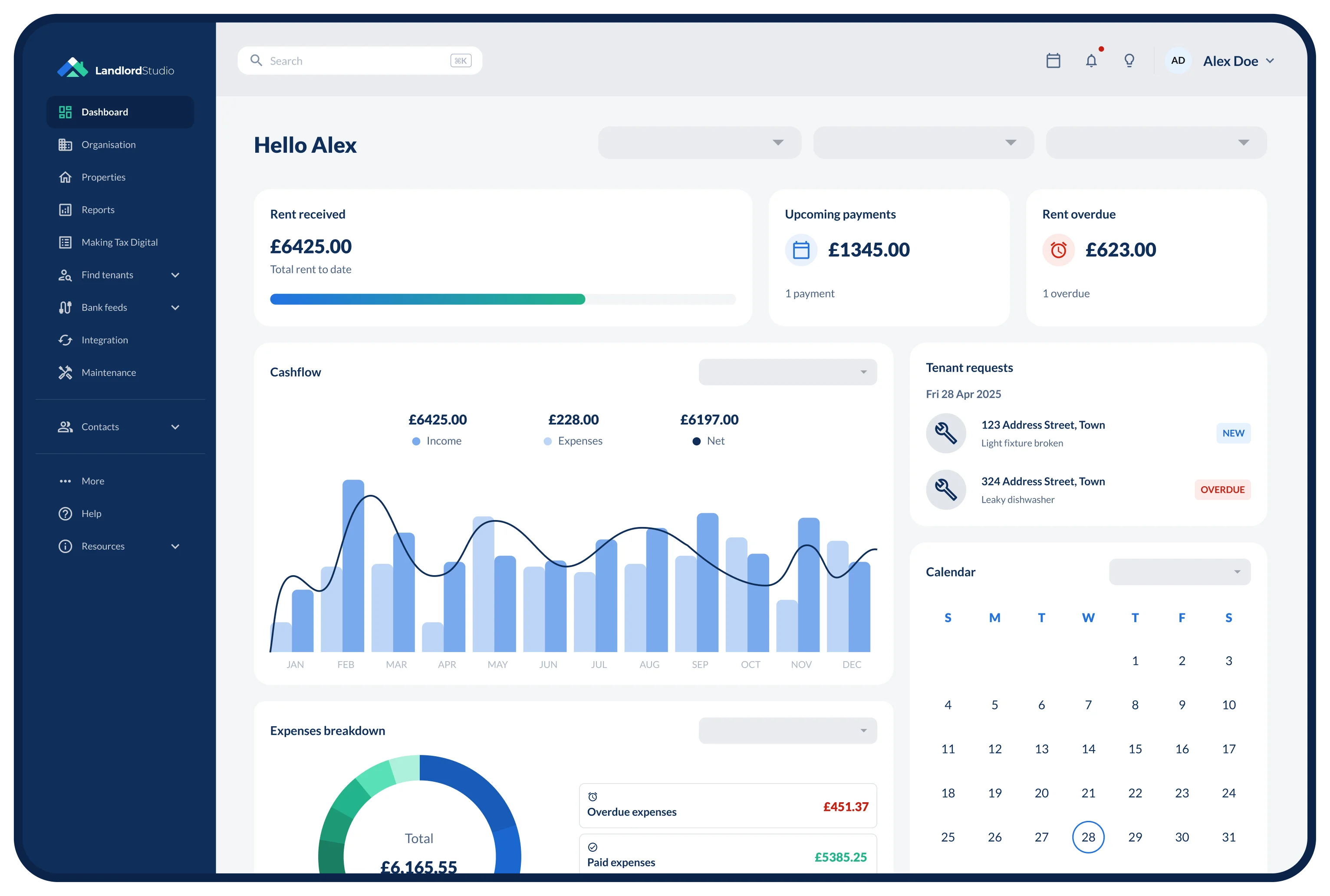
With Landlord Studio, landlords can track rent payments, send rent reminders, and keep a clear record of what has been paid and what remains outstanding.
If you automate late fees, make sure the amount and timing you configure match the law that applies to the property and the terms of the lease.
Collect and track rent with Landlord Studio
Frequently Asked Questions
Can a landlord charge a late fee the day after rent is due?
Sometimes, but not always. Several states require a statutory waiting period before a late fee can be charged. Even where state law does not set a mandatory grace period, the lease or local law may do so.
Is a 5% late fee always legal?
No. Some states use a 5% cap, but other states use different percentages, flat-dollar limits, reasonableness standards, or no specific numerical cap. Always check the law that applies to the property.
Can a landlord charge a late fee if the lease does not mention one?
It depends on the jurisdiction, but many states expressly require the fee to be included in the rental agreement. Even where state law is less explicit, putting the amount, timing, and conditions in writing helps establish clear terms.
Does a late-fee grace period delay an eviction for nonpayment?
Not necessarily. Late-fee timing and eviction/nonpayment notice timing are separate legal questions. A landlord may be prohibited from charging a fee during a grace period while other nonpayment procedures operate on a different timeline.
Can cities set stricter late-fee rules than the state?
In some jurisdictions, yes. Local ordinances can add caps, grace periods, disclosure rules, or other restrictions. Check city and county rules as well as state law.
There is no single nationwide rule for residential late fees
The maximum amount, required waiting period, lease requirements, and enforcement rules depend on where the property is located.
The safest approach is to treat the state table as a starting point, verify current state and local law before charging a fee, and keep the late-fee terms clear and consistent in the rental agreement.
This article is for general informational and educational purposes only and does not constitute legal advice. Laws change and local rules may differ. Landlords and tenants should verify the current law that applies to their property and seek advice from a qualified local professional where necessary.