



Rental Yield Calculator
Work out the gross and net yield on a rental property, factor in vacancy and operating costs, and see what your investment really returns.

How to manually calculate your rental yield
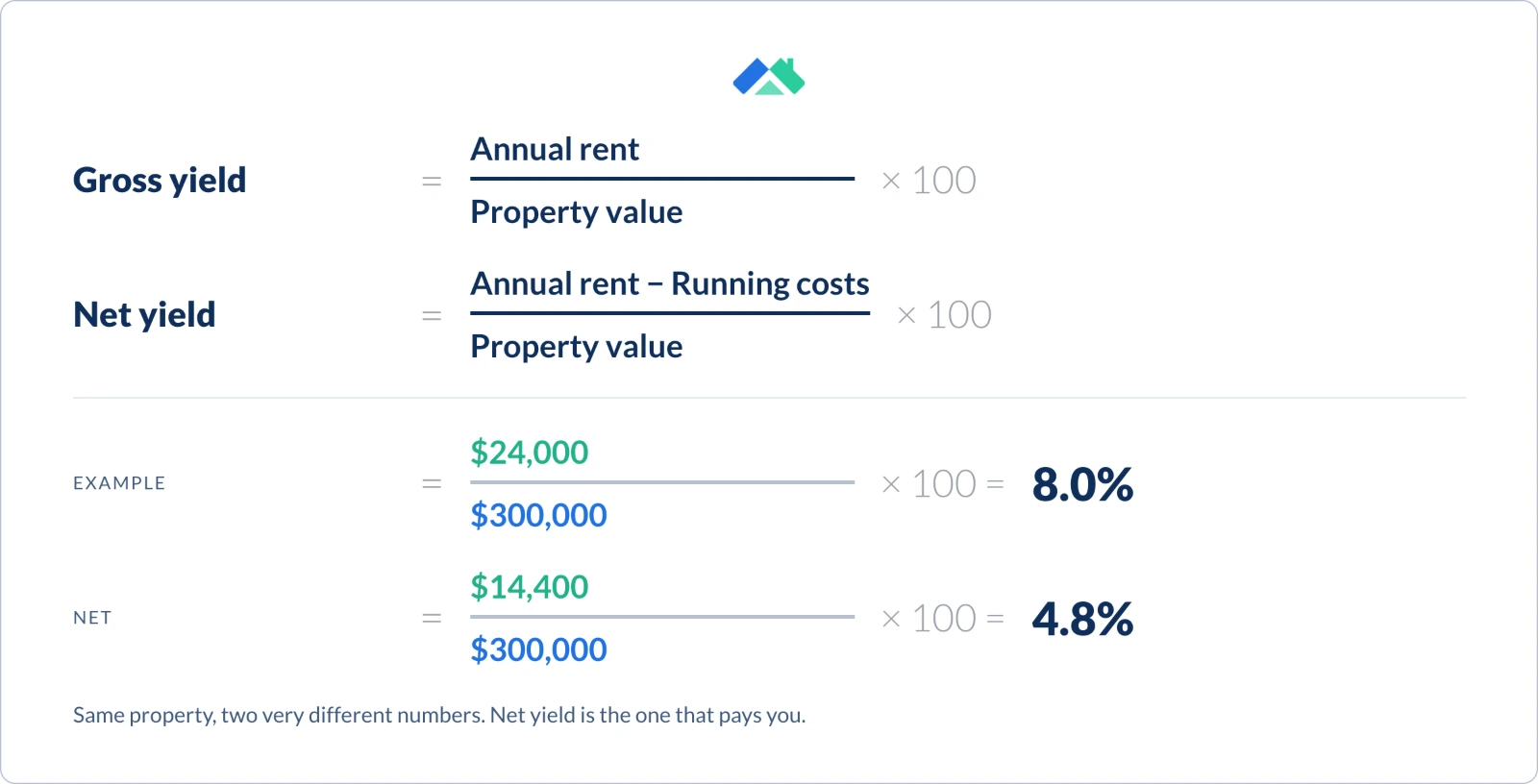
Gross yield is annual rent divided by the property value, times 100. Net yield does the same after operating costs come off the rent, and the gap is usually wider than investors expect.
Work out your annual rent
Multiply the monthly rent by 12.
Divide by the property value and multiply by 100
That's your gross yield, the headline figure most listings quote.
Take off operating costs and repeat
Management, insurance, repairs, tax and vacancy all come off the rent first, giving the net yield you actually earn.
Worked example
A property worth $280,000 rents for $1,750 a month, with $7,000 a year in operating costs.
Gross yield = ($21,000 ÷ $280,000) × 100 = 7.5%
Net yield = ($14,000 ÷ $280,000) × 100 = 5%

Other calculators you might be interested in

Cap Rate Calculator
Work out the cap rate on a rental property to compare deals on an unleveraged basis.

Net Operating Income Calculator
Calculate net operating income before financing, the starting point for most deal analysis.

Free Mileage Calculator
Log property trips, apply the IRS standard mileage rate, and download a tax-ready expense pack.

Manage up to 3 rental properties for free!
Sign up and get PRO free for 14 days. When the trial ends, keep tracking rent, expenses and reports for up to 3 properties, free forever with Landlord Studio GO.
By continuing you agree to our Terms & Conditions. · Already have an account? Log in
Calculating rental yield
Rental Yield Calculator
Before you buy, run the yield to judge whether the deal stacks up. You need the purchase price, expected rent, an estimate of operating expenses and a realistic vacancy rate for the market.
Understanding an existing property's performance
Keep an eye on yield across a property you already own so you know it's still returning what it should - and can act when insurance, taxes or maintenance creep up.

Why should you use our rental yield calculator?
- Gross and net yield side by side, so you can see what operating costs really do
- Factors in vacancy rather than assuming the unit is rented year-round
- Adds cash-on-cash return when you're financing the purchase
- Shows how long it takes to recover the cash you put in
- Free, fast and no sign-up
FAQs
What is rental yield?

Rental yield measures how much cash an investment property produces as a percentage of its value over a year. It's the quickest way to compare two deals side by side before you get into the detail.
There are two versions worth knowing: gross yield and net yield.
What is gross rental yield and how do you calculate it?
Gross yield is your return before expenses and vacancy, and it ignores mortgage interest. It's simple to calculate, which makes it useful for a first pass across several properties.
Take the annual rent, divide by the purchase price, multiply by 100. A $250,000 property renting at $1,800 a month: $21,600 ÷ $250,000 × 100 = 8.64% gross yield.
What is net rental yield and how do you calculate it?
Net yield accounts for operating expenses - property management, insurance, taxes, maintenance, HOA dues - and for the weeks the unit sits empty. It gives a far more honest picture of what a property actually returns.
Take the annual rent, subtract annual operating expenses, divide by the total invested, multiply by 100. On that same $250,000 property with $6,000 of annual costs: ($21,600 - $6,000) ÷ $250,000 × 100 = 6.24% net yield.
What is a good rental yield?
It varies enormously by market. Midwest and Southeast markets often show higher yields with slower appreciation; coastal and high-growth metros show lower yields but stronger capital gains. Comparing a Cleveland yield to a San Jose yield tells you very little.
What matters more is whether the property stays cash flow positive after every real cost - vacancy, capex, management, property taxes and insurance - and whether it still works if rates or insurance premiums rise.
What is cash-on-cash return and how does it differ from yield?
Cash-on-cash return measures annual profit against the cash you actually put in - your down payment plus closing costs - rather than against the full purchase price.
On a financed rental it's usually the more useful number, because leverage means the cash you tied up is much smaller than what the property cost. Yield tells you about the asset; cash-on-cash tells you about your money.