



Free Mileage Calculator
Log every business-related trip - inspections, contractor meetings, supply runs - calculate accurate driving distance automatically, and apply the IRS standard mileage rate (76¢/mile from July 1, 2026) to see your total deduction. Download a tax-ready PDF in three clicks.

How to manually calculate your mileage deduction
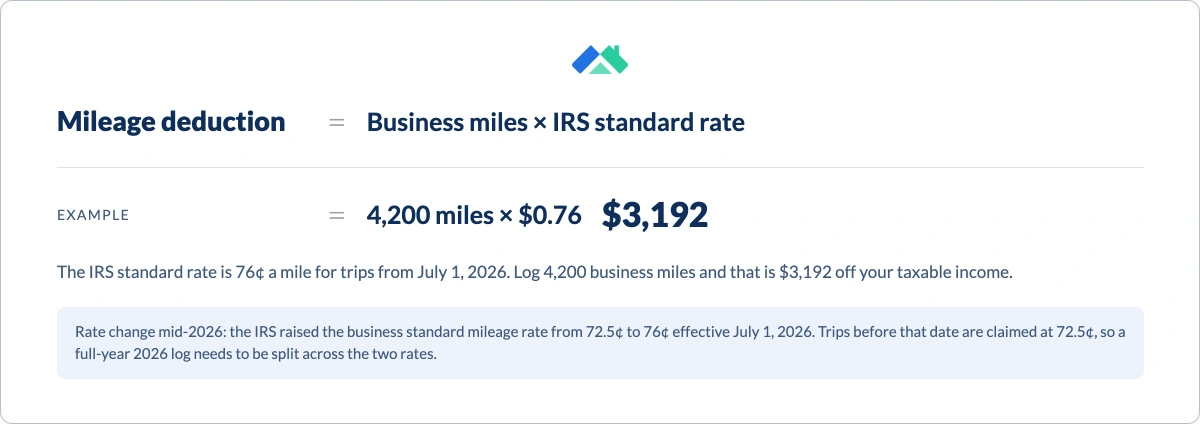
Multiply your business miles by the IRS standard rate. The total comes straight off your taxable rental income.
Log your business miles
Only trips to run the rental count: inspections, contractor meetings, showings and supply runs.
Apply the IRS standard rate
76¢ a mile from July 1, 2026, up from 72.5¢ for the first half of the year. Split your log by date if you drove across both periods.
Deduct the total
Claim it against your rental income and keep the log for your records.
Worked example
A landlord logs 5,400 business miles after July 1, 2026.
Mileage deduction = 5,400 × $0.76 = $4,104

Other calculators you might be interested in

Rental Income Tax
Quickly estimate your potential returns and taxes on a property.

Rental Yield
Calculate net yield, gross yield, repayment period and cash flow

Net Operating Income
Use our net operating income calculator to calculate the NOI

Manage up to 3 rental properties for free!
Sign up and get PRO free for 14 days. When the trial ends, keep tracking rent, expenses and reports for up to 3 properties, free forever with Landlord Studio GO.
By continuing you agree to our Terms & Conditions. · Already have an account? Log in
Prorated Rent for Move-In & Move-Out Calculations

Free Mileage Calculator
The IRS lets you deduct 76¢ per business mile driven to inspections, contractor meetings, supply runs, and viewings. Most self-managing landlords drive 3,000-8,000 business miles a year - that's $2,280-$6,080 in deductions left on the table if you're not tracking them.
The rate rose from 72.5¢ to 76¢ on July 1, 2026, so a full-year 2026 log has to be split across both rates.

Stay audit-ready with a proper log
Fuel receipts aren't enough. The IRS requires a contemporaneous mileage log with the date, route, purpose, and miles for each trip. This tool builds that log for you and prints it in the format auditors expect.

Log your mileage expenses in Landlord Studio
- Track every trip automatically - GPS-powered logging, no manual entry
- Categorize miles per property - deductions roll up correctly at tax time
- One place for mileage, rent, expenses, and tenants - no more spreadsheet sprawl
- Schedule E-ready reports - export a single document for your CPA
- Invite your accountant - they see exactly what they need, no email back-and-forth
FAQs
How does the mileage calculator work?

Enter the start and end address for each trip - the tool calculates the exact driving distance using mapping data. Add the date, business purpose, and whether it was a round trip. Repeat for as many trips as you need, then download a PDF expense pack with your total IRS mileage deduction (76¢/mile for trips from July 1, 2026) ready to file.
What counts as a deductible trip?
Any drive made for the active management of your rental property. Common deductible trips include: property inspections, meetings with contractors or maintenance crews, showing units to prospective tenants, picking up supplies for repairs, drives to your accountant or attorney about rental matters, and trips to court hearings. Commuting from your home to a single property you regularly manage may not qualify - check with a CPA on edge cases.
What's the difference between the standard mileage rate and actual expenses?
The IRS gives you two ways to deduct car costs. Standard mileage is one simple per-mile rate (76¢ from July 1, 2026, up from 72.5¢ earlier in the year) that bundles fuel, repairs, depreciation, and insurance together. Actual expenses is the harder path - you track and depreciate the real costs separately. Most landlords choose standard mileage because it's far less paperwork. Important: if you claim MACRS depreciation on a vehicle under actual expenses, you can't switch back to standard mileage for that car.
Do I need to keep fuel receipts?
Not under the IRS standard mileage rate. The standard rate is the IRS's all-in figure - it already covers fuel, depreciation, insurance, and maintenance. What the IRS does require is a written log of each trip, which is exactly what this tool produces. Keep parking and toll receipts separately, though - those are deductible on top of mileage.
How accurate is the mileage estimate, and why does it sometimes differ from Google Maps?
We use OpenStreetMap routing, which picks the shortest driving route - Google picks the fastest route with live traffic, so the two can disagree by 10–20% in cities (especially around large landmarks like airports). For tax purposes, the IRS wants actual miles driven, not a theoretical route - so if you took a different way, edit the miles for any trip directly in Step 2. The tool just saves you from typing in routine routes from scratch.