



70% Rule Calculator
Work out the most you should pay for a flip or BRRRR deal. Enter the after-repair value and your repair estimate to get a maximum offer in seconds.

How to manually calculate your maximum offer
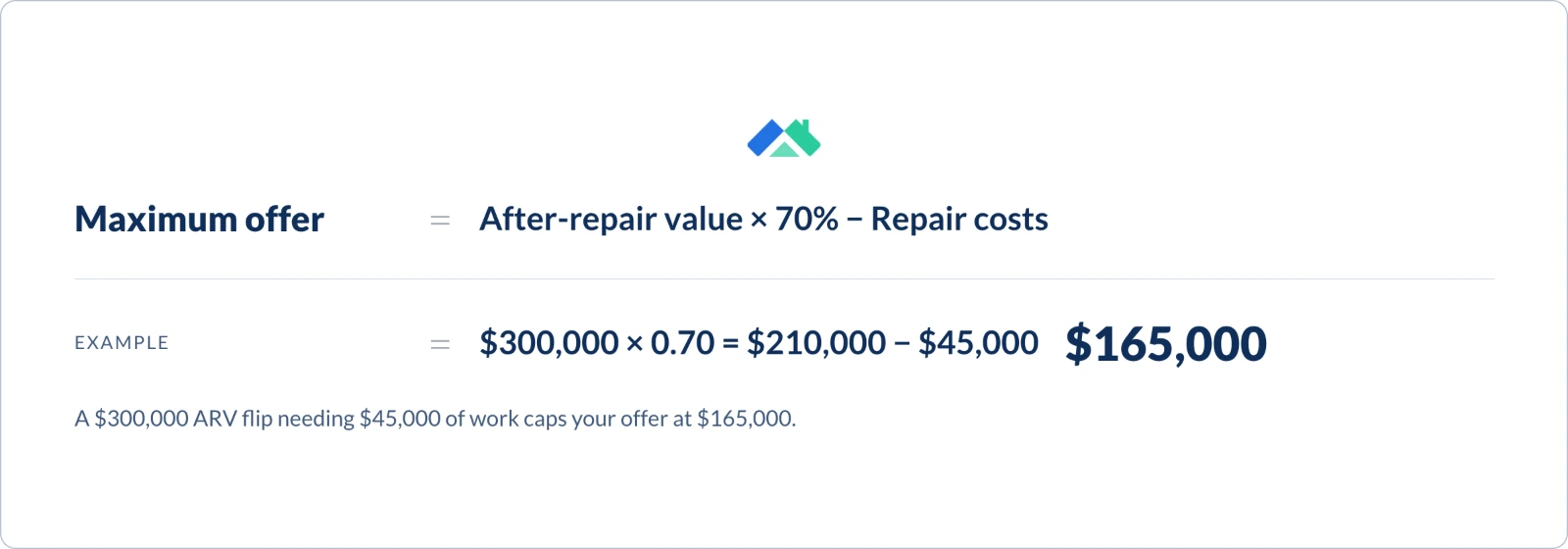
Take 70% of the after-repair value and subtract your repair estimate. What's left is the most you should pay - the 30% is your margin for holding costs, financing and profit.
Estimate the after-repair value
Use sold comps for finished properties, not asking prices.
Multiply by 70%
That leaves a 30% buffer covering closing, holding, selling costs and profit.
Subtract your repair estimate
Get contractor quotes rather than guessing, and add a contingency.
Worked example
A flip with a $240,000 after-repair value needing $30,000 of work.
Maximum offer = ($240,000 × 0.70) − $30,000 = $168,000 − $30,000 = $138,000

Other calculators you might be interested in

BRRRR Investment Calculator
Model a full Buy, Rehab, Rent, Refinance, Repeat deal from purchase to refinance.

Cap Rate Calculator
Work out the cap rate on a rental property to compare deals on an unleveraged basis.

Rental Yield Calculator
Gross and net yield, cash flow and cash-on-cash return on a rental property.

Manage up to 3 rental properties for free!
Sign up and get PRO free for 14 days. When the trial ends, keep tracking rent, expenses and reports for up to 3 properties, free forever with Landlord Studio GO.
By continuing you agree to our Terms & Conditions. · Already have an account? Log in
Screening a flip or BRRRR deal
70% Rule Calculator
The 30% you hold back is not profit - it absorbs holding costs, closing costs at both ends, agent commissions and your margin. Treat the result as the most you'd offer, not what the property is worth.
Your ARV is the weak link
Everything hinges on the after-repair value and the repair estimate. Get the ARV from recent comparable sales rather than listings, and pad the repair figure - overruns are the norm, not the exception.

Why should you use our 70% rule calculator?
- Gives you a maximum offer in seconds, before you waste time on a bad deal
- Adjustable percentage - stretch to 75% in a competitive market, or tighten it
- Shows your built-in margin in dollars, not just a rule of thumb
- Flags when the asking price is already above your maximum offer
- Free, fast and no sign-up
FAQs
What is the 70% rule in real estate?

The 70% rule is a quick screen used by flippers and BRRRR investors. You pay no more than 70% of the after-repair value, minus the cost of repairs.
Maximum offer = (ARV × 0.70) - repair costs. On a property worth $300,000 after $40,000 of work: ($300,000 × 0.70) - $40,000 = $170,000.
Is the 70% rule always right?
The 30% margin is meant to absorb holding costs, closing costs on both ends, agent commissions and profit. In competitive markets investors often stretch to 75% or even 80%, and on cheaper properties the fixed costs eat a bigger share so 70% can be too generous.
Treat it as a screening tool, not a valuation. It ignores holding period, financing costs and how confident your ARV estimate really is.