



Rent to Income Ratio Calculator
Screen an applicant against the 3x rent rule, a 30% threshold, or your own standard. Enter a housing voucher and the calculator tests the tenant's share of the rent, the way source-of-income laws require.

How to manually calculate rent to income ratio
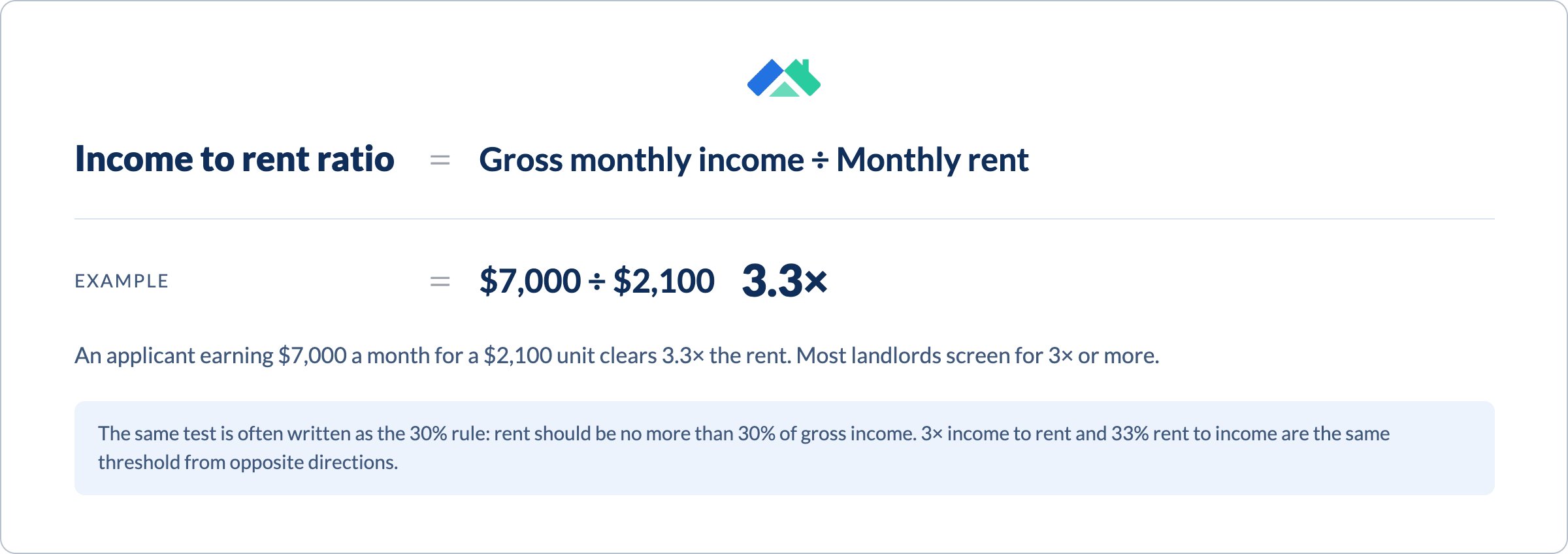
Rent to income ratio is the monthly rent divided by the tenant's gross monthly income, times 100. Most landlords screen at 30% or below, or use the 3x rent rule as the faster version of the same test.
Work out gross monthly income
Use income before tax, from every verified source — wages, Social Security, disability, self-employment and any second job. Ask for pay stubs or an employer's letter rather than taking the figure on the application.
Subtract any housing subsidy from the rent
If the applicant has a voucher, your standard applies to the portion they actually pay, not the full rent. Skip this step only where no subsidy is involved.
Divide and check against your standard
Divide the tenant's share by gross monthly income and multiply by 100. 30% or below is the common benchmark; the 3x rent rule is the quicker version and slightly looser, putting the ratio at about 33% against a strict 30% rule's 3.33x.
Worked example
A tenant earning $64,800 a year gross, applying for a home at $1,650 a month.
Rent to income ratio = ($1,650 ÷ $5,400) × 100 = 31%
3x rent rule minimum = $1,650 × 3 = $4,950 a month — this applicant clears the 3x rule but sits just above the 30% benchmark

Other calculators you might be interested in

Rental Increase Estimator
Find out what your property could rent for, using Zillow, HUD and Census data.
Rental Yield Calculator
Work out the gross and net yield on a rental property to see what your investment really returns.
Late Fees Calculator
Work out the late fee your lease allows, with grace period handling and tenant templates.

Manage up to 3 rental properties for free!
Sign up and get PRO free for 14 days. When the trial ends, keep tracking rent, expenses and reports for up to 3 properties, free forever with Landlord Studio GO.
By continuing you agree to our Terms & Conditions. · Already have an account? Log in
What the ratio actually tells you
Rent to Income Ratio Calculator
Where source-of-income laws apply, your income standard is tested against the tenant's share of the rent — the subsidy comes off first.
On an $1,800 home with a $900 voucher, a 3x standard asks for $32,400 a year, not $64,800. Applying the multiple to the full rent rejects people who comfortably qualify.

It is a screen, not a decision
The ratio is a fast first filter. It says nothing about payment history, job stability, or how someone has treated a property — a high earner with a poor record is the worse bet.
Run it early to size the shortlist, then let credit, employment and landlord references do the real work.

Why should you use our rent to income ratio calculator?
- Screens against the 3x rent rule, 2.5x, 30%, 35% or your own percentage
- Subtracts a housing voucher and tests the tenant's share, as source-of-income laws require
- Works backwards — enter the income to get the highest rent that clears your standard
- Combines co-applicant income, and shows the headroom or shortfall in dollars
- Free, fast and no sign-up
FAQs
What is a good rent to income ratio?

30% or below is the common benchmark, meaning rent takes no more than 30% of the tenant's gross monthly income. It is a guideline rather than a rule — in high-cost metros a 30% threshold rules out most of the applicant pool, so many landlords there screen at 35% or 40% and lean harder on credit and rental history.
What is the 3x rent rule, and is it the same as the 30% rule?
Close, but not identical. The 3x rent rule asks for gross monthly income of at least three times the rent, which puts the ratio at about 33%. A strict 30% rule needs income of roughly 3.33x rent. The 3x rule is the more common shorthand because the arithmetic is easier to do in your head.
How do housing vouchers affect the calculation?
Subtract the subsidy from the rent, then apply your standard to what the tenant actually pays. On an $1,800 home with a $900 voucher, a 3x standard needs $2,700 a month rather than $5,400 — the difference between rejecting an applicant and approving one. This calculator does that automatically when you enter a subsidy.
Should I use gross or net income?
Gross — income before tax and deductions. Both the 30% rule and the 3x rent rule are built on gross income, so screening on take-home pay makes your threshold far stricter than you intended and will filter out applicants who would comfortably have paid.
What if an applicant's income is below my standard?
It does not have to be an automatic rejection. A co-signer, an additional deposit where state law allows it, or strong rental and credit history can all offset a ratio slightly over your line. What matters is that you handle every applicant in that position the same way — inconsistent screening is the most common route to a fair housing complaint, whatever the intent.