



DSCR Calculator
Work out the debt service coverage ratio on a rental property: how many times its net operating income covers the annual loan payments, and whether that clears a lender's minimum.

How to manually calculate DSCR
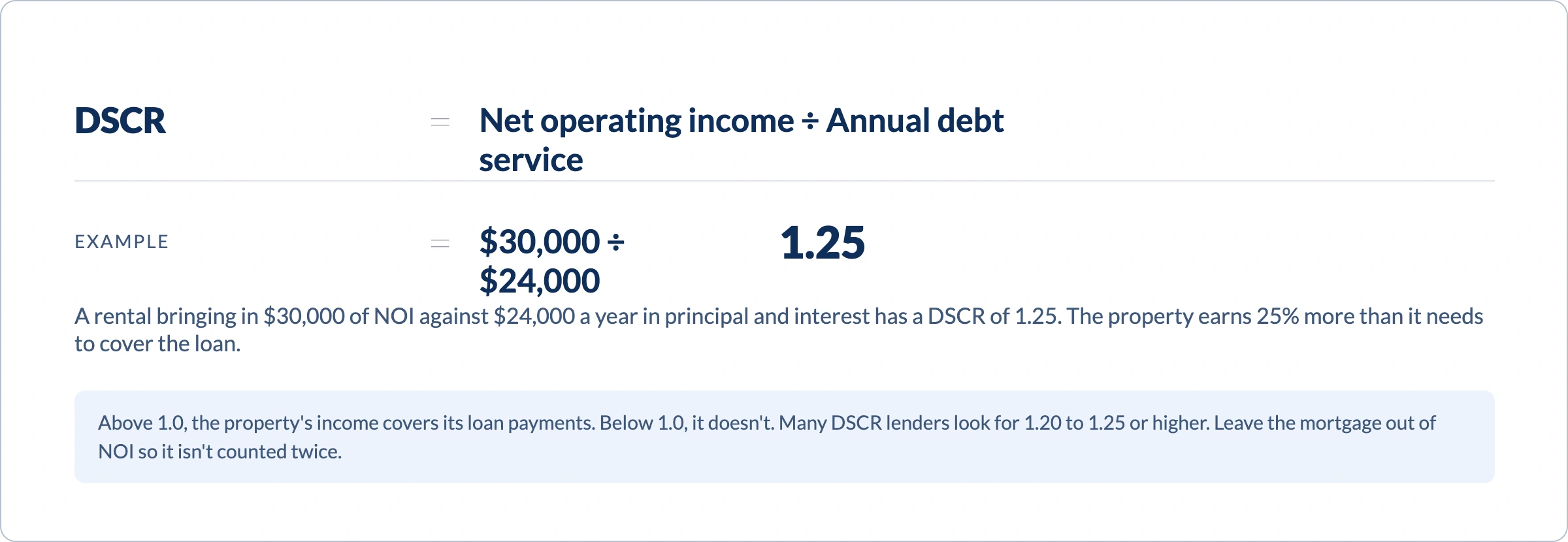
DSCR is net operating income divided by annual debt service. Above 1.0, the property's income covers its loan payments. Below 1.0, it doesn't.
Work out net operating income
Annual rent after vacancy, minus operating expenses such as taxes, insurance, repairs and management. Leave the mortgage out.
Add up annual debt service
Twelve months of principal and interest on every loan secured by the property.
Divide NOI by debt service
A result of 1.25 means the property earns 25% more than it needs to cover the loan.
Worked example
A rental collecting $2,400 a month ($28,800 a year), with 5% vacancy and $7,560 of annual operating expenses, financed with a $200,000 loan at 7% over 30 years.
Net operating income = $28,800 − $1,440 − $7,560 = $19,800
Annual debt service = $1,330.60 × 12 = $15,967
DSCR = $19,800 ÷ $15,967 = 1.24
That's just short of the 1.25 many lenders look for. At 1.25, the same property would support a loan of about $198,400.

Other calculators you might be interested in

Net Operating Income Calculator
Work out the net operating income your DSCR is built on.

Mortgage Calculator
Monthly principal, interest, taxes and insurance on a rental property.

Cap Rate Calculator
Turn your NOI into a cap rate to compare deals before financing.

Manage up to 3 rental properties for free!
Sign up and get PRO free for 14 days. When the trial ends, keep tracking rent, expenses and reports for up to 3 properties, free forever with Landlord Studio GO.
By continuing you agree to our Terms & Conditions. · Already have an account? Log in
What your DSCR tells a lender
DSCR Calculator
Most lenders want a DSCR of at least 1.20 to 1.25, so the property earns 20% to 25% more than its loan payments. That cushion absorbs a vacancy or a big repair without you missing a payment, and stronger ratios can earn better rates and terms.
DSCR loans are approved on the rent
DSCR loans qualify you on the property's income rather than your tax returns or pay stubs, which suits self-employed landlords and investors growing a portfolio. Lenders still want the rent to cover the full payment with room to spare.

Why should you use our DSCR calculator?
- Works out the debt service coverage ratio from your rent, expenses and loan
- Calculates the annual mortgage payment from the loan amount, rate and term
- Shows whether the result clears the 1.20 to 1.25 most lenders require
- Works for single-family rentals, small multifamily and commercial property
- Free, fast and no sign-up
FAQs
What is a good DSCR for a rental property?

Most lenders look for at least 1.20 to 1.25, and many treat 1.25 or higher as comfortable. At 1.0 the property exactly covers its loan payments with nothing left over. Below 1.0 the rent doesn't cover the debt, so you'd be topping up the mortgage from your own pocket every month.
What does a DSCR of 1.25 mean?
The property's net operating income is 1.25 times its annual debt service, or 25% more than it needs to make the loan payments. For example, $25,000 of NOI against $20,000 a year of mortgage payments gives a DSCR of 1.25.
How do DSCR loan lenders calculate the ratio?
It varies. For one- to four-unit rentals, many DSCR lenders divide the gross monthly rent by the full monthly payment: principal, interest, taxes, insurance and any HOA dues (PITIA). Commercial and multifamily lenders usually use the classic formula of net operating income divided by annual debt service. The two methods give different numbers for the same property, so ask your lender which one it uses.
Can I get a DSCR loan with a ratio below 1.0?
Some lenders offer DSCR loans below 1.0, or with no minimum ratio at all, but expect a larger down payment, a higher rate and stricter credit and reserve requirements. Most programs save their best terms for ratios of 1.25 and above.
How can I improve my DSCR?
Raise the income or lower the debt payments. Increasing rent to market rate, cutting operating costs, putting more money down, refinancing to a lower rate or choosing a longer amortization all push the ratio up. Use our NOI calculator to see which expenses move the number most.