





Read summarized version with:

ChatGPT

Gemini

Claude

Grok

Add as preferred on Google
The best landlord apps aren't nine versions of the same thing. Running rentals well means doing a dozen different jobs: collecting rent, scanning receipts, signing leases, pricing units, tracking miles, and keeping every document findable at tax time. Some of those jobs belong in one central platform. Others are solved brilliantly by a free app you can download this afternoon.
So instead of ranking lookalike software, we've built the landlord tech stack: the nine types of app a self-managing landlord actually needs, the top rated tools in each category, and which categories you won't need a separate app for at all.
| App category | Top rated tools | Built into Landlord Studio? |
|---|---|---|
| All-in-one landlord software | Landlord Studio | — |
| Dedicated phone line | Google Voice, OpenPhone | No |
| E-signatures | Landlord Studio, DocuSign, Dropbox Sign | Yes |
| Receipt scanning | Landlord Studio, Adobe Scan, Genius Scan | Yes |
| Mileage tracking | Landlord Studio, MileIQ, Everlance | Yes |
| Rent estimates | Landlord Studio, Rentometer, RentCast | Yes |
| Finding contractors | Thumbtack, Angi, TaskRabbit | No |
| Tax | Landlord Studio, TurboTax, H&R Block | Yes (Schedule E reports) |
| Cloud storage | Landlord Studio, Google Drive, Dropbox | Yes (property documents) |
1. All-in-One Landlord Software
Top rated: Landlord Studio
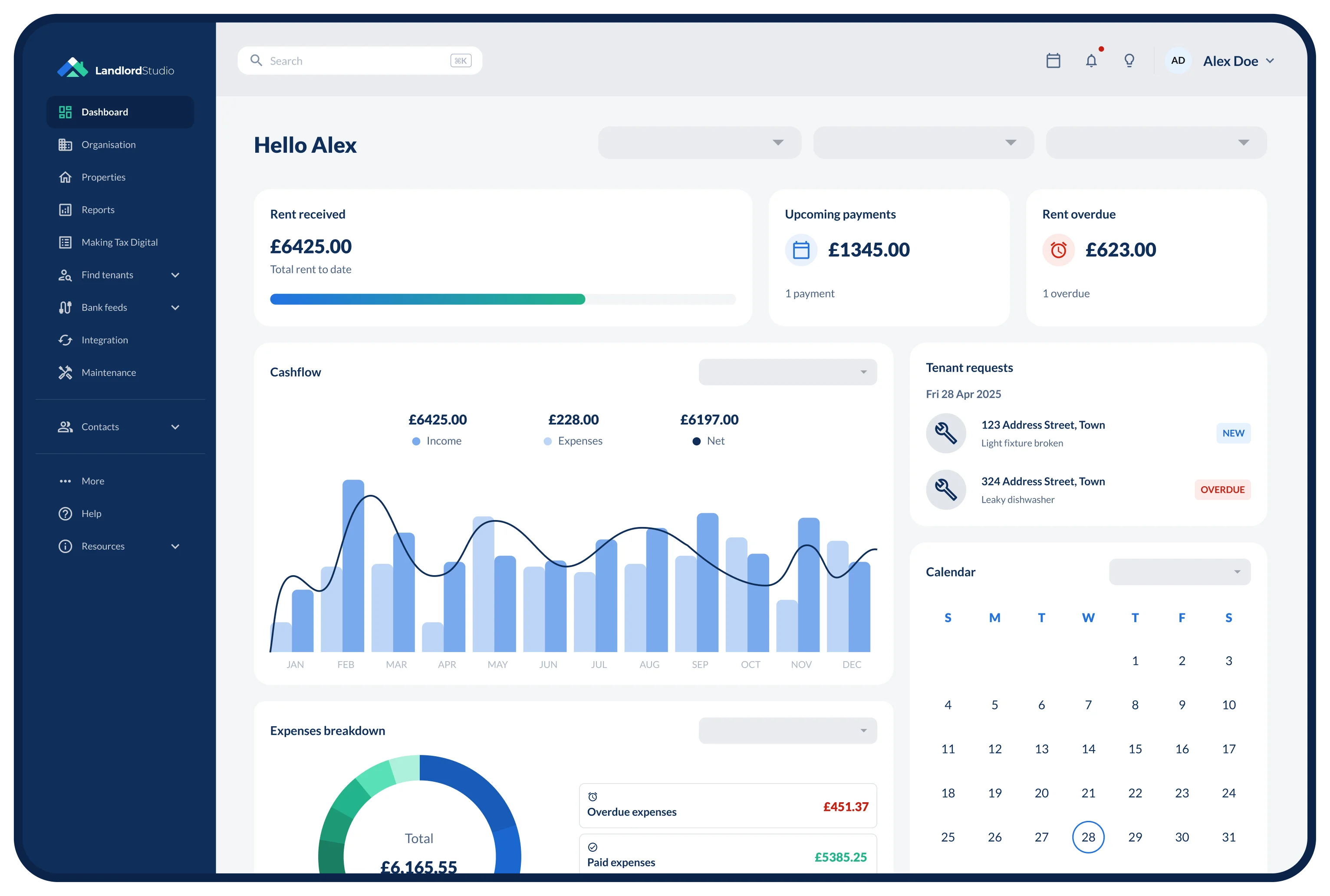
Every stack needs a hub, and for landlords that hub is where the money is tracked. Landlord Studio combines accounting-grade financial tracking with day-to-day property management: bank feeds reconcile your income and expenses automatically, rent is collected online with automatic reminders and late fees, tenants are screened through TransUnion, listings syndicate to major rental sites, and your Schedule E report is ready in a couple of taps at tax time.
Here's the part that shrinks the rest of this list: Landlord Studio already includes a receipt scanner, GPS mileage tracking, e-signatures for leases, a rent estimate tool, document storage, and tax-ready reporting. Six of the nine categories below are built in. The standalone apps in those sections are for landlords who want a single-purpose tool or already have a workflow they love; everyone else can cover the job from one place, with every record ending up in the same set of books.
Best for: The core of your stack, and most of the rest of it. Free plan available to start.
2. Dedicated Phone Line App
Top rated: Google Voice and OpenPhone
Giving tenants your personal cell number is a decision most landlords regret by year two. A second-line app gives you a free or low-cost business number that rings on your existing phone, with voicemail transcription, custom hours, and the ability to silence it when you're off the clock. Google Voice is the free standard; OpenPhone adds shared numbers and better organization if you manage with a partner or team. Either way, you get a clean written record of tenant communication, which matters if a dispute ever reaches court.
Best for: Separating landlord life from personal life, and keeping a paper trail of calls and texts.
3. E-Signature App
Top rated: DocuSign and Dropbox Sign
Chasing wet signatures adds days to every lease signing and renewal. An e-signature app gets a lease signed from a tenant's phone in minutes, with a tamper-evident audit trail that is legally recognized for residential leases in most states. Landlord Studio includes e-signatures, so your lease is signed and stored against the tenancy in the same place your rent and expenses live. DocuSign and Dropbox Sign are the general-purpose standards if you need signatures on documents beyond your rental business. We've covered the legal position in our guide to whether digital signatures are legal for leases, and compared the options in our roundup of the best eSign tools for landlords.
Best for: Fast, legally robust lease signing without printing a page.
4. Receipt Scanner App
Top rated: Adobe Scan and Genius Scan
Every paper receipt is a deduction waiting to be lost. Landlord Studio's built-in scanner digitizes a receipt with your phone camera and attaches it to the matching expense, which means the proof and the transaction live together when your accountant or the IRS asks. For paperwork that isn't a property expense, closing documents or warranty booklets, a general scanner like Adobe Scan or Genius Scan turns anything into a clean, searchable PDF.
Best for: Making sure the proof of every deduction is attached to the expense it supports.
5. Mileage Tracking App
Top rated: MileIQ, and Everlance
Mileage is one of the most under-claimed landlord deductions because nobody remembers to log the trips. Landlord Studio's GPS mileage tracker logs property visits automatically and files them straight into your tax records against the right property. Standalone trackers like MileIQ and Everlance make sense if you want one log spanning multiple businesses. See our comparison of the best free mileage tracker apps for landlords.
Best for: Capturing a deduction most landlords leave on the table.
6. Rent Estimate App
Top rated: Rental Increase Calculator, Rentometer, and RentCast
Set the rent too high and you pay for it in vacancy; too low and you pay for it every month. Landlord Studio's rent estimate tool benchmarks your unit against local market data before you list or renew, and because it sits next to your income records you can see exactly what a proposed increase does to the property's numbers. Rentometer is a quick free-standing sanity check and RentCast offers deeper comp data if you want a second opinion. We've broken down how Rentometer works and how reliable it is.
Best for: Pricing with evidence instead of instinct before you list or renew.
7. Contractor Finding App
Top rated: Thumbtack, Angi, and TaskRabbit
When the water heater dies, the job isn't managing the ticket, it's finding someone competent to fix it today. Thumbtack and Angi surface local, reviewed contractors with upfront quotes, while TaskRabbit covers smaller same-day jobs. All three are especially valuable for out-of-state landlords with no local network. Log the resulting invoice and the repair history against the property in Landlord Studio so the next owner, lender, or tax return has the full picture.
Best for: Sourcing vetted contractors fast, especially in markets where you don't live.
8. Tax Software
Top rated: TurboTax and H&R Block
Tax season is really two jobs. The first is having twelve months of categorized income, expenses, receipts, and mileage in one place, which is what Landlord Studio's Schedule E reporting does: your rental figures arrive at filing time already organized by IRS category. The second is submitting the return, where TurboTax and H&R Block walk self-filers through the rest. The filing software is only as good as the records you feed it, which is why the first job matters more. We've covered whether landlords should use TurboTax, and when a CPA makes more sense.
Best for: Turning a year of records into a filed return without a March panic.
9. Cloud Storage App
Top rated: Google Drive and Dropbox
Insurance policies, HOA correspondence, renovation photos, warranty documents: every rental generates paperwork. Landlord Studio's document storage keeps leases, inspection reports, and property documents attached to the property record they belong to, so nothing lives only on one laptop. A free cloud drive with a folder per property works as the catch-all archive behind it for everything that isn't property paperwork.
Best for: Keeping every document findable, and attached to the property it belongs to.
Building Your Stack
Start with the hub. Landlord Studio covers six of these nine categories out of the box: the money, the receipts, the mileage, the signatures, the rent estimates, and the documents. That leaves exactly three gaps for most self-managing landlords: a dedicated phone line, a way to find contractors, and filing software at tax time.
The test for any new app is simple: does it feed your records, or fragment them? Tools that end with clean data in your accounting system earn their place. Tools that create another silo of screenshots usually don't.
Create your free Landlord Studio account today and start with the six jobs already covered.
FAQs
What is the best app for landlords?
Landlord Studio covers the widest set of landlord jobs in one app: accounting, rent collection, screening, e-signatures, receipt scanning, mileage tracking, rent estimates, and document storage. Around it, a dedicated phone line app and a contractor finding app fill the main gaps.
Are landlord apps free?
Many of the tools in this stack are free, including Google Voice, Adobe Scan, and Google Drive. Landlord Studio's free plan covers core income and expense tracking, with paid plans unlocking bank feeds and larger portfolios.
How many apps do landlords actually need?
Fewer than most end up with. One central platform covering money, tenants, signatures, and documents, plus a phone line app and filing software at tax time, covers the vast majority of a self-managing landlord's workload.