






Read summarized version with:

ChatGPT

Gemini

Claude

Grok

Add as preferred on Google
In the US, rent is usually due on the 1st of the month. In our data, 8 in 10 US monthly leases set rent due on the 1st, and nearly 9 in 10 online rent payments are for rent due on the 1st.
But is the 1st the best due date?
We looked at more than 125,000 online rent payments made through Landlord Studio to find out.
- The 1st is the norm: 81% of leases have rent due on the 1st, far ahead of the 5th and the 15th.
- Later due dates look better on paper: tenants who paid manually, rather than by autopay, were on time 72% of the time when rent was due on the 2nd to 5th, against 55% when it was due on the 1st.
- The money doesn't arrive sooner: tenants pay close to whatever date you set, so a later due date mostly turns late payments into on-time ones.
- Friday due dates land fastest: when the 1st fell on a Friday, rent reached the landlord by the due date almost twice as often as when it fell on a Sunday or Monday.
When is rent usually due?
Rent is usually due on the 1st. No other day comes close.
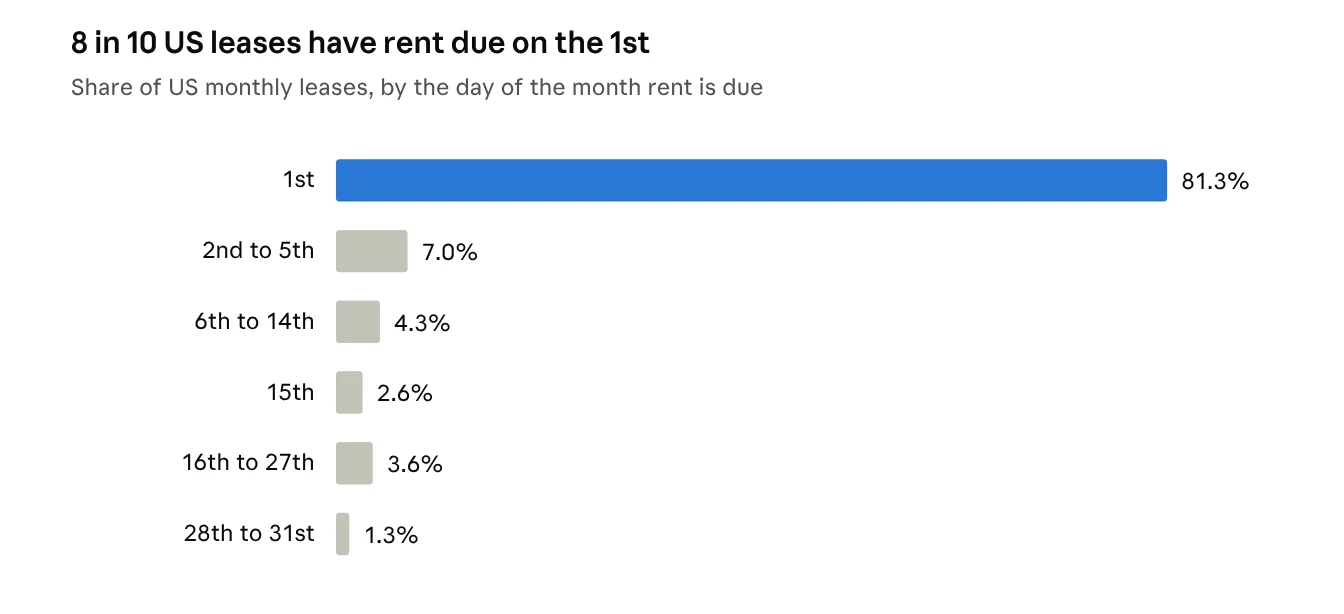
- The 5th: the most common due date after the 1st, on 3.9% of leases.
- The 15th: 2.6% of leases.
- The 3rd: 1.8% of leases.
- Every other day: 1.1% of leases or fewer each.
Many landlords put rent on the 1st even when the lease starts mid-month. Almost a quarter of leases with rent due on the 1st started on a different day.
When a lease starts mid-month, landlords can charge prorated rent from the move-in date through the end of that month, then collect the full monthly rent on the 1st from then on.
Landlords who collect rent online lean even harder on the 1st: 85% of those leases have rent due that day, and 88% of online payments are for rent due on the 1st.
Is rent paid on time more often with a different due date?
Yes, on paper. Tenants who pay by hand (manual payments) are on time far more often when rent is due a few days after the 1st.
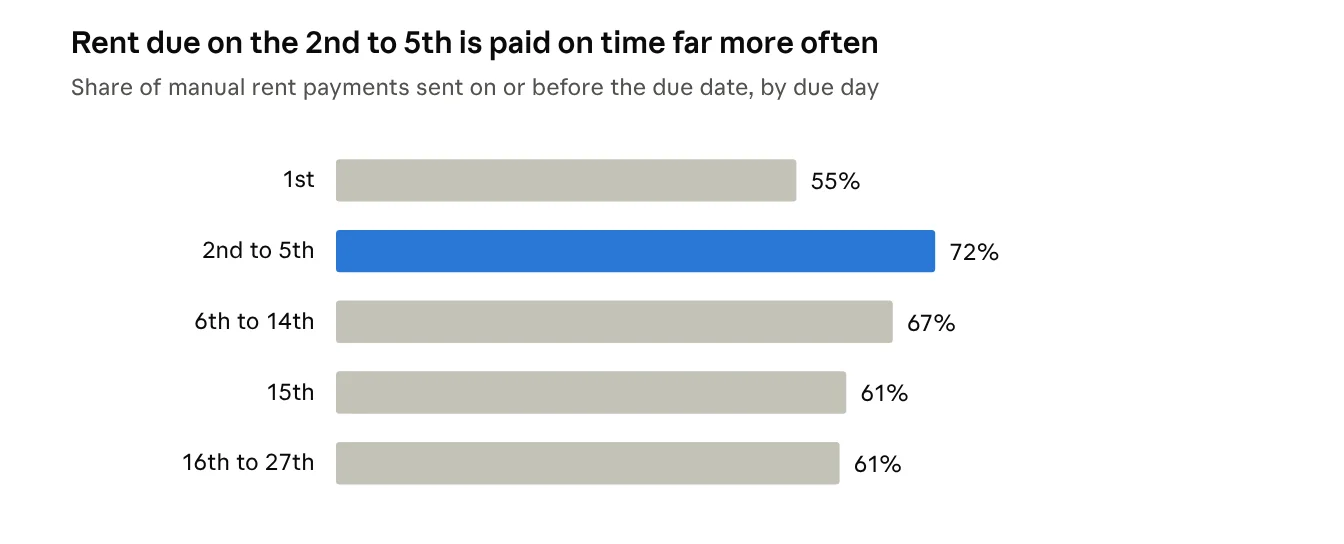
- Due on the 1st: 55% of manual payments were sent on time.
- Due on the 2nd to 5th: 72% were on time, 17 points higher.
- Due later in the month: 61% to 67% were on time, still ahead of the 1st.
Autopay narrows the gap.
Every autopay payment in our data was scheduled on or before the due date, whatever the date. Counting autopay too, 80% of payments due on the 2nd to 5th were on time, against 68% for the 1st.
On-time rates also vary by state, as our state-by-state rent data shows.
Is it just different landlords or different tenants?
Not as far as we can see. We checked three things:
- Same landlords: landlords with some leases due on the 1st and others due on the 2nd to 5th saw the same gap, 53% against 72% on time.
- Same rent levels: higher rents are paid on time slightly more often, but even after adjusting for rent, no due date's result moved by more than 2 points.
- Tenants aren't better off: payments due on other dates bounced for insufficient funds more often (5% to 6.5% of manual attempts, against 4% for the 1st).
So a later due date doesn't come with tenants who simply have more money. Something else is going on.
Do tenants pay sooner with a later due date?

No. Tenants pay close to whatever date the lease sets, so moving the due date later mostly changes which payments count as on time.
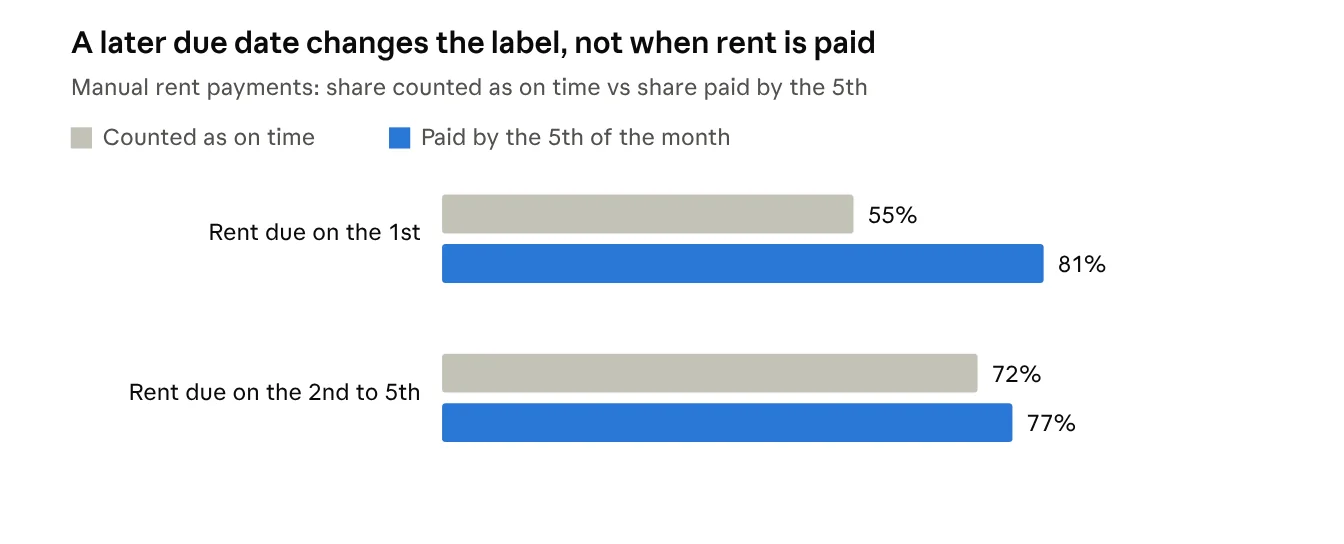
- Due on the 1st: only 55% of manual payments were on time, but 81% had been sent by the 5th.
- Due on the 2nd to 5th: 72% were on time, but fewer, 77%, had been sent by the 5th.
In other words, tenants with rent due on the 1st sent it slightly earlier overall. They just missed the exact date more often.
When tenants actually pay
Tenants cluster around the due date, wherever it sits in the month.
Manual payments, by the day of the month the tenant sent rent.
For rent due on the 1st, the 2nd and 3rd are busy days: 18% of manual payments were sent then, a day or two after the due date.
What this means for your due date
- Due on the 5th is close to due on the 1st with a grace period: your on-time rate looks better, but the money comes in at about the same time.
- Pick the date you actually need the money: then build any grace period around it.
- Know when rent counts as late: usually the day after the due date, unless the lease or state law gives a grace period, as our late fees and grace periods guide explains.
- Judge tenants against the lease: rent paid on the 3rd is late under a 1st-of-the-month lease, even if a grace period means no fee yet.
Does the day of the week matter?

Yes, for when the money lands in your account, though not for when tenants send it.
When the 1st fell on a Friday, 12% of rent reached the landlord's account by the due date, almost twice the rate when it fell on a Sunday or Monday. That's still only about 1 in 8 payments.
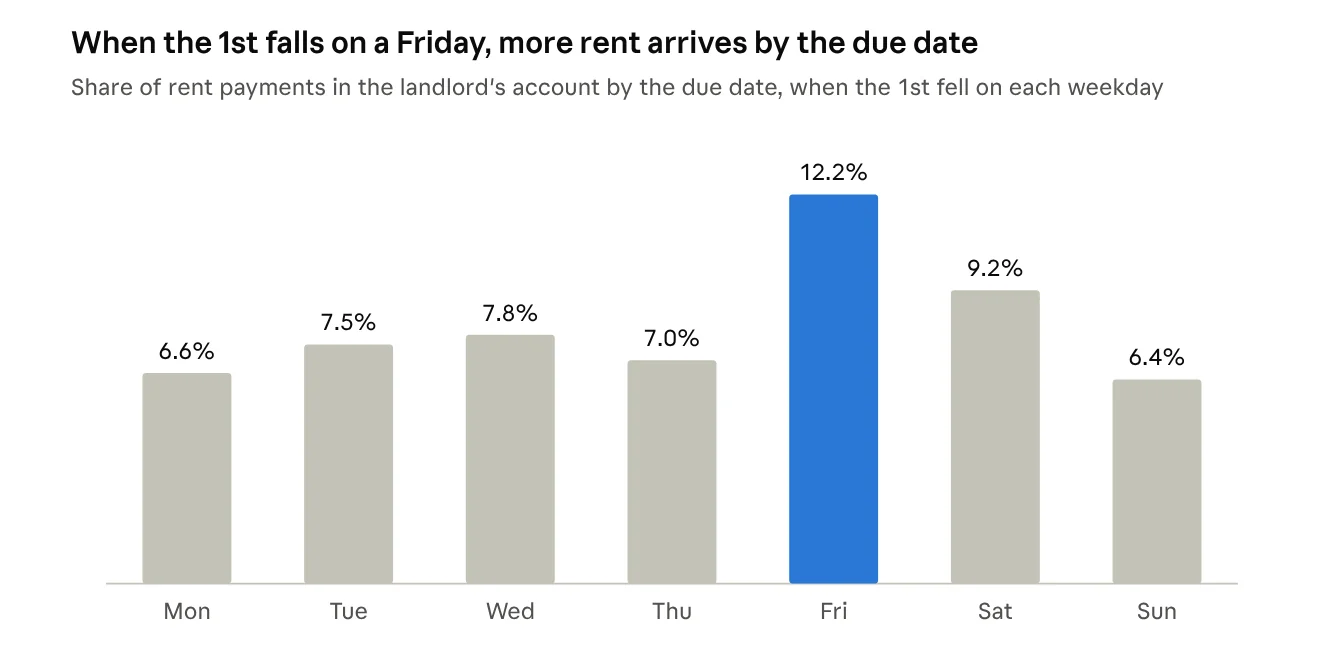
- Friday and Saturday do best: the business days before the due date give an online bank (ACH) payment time to clear.
- Sunday and Monday do worst: the weekend falls inside the processing window, so payments sent a day or two early still arrive late.
- Tenants send on time at the same rate: 66% to 70% of payments were sent on time whichever weekday the 1st fell on.
Online bank (ACH) payments through Landlord Studio typically take 3 to 5 business days to reach the landlord, and weekends don't count. Our guide on how long ACH takes for rent explains why.
You can't pick the weekday of a monthly due date; it moves every month. But it explains why some months feel slower, and it's a reason to ask tenants on autopay to schedule rent a few days early.
How do you choose or change a rent due date?
Start from when you need the money, then work backwards. These steps keep it simple:
- Work back from your own bills: if your mortgage leaves your account on the 5th, rent needs to land before then.
- Allow processing time: online bank payments typically take 3 to 5 business days to reach you, longer over a weekend or federal holiday.
- Ask when your tenant is paid: being paid every two weeks is the most common US pay schedule, used by 43% of private businesses in February 2023, so paydays drift through the month.
- Put it in the lease: the due date, any grace period, the late fee and how to pay. Check your state's rules first, as some set minimum grace periods or cap late fees.
- Change it in writing: agree any change with your tenant in writing, usually as a lease amendment, after checking your state's rules.
Matching rent to payday is one of our ways to reduce late rent payments. Rules on due dates, grace periods and late fees vary by state, so check your state's landlord-tenant laws before you change anything.
Which due date works best for your rentals?
The 1st is the standard for a reason: tenants expect it, and most of them pay within a few days of it. A later date makes your on-time rate look better but won't bring the money in sooner. If timing matters, autopay scheduled a few days early is more likely to help than moving the due date.
Landlord Studio's online rent collection lets tenants pay by bank transfer or set up autopay, and shows you where every payment is. You can get started free.
Methodology
This analysis uses more than 125,000 US residential rent payments made by ACH bank transfer or card through Landlord Studio's online rent collection, on leases with monthly rent.
- Due date: the date rent was due under the lease. Due-day groups use the day of the month set on the lease.
- Sent on time: the tenant or autopay scheduled the payment on or before the due date.
- Arrived: the transfer to the landlord's bank account had completed.
- Manual payments: payments the tenant made themselves rather than through autopay.
- Bounced payments: attempts that failed for insufficient funds.
- Excluded: due dates from the 28th to the 31st, because there were too few payments.
Data is anonymized and aggregated. Figures show patterns, not cause and effect. This article covers US rentals. It is general information, not legal advice, and rules on rent due dates, grace periods and late fees vary by state.