Welcome! Where would you like to log in?

Sign up and get
PRO free for 14 days
Once your PRO trial is over you can continue using Landlord Studio GO completely free.
By continuing you agree to our Terms & Conditions.

Visiting from the
United Kingdom?
Please visit our United Kingdom site for a better experience
Continue
Qualified Business Income Deduction for Real Estate
Learn how rental property owners can use the QBI deduction to cut taxes, about the 250-hour rule, and maximize real estate tax savings with Landlord Studio.
.jpg)
Read summarized version with:


The qualified business income (QBI) deduction represents one of the most valuable tax benefits available to rental property owners, potentially reducing your tax bill by up to 20% of your rental income.
Originally introduced under the Tax Cuts and Jobs Act of 2017 and made permanent through the One Big Beautiful Bill Act in July 2025, this deduction offers substantial savings (if your rental activity meets the specific IRS requirements).
For landlords managing residential or commercial properties, understanding how to qualify for and maximize the QBI deduction can result in significant tax savings.
What Is Qualified Business Income (QBI)?
Qualified business income (QBI) is the net taxable income generated from a qualified trade or business. For real estate investors, QBI includes rental income minus allowable real estate deductions such as property taxes, insurance, maintenance expenses, depreciation, and other operating costs.
The QBI deduction (also known as the Section 199A deduction or the 20% pass-through deduction) allows eligible taxpayers to deduct up to 20% of their qualified business income from their taxable income.
This deduction is available regardless of whether you itemize deductions or take the standard deduction.
What Income Qualifies as QBI?
For rental property owners, QBI includes:
- Net rental income from residential or commercial properties
- Income from partnerships, S corporations, or LLCs taxed as pass-through entities
- Sole proprietorship income from rental activities
What Income Does NOT Qualify as QBI?
The IRS specifically excludes several types of income from QBI calculations:
- W-2 wages from an employer
- Reasonable compensation from an S corporation
- Guaranteed payments to partners in a partnership
- Capital gains and losses from property sales
- Most dividend and interest income not allocable to the business
- Income earned outside the United States
- Income from C corporations
This means if you're a real estate professional receiving W-2 wages from a property management company, those wages don't qualify.
However, your share of rental income from properties that you personally own do qualify, assuming other requirements are met.
Does My Rental Property Qualify for the QBI Deduction?
The most critical question for landlords: does rental real estate qualify as a "trade or business" for QBI purposes? The answer isn't always straightforward.
The Safe Harbor Rule for Rental Real Estate
In 2019, the IRS issued Notice 2019-07, establishing a "safe harbor" that clarifies when rental activities qualify. To meet the safe harbor requirements, your rental real estate enterprise must satisfy these conditions:
1. Maintain Separate Books and Records
Each rental real estate enterprise must have detailed documentation showing income and expenses. Modern property management software makes this requirement manageable, allowing you to automatically track transactions at both the property and portfolio level.
2. Meet the 250-Hour Requirement
This is often the biggest hurdle for landlords. You must document at least 250 hours per year of "rental services" for each rental real estate enterprise. Qualifying rental services include:
- Advertising properties for rent
- Screening and selecting tenants
- Negotiating and executing leases
- Collecting rent payments
- Managing day-to-day operations
- Performing or supervising repairs and maintenance
- Purchasing materials and supplies
- Supervising employees or independent contractors
Important: The 250-hour requirement has different rules based on how long you've owned the property:
- Properties owned less than 4 years: Must meet 250 hours annually
- Properties owned 4+ years: Must meet 250 hours in at least 3 of the past 5 years
Activities that DON'T count toward the 250-hour requirement:
- Travel time to and from properties
- Financial planning or investment management
- Arranging financing or studying financial statements
- Planning or managing long-term capital improvements
3. Maintain Contemporaneous Records
You must keep time logs, reports, or similar documentation showing the hours spent, services performed, dates, and who performed the services. This documentation requirement is non-negotiable.
4. Attach an Annual Statement
When filing your tax return, you must attach a statement confirming your reliance on the safe harbor, listing all properties with addresses and rental categories (residential or commercial), and detailing any properties acquired or disposed of during the year.
Related: 3 IRS Safe Harbors Landlords Need to Know About
Grouping Properties as a Single Enterprise
The safe harbor allows flexibility in how you structure your rental real estate enterprise. You can either:
- Treat each property as a separate enterprise, or
- Combine similar properties into a single enterprise
However, residential and commercial properties cannot be combined in the same enterprise. If you own both a residential duplex and a commercial office building, they must be treated as separate enterprises.
For landlords with multiple properties, grouping can be advantageous. Instead of tracking 250 hours per property, you track 250 hours for the entire group of similar properties.
How to Calculate Qualified Business Income
Calculating your QBI involves several steps, and the complexity increases with your income level.
Step 1: Determine Your Net Rental Income
Start by calculating your gross rental income and subtracting ordinary and necessary business expenses:
Gross Rental Income:
- Monthly rent payments
- Pet rent and fees
- Late payment fees
- Tenant-paid expenses normally paid by the landlord
Minus Deductible Expenses:
- Property taxes
- Insurance premiums
- Property management fees
- Repairs and maintenance
- Utilities (if landlord-paid)
- Advertising costs
- Legal and professional fees
- Depreciation
- Mortgage interest (but not principal payments)
The resulting figure is your net rental income, your potential QBI before applying any limitations.
Step 2: Apply Income Threshold Tests
Your eligibility for the full QBI deduction depends on your total taxable income:
2025 Income Thresholds:
- Single filers: $197,300
- Married filing jointly: $394,600
2026 Thresholds (adjusted for inflation):
- Single filers: Will be inflation-adjusted
- Married filing jointly: Will be inflation-adjusted
If your taxable income is below these thresholds:
You generally qualify for the full 20% QBI deduction, subject only to the overall limitation that your deduction cannot exceed 20% of your taxable income minus net capital gains.
Example: Sarah, a single filer, has $120,000 in total taxable income, including $50,000 in QBI from her rental properties. Her QBI deduction is $10,000 (20% × $50,000), reducing her taxable income to $110,000.
If your taxable income exceeds these thresholds:
Additional limitations apply based on W-2 wages paid and the unadjusted basis immediately after acquisition (UBIA) of qualified property.
Step 3: Apply W-2 Wage and UBIA Limitations (High-Income Taxpayers)
For taxpayers above the income thresholds, the QBI deduction is limited to the greater of:
- 50% of W-2 wages paid by the business, or
- 25% of W-2 wages plus 2.5% of the UBIA of qualified property
This limitation is phased in over a range:
2025 Phase-In Ranges:
- Single filers: $197,300 to $247,300
- Joint filers: $394,600 to $494,600
2026 Phase-In Ranges:
- Single filers: $197,300 to $272,300 (increased by $75,000)
- Joint filers: $394,600 to $544,600 (increased by $150,000)
For rental property owners, this creates challenges:
Most landlords don't pay W-2 wages (they're often solo operators or use independent contractors). However, the UBIA component can help. UBIA is essentially the original cost basis of depreciable property, which for real estate typically includes:
- Building cost (not land)
- Capital improvements
- Equipment and appliances
Example: Michael, a married joint filer, has taxable income of $450,000 and $80,000 in rental QBI. His rental properties have a UBIA of $1,200,000. He pays no W-2 wages.
Without the wage limitation, his QBI deduction would be $16,000 (20% × $80,000). However, his deduction is limited to 2.5% of UBIA = $30,000, which is greater than his tentative deduction. Therefore, he can claim the full $16,000.
Step 4: Calculate Your Final Deduction
Your final QBI deduction is the lesser of:
- Your combined QBI amount (20% of QBI, subject to W-2/UBIA limitations), or
- 20% of your taxable income minus net capital gains
This ensures high-income taxpayers don't receive a disproportionate benefit.
.jpg)
Qualified Business Income Deduction Carryforward Rules
If you have negative QBI in a given year (meaning your deductions exceed your income) you receive no QBI deduction for that year. However, the negative amount can be carried forward indefinitely to offset future QBI.
How QBI Loss Carryforwards Work
Key Points About QBI Loss Carryforwards:
- Indefinite carryforward: Losses carry forward until fully used against future positive QBI
- Cannot offset W-2 wages: QBI losses only reduce future QBI, not wages or other income
- Separate tracking required: W-2 wages and UBIA amounts do NOT carry forward
- Business-specific: If a specific business generates the loss, it's tracked separately
Example: David owns two rental properties. In 2025:
- Property A generates QBI of $15,000 (loss)
- Property B generates QBI of $30,000
His net QBI is $15,000, and his deduction is $3,000 (20% × $15,000).
If Property A had generated $35,000 instead, his overall QBI would be $(5,000). He'd receive no deduction in 2025, and the $5,000 would carry forward to 2026 to reduce that year's QBI before calculating the deduction.
Losses Suspended by Other Provisions
Passive activity losses, at-risk limitations, and other tax provisions may temporarily suspend losses. When these losses are later allowed, the qualified portion is treated as a QBI loss carryforward from a separate business in the year they're released.
Maximizing Your QBI Deduction: Strategies for Rental Property Owners
1. Property Aggregation
If you own multiple properties, aggregate them when beneficial. This simplifies record-keeping (one 250-hour log instead of separate logs per property) and can help high-income taxpayers meet W-2/UBIA limitations.
2. Document Everything
Maintain meticulous records of all rental services performed. Use time-tracking apps, calendars, or dedicated logs showing:
- Date and time spent on each activity
- Description of services performed
- Who performed the services
3. Consider Cost Segregation
Cost segregation studies can identify personal property and land improvements that can be depreciated faster than the building itself. This increases your UBIA, which helps high-income taxpayers meet the 2.5% UBIA component of the W-2/UBIA limitation.
4. Structure Ownership Strategically
Consider holding rental properties in LLCs or S corporations. These structures can provide legal protection while maintaining pass-through taxation and QBI eligibility. Most landlords use single-member LLCs taxed as sole proprietorships because they provide liability protection without complicating tax filings.
5. Avoid Triple Net Lease Arrangements When Possible
Because triple net leases generally do not qualify as a trade or business under Section 162, structuring leases to include landlord-provided services (such as maintenance, landscaping, or tenant support) may help ensure eligibility.
Review your lease language to confirm that you are actively performing meaningful rental services.
6. Reevaluate Portfolio Management Practices Each Year
Tax laws governing the QBI deduction continue to evolve. Income thresholds, inflation adjustments, and IRS guidance may change year over year.
Conduct annual reviews of your rental portfolio, lease structures, and recordkeeping processes to confirm ongoing eligibility and maximize your deduction.
Common Mistakes Landlords Make With the QBI Deduction
Even experienced landlords can inadvertently disqualify themselves or underclaim the deduction. Some of the most frequent mistakes include:
Failing to Maintain Time Logs
Contemporaneous documentation is one of the most common failure points during IRS audits. Without records showing 250 hours of rental services, auditors are likely to deny the deduction, even if you clearly operated your rentals as a business.
Combining Commercial and Residential Properties Incorrectly
Grouping rules are strict. Mixing commercial and residential properties in the same rental enterprise violates IRS safe harbor guidelines and can disqualify an entire aggregated group.
Overlooking UBIA
High-income taxpayers often fail to calculate UBIA correctly, especially when they have made significant capital improvements. Because UBIA includes original cost basis plus improvements, maintaining accurate depreciation schedules and asset logs is essential.
Not Revisiting Lease Terms
Leases structured as triple net arrangements may unintentionally disqualify otherwise eligible properties. Annual lease reviews help ensure that your rental activity rises to the level of a trade or business.
Misclassifying Passive Losses
Suspended passive activity losses, when released, must be handled correctly for QBI purposes. Improperly applying them can distort QBI calculations and impact carryforward amounts.
How Landlord Studio Helps You Qualify for and Maximize the QBI Deduction
The Qualified Business Income (QBI) deduction is one of the most valuable tax benefits available to real estate investors. But to qualify under the IRS safe harbor, landlords must maintain detailed, accurate, and timely records of income, expenses, and operations.
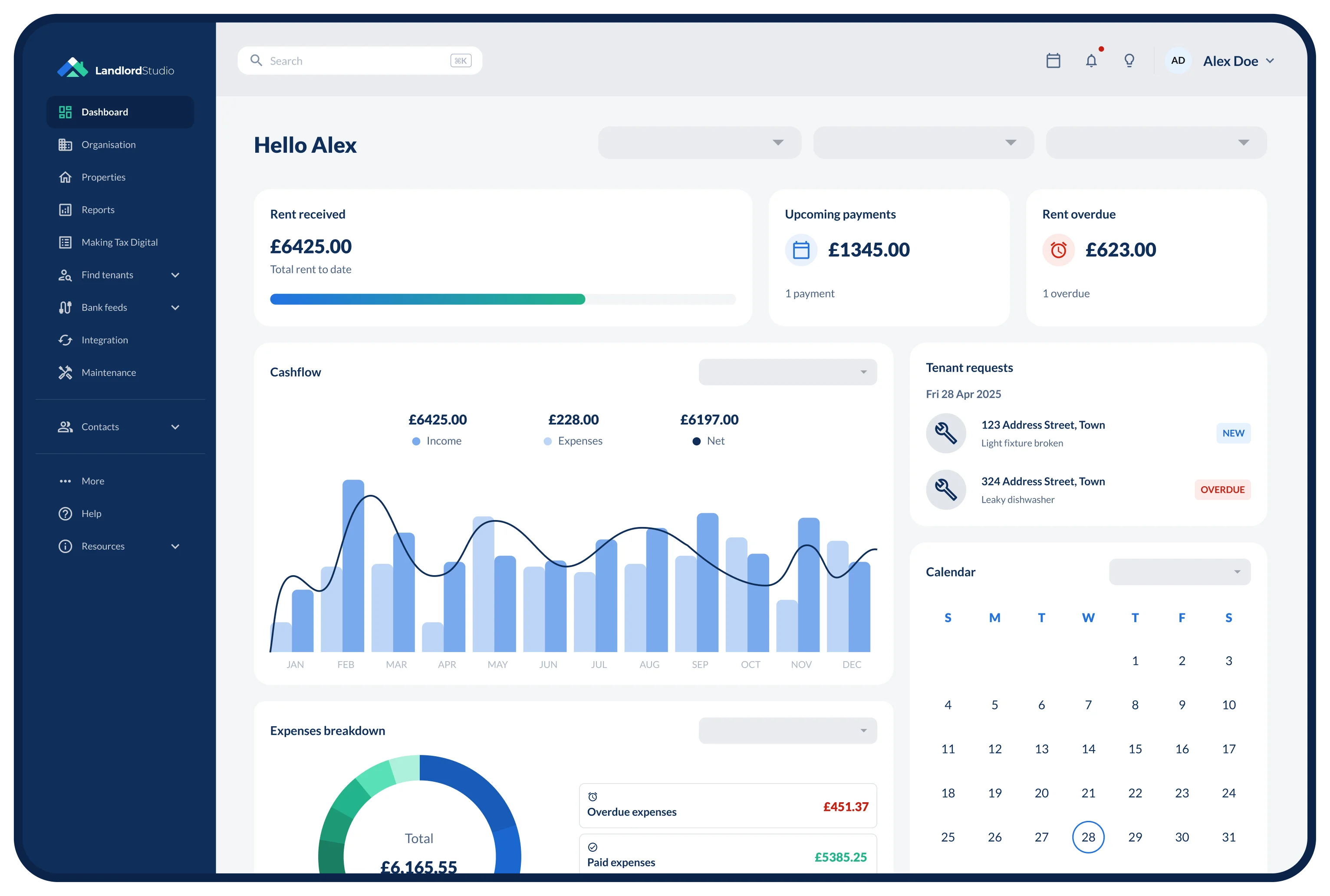
Landlord Studio simplifies this process with automated tools built specifically for landlords, helping you stay compliant, organized, and tax-efficient.
Here’s how it helps:
- Automated Income & Expense Tracking: Sync bank feeds, categorize income and expenses, and attach receipts automatically.
- Activity Logging: Track maintenance and management tasks to meet the 250-hour safe harbor threshold.
- Document Storage: Keep all leases, invoices, and contracts securely in one place.
- Instant Professional Reports: Generate tax summaries and financial statements in seconds for your CPA.
Qualifying for the QBI deduction takes discipline, but with Landlord Studio, it’s simple and stress-free. Automate your recordkeeping, strengthen compliance, and ensure you capture every deduction you deserve.
Create your free Landlord Studio account today.


About Landlord Studio

Landlord Studio is an easy to use property management and accounting software designed for landlords.
Find and screen tenants, collect rent online, track income and expenses, run reports, and more - all for free.
Create your FREE account with Landlord Studio today.

From finding tenants to filing taxes. Reduce vacancies and maximize your portfolio ROI with software designed for you.
Get started for free