




.jpg)
Read summarized version with:

ChatGPT

Gemini

Claude

Grok

Add as preferred on Google
Tax season hits different when you own rental property. Instead of plugging a W-2 into free software and calling it a day, you are staring at Schedule E, trying to figure out what counts as a repair versus an improvement, and wondering if you calculated depreciation right. One wrong number could mean overpaying the IRS by hundreds of dollars, or worse, triggering an audit.
So what is the smarter move for landlord tax filing: doing it yourself with tax software, or handing everything to a CPA? The answer depends on how many properties you own, how complex your deductions are, and how confident you feel navigating IRS forms. This guide breaks down the real costs, the real risks, and the clear criteria for choosing the right path.
What Self-Filing Your Rental Property Taxes Actually Involves
Filing your own rental property taxes is not the same as filing a basic W-2 return. Rental income gets reported on Schedule E (Form 1040), Supplemental Income and Loss, which is the IRS form used to report income and expenses from rental real estate. You will need to report every dollar of rent you collected, then subtract allowable expenses like mortgage interest, property taxes, insurance, repairs, and management fees.
Here are the key IRS forms most landlords will encounter:
- Schedule E (Form 1040) – The core form for reporting rental income and expenses. You can list up to three properties per Schedule E; if you own more, you attach additional copies.
- Form 4562, Depreciation and Amortization – Used to calculate and report depreciation on your rental property. Residential rental buildings are depreciated over 27.5 years using the straight-line method under MACRS.
- Form 8582, Passive Activity Loss Limitations – Required if your rental expenses exceed your rental income and you need to determine how much of that loss you can deduct against other income. The IRS allows landlords who actively participate to deduct up to $25,000 in rental losses against non-passive income, phasing out when modified AGI exceeds $100,000.
- Form 1099 filings – If you paid any individual contractor $600 or more during the year, you are required to issue them a Form 1099-NEC.
Self-filing with tax software like TurboTax Premium or H&R Block Premium typically costs between $70 and $150 for a federal return, plus $37 to $49 per state.
How Much Does a CPA Cost for Rental Property Taxes?
CPA fees for landlords vary widely based on the number of properties, the complexity of your deductions, and where you live. Based on multiple industry surveys for 2025, here is what landlords can expect to pay:
Basic return with 1 rental property: $500 – $800
Complex return (multiple properties, depreciation): $800 – $1,500+
Per additional rental property: $200 – $500 each
Tax software (TurboTax/H&R Block): $70 – $150 total
Several factors push CPA costs higher. Geographic location matters: CPAs in New York, California, and other high-cost-of-living states typically charge at the upper end of these ranges. The timing of your filing also affects pricing, as last-minute filers often pay rush fees.
One important note: CPA fees paid for the rental property portion of your tax return are tax-deductible as a rental business expense on Schedule E. So the effective cost is lower than the sticker price.
When Self-Filing Makes Sense for Landlords
Self-filing your rental property taxes is a reasonable choice if your situation is relatively straightforward. Here are the scenarios where doing it yourself works well:
- You own one to two rental properties with stable, long-term tenants
- Your deductions are standard: mortgage interest, property taxes, insurance, basic repairs, and depreciation
- You did not buy, sell, or exchange any properties during the tax year
- Your properties are all in one state
- You keep organized records of income and expenses throughout the year
- Your modified adjusted gross income is straightforward enough that passive activity loss rules do not create complications
If these describe your situation, tax software like TurboTax Premium can handle Schedule E, depreciation calculations, and passive loss limitations for roughly $100 to $150 total. That is a fraction of what a CPA charges for the same work.
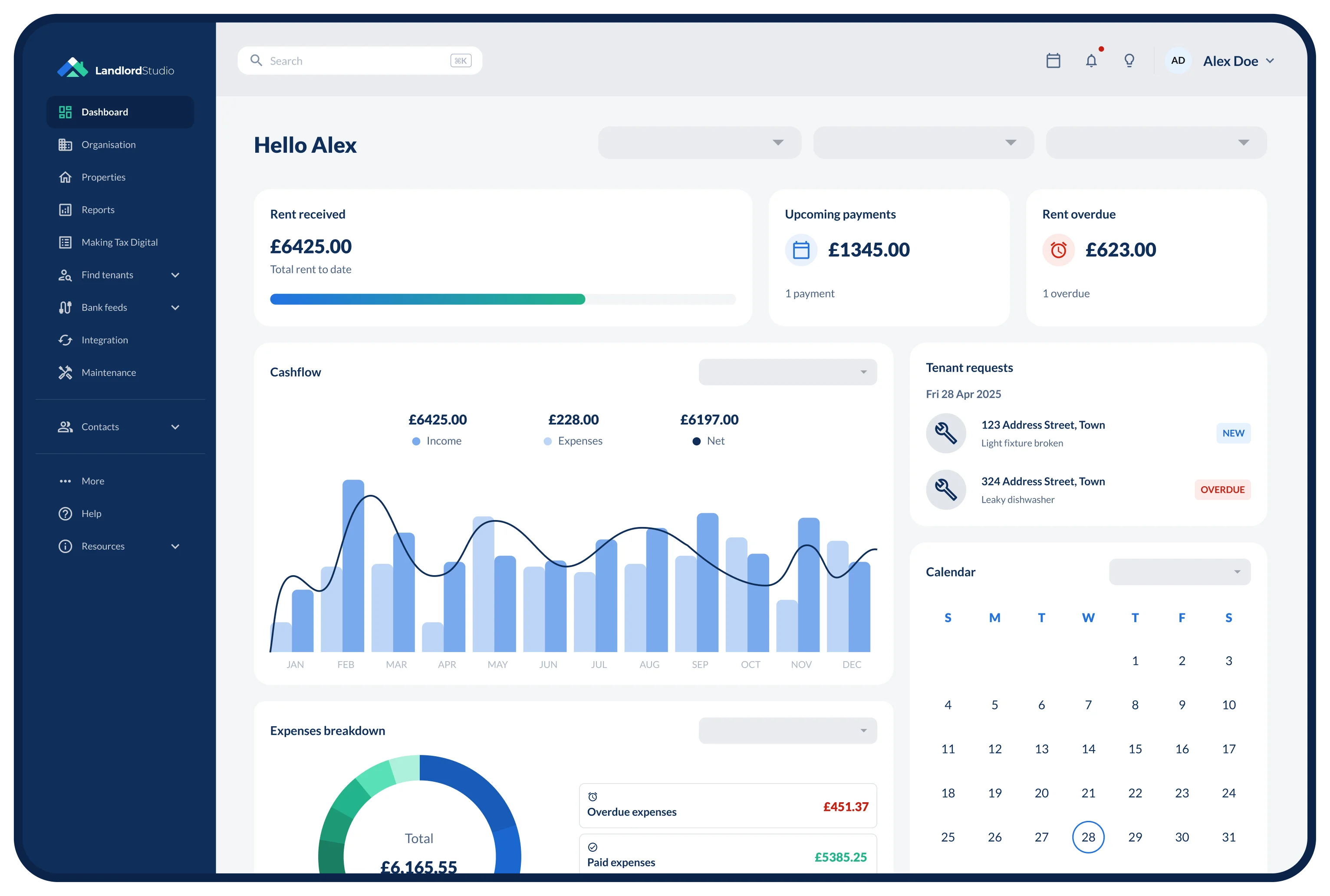
The key requirement for self-filing success is organized records. If you track your rental income and expenses consistently throughout the year, rather than scrambling to reconstruct them in March, tax software becomes a practical and affordable tool. This is where property management software like Landlord Studio pays for itself: it categorizes your income and expenses automatically and generates tax-ready reports that map directly to Schedule E line items, whether you file yourself or hand them to a CPA.
When You Should Hire a CPA for Rental Property Taxes
A CPA becomes worth the investment when your tax situation has layers of complexity that go beyond what software can reliably handle. Hire a CPA if any of the following apply:
You Own Multiple Properties Across States
Each state has its own tax rules for rental income. If you collect rent in more than one state, you may need to file multiple state returns with different allocation rules. A CPA familiar with multi-state filing can prevent costly errors and double-taxation issues.
You Completed a 1031 Exchange
A 1031 like-kind exchange lets you defer capital gains taxes when you sell one investment property and buy another, but the reporting requirements are strict. Incorrect filing can disqualify the exchange entirely and create a large unexpected tax bill.
You Made Major Improvements or Renovations
The IRS draws a clear line between repairs (which you deduct fully in the current year) and improvements (which must be capitalized and depreciated over time). Getting this classification wrong is one of the most common audit triggers for rental property owners. A CPA can help you classify each expenditure correctly and take advantage of strategies like cost segregation studies to accelerate depreciation.
Your Business Structure Is Complex
If your properties are held in LLCs, partnerships, S-corps, or trusts, the tax filing requirements change significantly. Partnerships require Form 1065 and K-1 distribution. S-corps file Form 1120-S. These entity returns have their own deadlines and rules, and getting them wrong can result in penalties.
You Qualify as a Real Estate Professional
The IRS real estate professional status lets you deduct rental losses without the $25,000 passive activity limitation, but the qualification requirements are demanding. You need to spend more than 750 hours per year in real property trades or businesses, and more than half of your total working hours must be in real estate.
Your Income Is Near the Passive Loss Phaseout Threshold
The $25,000 special rental loss allowance begins phasing out when your modified adjusted gross income exceeds $100,000 and disappears entirely at $150,000. If your income is in this range, a CPA can help you plan strategies to maximize the deduction.
Rental Property Tax Deductions Every Landlord Should Know
Whether you self-file or hire a CPA, make sure you are not leaving money on the table. These are the deductions landlords most commonly miss or undercount:
Depreciation
This is the single most powerful tax benefit for rental property owners. The IRS allows you to depreciate the building portion (not the land) of your residential rental property over 27.5 years. For a property with a building value of $275,000, that translates to a $10,000 annual deduction, reducing your taxable rental income even while your property appreciates in market value.
100% Bonus Depreciation (Restored in 2025)
The One Big Beautiful Bill Act permanently restored 100% bonus depreciation for qualifying assets acquired and placed in service after January 19, 2025. While the main building structure must still be depreciated over 27.5 years, components like appliances, carpeting, landscaping, and certain property improvements with recovery periods under 20 years can be written off entirely in the first year.
Mortgage Interest
Interest paid on loans for your rental property is fully deductible on Schedule E, with no cap like the one that applies to personal residence mortgages. This is typically the largest single deduction for leveraged landlords.
Repairs and Maintenance
Painting, fixing leaks, replacing broken appliances, pest control, and general upkeep are all deductible in the year you pay for them. Remember: these must be repairs that maintain the property in its current condition, not improvements that add value or extend its useful life.
Property Taxes and Insurance
Real estate taxes paid on your rental properties are fully deductible as a business expense on Schedule E. The same goes for landlord insurance premiums, flood insurance, and liability coverage.
Travel and Mileage
Driving to your rental properties for inspections, repairs, tenant showings, or maintenance is deductible. For 2025, the IRS standard mileage rate is 70 cents per mile. You can also deduct airfare, lodging, and meals (at 50%) if you travel to manage out-of-state properties.
Professional and Legal Fees
Attorney fees for lease drafting or evictions, CPA fees for tax preparation, property appraisals, and property management fees (typically 8% to 12% of collected rent) are all deductible on Schedule E.
Advertising and Tenant Screening
Listing fees, signage, online advertising, and tenant screening costs are deductible business expenses for your rental activity.
Self-Filing vs. Hiring a CPA: A Side-by-Side Comparison
Cost: Self-filing runs $70 – $150 (federal + state). A CPA costs $500 – $1,500+ depending on complexity.
Best for: Self-filing suits 1–2 properties with standard deductions and organized records. A CPA is better for multiple properties, multi-state filing, 1031 exchanges, and entity structures.
Time investment: Self-filing takes 4–10 hours depending on complexity. Hiring a CPA requires 1–2 hours gathering documents.
Error risk: Moderate with software (catches math errors but not classification mistakes). Low with a CPA (catches classification, strategy, and compliance issues).
Audit support: Limited with software (basic audit guidance only). Strong with a CPA (can represent you before the IRS).
Tax planning: None with software (files what you give it). Proactive with a CPA (advises on strategy to reduce future liability).
Record quality needed: Excellent for self-filing (you must organize and input everything accurately). Good for a CPA (can work with less-than-perfect records, at higher cost).
The Best of Both Worlds: The Hybrid Approach
Many smart landlords use a strategy that combines the cost savings of self-filing with the safety net of professional guidance. Here is how it works:
- Track your finances year-round using property management software that categorizes income and expenses automatically as they happen. Landlord Studio, for example, generates Schedule E-ready reports and organizes receipts so your records are always tax-season ready.
- File straightforward years yourself using tax software when your situation is stable: same properties, same tenants, standard deductions.
- Bring in a CPA for milestone years when you buy or sell a property, complete a 1031 exchange, make major renovations, change your business structure, or cross income thresholds that affect passive loss deductions.
This approach keeps your costs low in routine years while ensuring you have expert guidance when the stakes are highest. Even if you hire a CPA, having clean, organized records from your property management software reduces the time they spend on your return, which directly lowers their fee.
How Landlord Studio Helps With Rental Property Tax Preparation
Whichever route you choose, the biggest variable in your tax filing experience is the quality of your records. Landlord Studio is designed to solve that problem for self-managing landlords.
Throughout the year, it automatically tracks and categorizes rental income and expenses, captures and stores receipt images, and logs mileage for property visits. When tax season arrives, you can generate reports that align with Schedule E line items, giving you (or your CPA) a clear, accurate picture of your rental finances without the shoebox-of-receipts scramble.
Landlords who track expenses consistently convert to paid subscribers at over twice the rate of those who do not engage with financial features, which tells you something about the value of staying organized. Whether you self-file and import your data into tax software or hand a clean summary to your accountant, the time and money you save on preparation often pays for the software many times over.
Ready to simplify your rental property tax prep? Start your free trial of Landlord Studio and get your finances organized before next tax season.
Frequently Asked Questions About Landlord Tax Filing
Can I file my rental property taxes myself without a CPA?
Yes. If you own one to two rental properties with standard deductions and keep organized records, tax software like TurboTax Premium or H&R Block Premium can handle Schedule E, depreciation, and passive loss calculations. The cost is typically $100 to $150 for federal and one state return, compared to $500 to $1,500 for a CPA.
How much does a CPA charge for a rental property tax return?
CPA fees for landlords range from $500 to $1,500 or more, depending on the number of properties, complexity of deductions, and geographic location. Individual rental properties typically add $200 to $500 each in preparation costs.
What tax forms do landlords need to file?
Most landlords file Schedule E (Form 1040) to report rental income and expenses, Form 4562 for depreciation, and potentially Form 8582 for passive activity loss limitations. If you paid any contractor $600 or more, you also need to issue Form 1099-NEC. Properties held in partnerships require Form 1065, and S-corps file Form 1120-S.
What happens if I forget to claim depreciation on my rental property?
The IRS assumes you claimed depreciation whether you actually did or not. When you sell the property, you will owe depreciation recapture tax (at a maximum rate of 25%) on the amount you should have deducted. If you missed depreciation in prior years, you can file Form 3115 to catch up without amending old returns.
Is the cost of hiring a CPA tax-deductible for landlords?
Yes. The portion of your CPA fee related to your rental property tax preparation is deductible as a business expense on Schedule E. If your CPA handles both your personal and rental tax work, you can deduct the portion attributable to the rental activity.
What is the $25,000 passive activity loss allowance for landlords?
If you actively participate in managing your rental property and own at least 10% of it, you can deduct up to $25,000 in rental losses against your regular (non-passive) income. This allowance starts phasing out when your modified adjusted gross income exceeds $100,000 and disappears at $150,000.
When is the tax filing deadline for landlords?
Individual landlords who report rental income on their personal return (Form 1040) follow the standard April 15 deadline. You can file for a six-month extension using Form 4868, which pushes the filing deadline to October 15. Partnerships (Form 1065) have an earlier deadline of March 15. Filing an extension gives you more time to file, but it does not extend the deadline for paying any taxes owed.