




Read summarized version with:

ChatGPT

Gemini

Claude

Grok

Add as preferred on Google
Bonus depreciation lets real estate investors deduct the cost of certain qualifying assets much faster than under normal depreciation schedules.
For rental property owners, the important point is that the building itself usually does not qualify for bonus depreciation. Residential rental buildings are generally depreciated over 27.5 years and nonresidential real property over 39 years. Bonus depreciation instead applies to qualifying property with shorter recovery periods, such as certain appliances, fixtures and land improvements.
Cost segregation can be used to identify those shorter-life components within a property.
Under current federal law, qualifying property acquired and placed in service after January 19, 2025 is generally eligible for 100% bonus depreciation. Different rates can still apply to qualifying property acquired before January 20, 2025.
Tax rules checked September 2026. Bonus depreciation can interact with passive activity loss rules, cost segregation, depreciation recapture and other tax provisions. This guide is educational only; consider reviewing your circumstances with a CPA or other qualified tax professional.
What Is Bonus Depreciation?
Bonus depreciation is an additional first-year depreciation deduction under Section 168(k) of the Internal Revenue Code.
Normally, the cost of a depreciable asset is deducted over its IRS recovery period. Bonus depreciation allows a taxpayer to deduct a percentage of the qualifying asset's adjusted basis in the year the asset is placed in service.
For property qualifying for the current 100% rate, that can mean deducting the full qualifying basis in the first year rather than depreciating it over 5, 7, 15 or 20 years.
This is an acceleration of deductions, not an extra deduction on top of the asset's cost. Claiming more depreciation now generally means less remaining basis to depreciate later.
IRS sources: Publication 946 and IRS Topic No. 704.
What Is the Bonus Depreciation Rate in 2026?
For most qualifying property, the rate depends on when the property was acquired and placed in service.
| Property timing | General bonus depreciation treatment |
|---|---|
| Acquired and placed in service after January 19, 2025 | 100% |
| Placed in service January 1–19, 2025 | 40% under the previous phase-down rules |
| Acquired before January 20, 2025 and placed in service during 2025 | Generally 40% under the previous rules |
| Acquired before January 20, 2025 and placed in service during 2026 | Generally 20% under the previous phase-down rules |
The One Big Beautiful Bill Act made the 100% rate permanent for qualifying property acquired after January 19, 2025. However, it did not simply turn every qualifying asset placed in service after that date into 100% property.
The IRS confirmed in 2026 guidance that qualified property acquired after September 27, 2017 and before January 20, 2025, then placed in service during calendar year 2026, remains under the former phase-down schedule and generally receives a 20% bonus depreciation rate.
Acquisition-date rules can be technical. For example, a written binding contract entered into before January 20, 2025 can affect when property is treated as acquired. If a purchase spans the January 2025 rule change, confirm the applicable rate with your tax professional rather than relying only on the closing or placed-in-service date.
IRS source: Internal Revenue Bulletin 2026-13.
What Rental Property Assets Qualify for Bonus Depreciation?
The entire purchase price of a rental property is not eligible for 100% bonus depreciation.
Under current rules, qualifying property generally includes tangible property depreciated under MACRS with a recovery period of 20 years or less, along with certain other categories of property.
For a typical rental property, potentially qualifying assets can include appropriately classified:
- Appliances.
- Furniture.
- Certain removable floor coverings.
- Certain fixtures and equipment.
- Fencing.
- Parking areas and some other land improvements.
- Other 5-, 7- or 15-year property identified through a cost segregation analysis.
The 27.5-year residential rental building and 39-year nonresidential building themselves do not qualify for bonus depreciation simply because they are rental properties.
Eligible used property can also qualify, subject to acquisition rules including restrictions involving prior use by the taxpayer and related-party transactions.
What About Improvements?
An improvement is not automatically eligible for bonus depreciation just because you spent money improving a rental.
First determine whether the expenditure must be capitalized rather than currently deducted as a repair. If it is capitalized, its tax classification and recovery period determine whether it is qualifying property for bonus depreciation.
For example, some shorter-life components may qualify, while improvements treated as part of a 27.5-year residential building generally will not.
For the broader distinction, see Capital Improvements vs Repairs.
How Cost Segregation and Bonus Depreciation Work Together
A cost segregation study separates qualifying components of a building from the longer-life building structure and assigns the appropriate recovery periods.
A residential rental purchase might otherwise be allocated mainly between:
- Land: not depreciable.
- Building: generally 27.5-year residential rental property.
A cost segregation study may identify portions of the depreciable basis that properly belong in 5-, 7- or 15-year asset classes. If those assets also satisfy the bonus depreciation requirements, their qualifying basis may be eligible for the current 100% first-year deduction.
Cost segregation therefore does not make the whole building eligible for bonus depreciation. It identifies components that may already qualify for shorter recovery periods.
For a deeper discussion of depreciation and cost segregation, watch our CPA interview below.
Worked Example: Bonus Depreciation on a Rental Property
Assume an investor buys a residential rental property for $1,000,000 and allocates $200,000 to land, leaving $800,000 of depreciable basis.
A cost segregation study identifies:
- $80,000 of 5-year property.
- $40,000 of 7-year property.
- $120,000 of 15-year property.
- $560,000 remaining as 27.5-year residential rental building basis.
Assuming the shorter-life assets are eligible for 100% bonus depreciation, the investor could potentially deduct $240,000 of qualifying cost-segregated basis in the first year.
The remaining $560,000 building basis is not bonus-depreciation property. It continues to be depreciated under the residential rental property rules.
Important: The Building Does Not Get a Full Year's Depreciation Automatically
Residential rental property uses the IRS mid-month convention. First-year depreciation therefore depends on the month the property is placed in service.
That means it would be misleading to simply add $560,000 ÷ 27.5 as a full-year building deduction to the $240,000 bonus deduction.
The actual first-year total would be:
$240,000 bonus depreciation on qualifying shorter-life assets + the applicable first-year MACRS depreciation on the remaining building basis.
The regular building deduction should be calculated using the correct mid-month percentage for the month it was placed in service.
Other cost-segregated assets may also be affected by MACRS convention rules if bonus depreciation does not fully deduct them.
IRS source: Publication 527 — Residential Rental Property.
Can You Actually Use the Bonus Depreciation Deduction?
A large depreciation deduction does not necessarily mean an immediate reduction in tax from salary or other non-rental income.
Rental real estate activities are generally passive under the passive activity loss rules unless an exception applies. Passive losses are generally limited to passive income and unused losses may be carried forward.
There are important exceptions and special rules, including:
- A special allowance of up to $25,000 for qualifying taxpayers who actively participate in rental real estate, subject to income phase-outs and other requirements.
- Rental real estate activities in which a qualifying real estate professional materially participates.
- Activities that are not treated as rental activities under the passive-activity rules, including some short-term rental arrangements where the average customer use is 7 days or less.
So before commissioning a cost segregation study mainly to generate a large first-year deduction, it is worth establishing whether you are likely to be able to use the resulting loss now or whether it will be suspended.
For more detail, see Passive Activity and Passive Activity Loss Limitations in Real Estate.
IRS source: Publication 925 — Passive Activity and At-Risk Rules.
Is a Cost Segregation Study Worth It?
There is no universal property-value threshold or guaranteed return that makes cost segregation worthwhile.
The economics depend on factors such as:
- The property's depreciable basis.
- How much basis can legitimately be reclassified.
- Your marginal tax rate.
- Whether you can currently use the resulting loss.
- How long you expect to hold the property.
- The cost and scope of the study.
- The potential tax consequences when the assets are sold.
Providers may quote typical study prices or estimated return multiples, but those figures vary substantially by property and taxpayer. A better approach is to request a preliminary benefit estimate and compare the expected after-tax timing benefit with the cost of the study and future recapture exposure.
For a material deduction, an engineering-based study prepared or reviewed by appropriately qualified professionals can also provide stronger support for the asset classifications used.
What Happens When You Sell Property That Received Bonus Depreciation?
The tax treatment on sale depends on what type of asset received the depreciation.
This is why saying simply that “depreciation recapture is taxed at up to 25%” is incomplete.
Shorter-Life Personal Property: Section 1245
Many assets identified through cost segregation — such as certain equipment, appliances and other personal property — are Section 1245 property.
When Section 1245 property is sold at a gain, the IRS generally treats gain as ordinary income to the extent of depreciation allowed or allowable, limited by the gain on the asset. Bonus depreciation is included in the depreciation taken into account for this purpose.
The Rental Building: Section 1250
The building itself is generally Section 1250 real property.
For typical residential rental property depreciated using straight-line depreciation and held for more than one year, the rules differ from Section 1245. Gain attributable to depreciation can be treated as unrecaptured Section 1250 gain, which is subject to a maximum federal rate of 25% for individuals.
The exact result depends on the assets sold, gain allocated to each asset, depreciation history and transaction structure.
For a fuller explanation, see Rental Property Depreciation and Depreciation Recapture.
IRS source: Publication 544 — Sales and Other Dispositions of Assets.
Can a 1031 Exchange Defer Bonus Depreciation Recapture?
Do not assume a 1031 exchange automatically defers every tax consequence created by a cost segregation study.
Section 1031 now applies to qualifying real property, while cost segregation can identify assets treated as personal property for tax purposes. IRS recapture rules can therefore produce different results for Section 1245 components and Section 1250 real property in an exchange.
If a planned exit depends on a 1031 exchange, model the asset-level consequences with a CPA and qualified exchange professional before the sale.
Related: How a 1031 Exchange Works.
What If You Forgot to Claim Depreciation?
Missed depreciation is not necessarily lost forever.
The IRS says you should claim the correct amount of depreciation each year. Even if you failed to claim all the depreciation you were entitled to, your basis generally still has to be reduced by the amount that was allowed or allowable.
Depending on the circumstances, an incorrect depreciation deduction may be corrected by:
- Filing an amended return where permitted, or
- Changing the accounting method, which may require Form 3115 and a catch-up adjustment.
The correction method depends on how many years the incorrect treatment occurred and the specific facts.
This is important because simply ignoring depreciation can leave you with a lower basis later without having received the corresponding deduction.
IRS source: Publication 527 — Claiming the Correct Amount of Depreciation.
Bonus Depreciation vs Section 179
Bonus depreciation and Section 179 can both accelerate deductions, but they are separate provisions with different eligibility rules, elections and limitations.
For rental real estate investors, the practical differences include:
| Feature | Bonus depreciation | Section 179 |
|---|---|---|
| How it applies | Generally automatic for qualifying property unless you elect out | Taxpayer elects to expense qualifying property |
| Income limitation | Can contribute to a tax loss, subject to other loss-limitation rules | Generally limited by taxable income from active trades or businesses |
| Dollar cap | No general annual dollar cap on the bonus deduction itself | Annual deduction and investment phase-out limits apply |
| Rental use | Can apply to qualifying rental assets | Eligibility can depend on whether the activity meets Section 179's trade-or-business requirements |
This article focuses on bonus depreciation. For the broader accelerated-depreciation options available to landlords, see Accelerated Depreciation for Landlords.
Do Repairs Qualify for Bonus Depreciation?
Usually, this is the wrong question.
A repair that is currently deductible as an ordinary rental expense is generally deducted under the repair rules rather than capitalized and depreciated. Bonus depreciation is relevant to expenditures that are capitalized as depreciable property and then meet the qualifying-property requirements.
So the process is:
- Determine whether the expenditure is a repair or a capital improvement.
- If it is capitalized, determine the asset's correct tax classification and recovery period.
- Then determine whether that property qualifies for bonus depreciation.
A Brief Note on Qualified Production Property
The 2025 tax law also created a separate 100% depreciation provision for certain qualified production property used in qualifying manufacturing, production and refining activities.
That provision is important for some industrial real estate, but it is not the main bonus-depreciation rule for ordinary residential rental investors, so it is outside the scope of this guide.
Recordkeeping for Bonus Depreciation
Bonus depreciation and cost segregation make asset-level records more important, not less.
Keep documentation showing:
- Purchase and closing documents.
- How purchase price was allocated between land and building.
- Cost segregation reports and supporting schedules.
- Dates assets were acquired and placed in service.
- Improvement invoices and contracts.
- Asset classifications and recovery periods.
- Depreciation claimed each year.
- Disposals, replacements and sales.
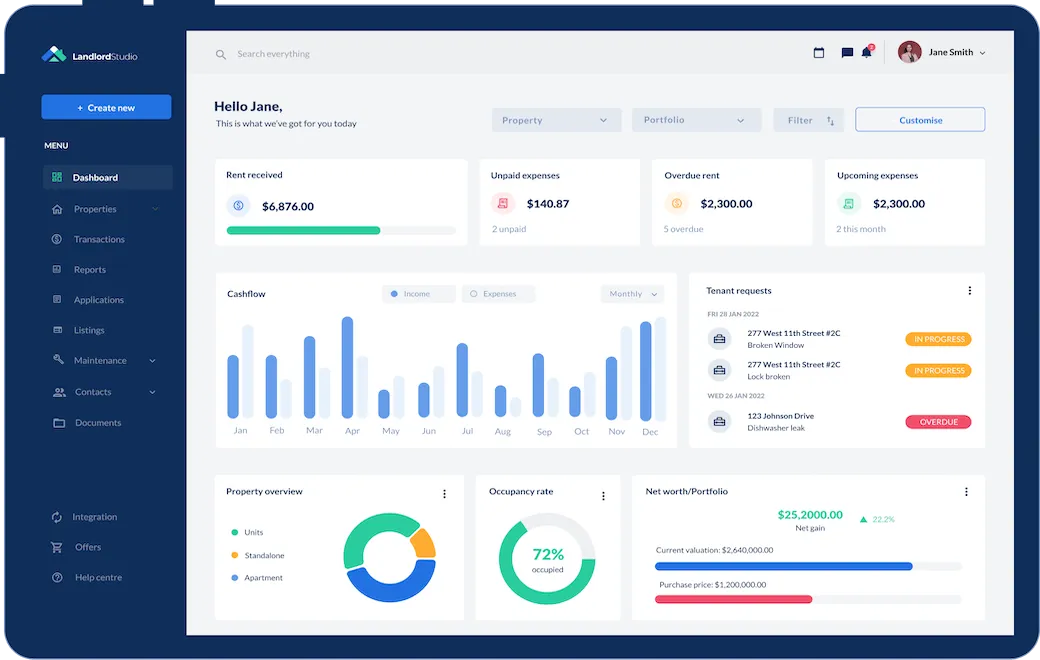
Landlord Studio can help keep rental income, expenses, receipts and property documents organized so you can provide cleaner records to your accountant. Your tax preparer or depreciation schedule should separately maintain the tax basis, asset classifications and depreciation calculations required for the return.
Frequently Asked Questions
Is bonus depreciation still 100% in 2026?
For qualifying property acquired and placed in service after January 19, 2025, the current federal bonus depreciation rate is generally 100%. Qualifying property acquired before January 20, 2025 can remain subject to the old phase-down schedule; property in that group placed in service during 2026 generally has a 20% rate.
Can you take 100% bonus depreciation on a rental property?
Not on the entire rental building. The building itself is generally 27.5-year residential rental property or 39-year nonresidential real property and does not qualify under the 20-years-or-less rule. Certain shorter-life assets and land improvements can qualify, which is why cost segregation is often discussed alongside bonus depreciation.
Does used property qualify for bonus depreciation?
Certain used property can qualify. The rules include limitations involving prior use by the taxpayer and acquisitions from related parties, so eligibility should be checked for the particular transaction.
Do you need a cost segregation study to claim bonus depreciation?
Not in every case. A separately purchased qualifying asset may already have a clear recovery period. Cost segregation becomes particularly relevant when trying to identify shorter-life qualifying components within a building acquisition or major project.
Can bonus depreciation create a rental property tax loss?
Bonus depreciation can create or increase a tax loss, but whether that loss is currently deductible depends on other tax rules, including basis, at-risk, passive activity and excess business loss limitations where applicable.
Can you opt out of bonus depreciation?
Yes. Taxpayers can elect out of bonus depreciation for a class of qualifying property. There are also special election rules for certain property under the 2025 legislation. Because the election applies by property class and can affect future deductions, discuss the choice with a tax professional.
What happens to bonus depreciation when you sell?
The sale can trigger depreciation-related gain rules. Many shorter-life cost-segregated assets are Section 1245 property, for which gain can be ordinary income up to prior depreciation allowed or allowable. The building generally falls under Section 1250 rules. The result should be calculated asset by asset rather than applying one flat “recapture rate” to the whole property.
Bonus depreciation can significantly accelerate deduction
Bonus depreciation can significantly accelerate deductions on qualifying rental-property assets, particularly when cost segregation identifies shorter-life components within a building.
The current 100% rate makes the timing benefit substantial, but the size of the first-year deduction is only one part of the decision. Investors also need to consider whether they can use the resulting loss, what deductions they are giving up in later years, and how different asset classes will be taxed when the property is sold.
For larger or more complex investments, model the full holding-period tax effect with a qualified tax professional rather than judging the strategy only by the first-year deduction.
This article is for general informational and educational purposes only and does not constitute tax, legal or financial advice. Tax rules are complex and individual circumstances vary. Consult a qualified professional about your own situation.