Welcome! Where would you like to log in?

Sign up and get
PRO free for 14 days
Once your PRO trial is over you can continue using Landlord Studio GO completely free.
By continuing you agree to our Terms & Conditions.

Visiting from the
United Kingdom?
Please visit our United Kingdom site for a better experience
Continue
Short-Term Rental Management: Self-Manage or Hire? Costs, Pros and Cons
Short-term rental managers charge 10-40% of gross booking revenue. Compare self-managing vs hiring, with verified 2026 platform and management fees.

Read summarized version with:


Last updated: August 2026. Platform fees, management fee ranges and the licensing examples on this page were verified against primary sources in August 2026.
Short-term rental managers typically charge 10% to 40% of gross booking revenue depending on how much of the work they take on, against 8% to 12% of monthly rent for a long-term rental. Self-managing keeps that margin, but you absorb the work: bookings, cleaning turnovers, guest communication and dynamic pricing, which runs to roughly 5 to 10 hours per week for a single actively managed property. Which way you go depends on how close you live to the property, how many units you own, and whether your city still issues short-term rental licenses.
Page Contents
- Should You Self-Manage or Hire a Short Term Rental Management Company?
- How Much Do Short Term Rental Managers Charge?
- What is Short Term Rental Management?
- What Short Term Rental Rules Apply Where Your Property Is?
- Is Short-Term Rental Property Management Right for You?
- Advantages of Short Term Rentals
- Disadvantages of Short Term Rentals
- 8 Tips for Effective Short Term Rental Management
- Where Should You List a Short Term Rental?
- Using Landlord Studio to manage your short term rental income and expenses
- Frequently Asked Questions
- Short Term Rental Management: Final Thoughts
In this guide we take a look at everything you need to know about short term rental property management, starting with the decision that determines most of your return: whether you run the property yourself or pay somebody else to do it.
Should You Self-Manage or Hire a Short Term Rental Management Company?
Hire a manager if you live away from the property, own several units, or cannot answer a guest message within an hour. Self-manage if you are local, hands-on, and running one to three properties, because the management fee is the single largest controllable cost on a short-term rental and self-managing is the only way to keep it.
Short term rentals in some markets can be incredibly lucrative, and in order to scale your operations you might decide to look at property management companies willing to take on the majority of the work involved. This will free up your time, allowing you to focus on finding new deals and making your income more passive.
However, since short-term vacation rental properties necessarily require greater attention to detail, with small personal touches like welcome communications, fresh flowers or gifts like chocolates and champagne, laundry facilities or services, a well-maintained private space to relax, and local tips and advice, outsourcing the management of these is often expensive. There is no getting around paying for the time it takes to pay that level of attention.
A more cost-effective solution is to self-manage your short term rentals. By utilizing tools like Landlord Studio you can simplify this management, and once you have developed processes and found quality contractors for things like maintenance and cleaning you can streamline day to day operations.
That being said, if you are looking to scale your portfolio, you may find that operating your short term rentals yourself is just not practical, taking up too much of your time.
Whether you choose to self-manage or outsource your short term rental property management depends on your available time, property location (it will be easier if you are closer to the property), and long term investment goals.
How Much Do Short Term Rental Managers Charge?
Short-term rental management fees are quoted as a percentage of gross booking revenue and scale with how much on-site work the manager absorbs. The figures below are taken from Evolve’s guide to vacation rental management fees (updated July 1, 2026), cross-checked against All Property Management’s 2026 fee guide, which puts the overall short-term and vacation rental range at 20% to 40% of rental income.
- Full-service local management, 25% to 35% of gross revenue. On-site coordination, local vendor relationships, in-person property checks and full guest management. Best for remote owners, or anyone who wants zero personal time in the property. Fees can go higher in premium markets.
- Tech-forward hybrid management, 10% to 15% of gross revenue. Listing creation, dynamic pricing, distribution across booking sites and guest communication, but not cleaning, maintenance or local operations. Evolve prices this at 10% on its Core plan and 15% on Plus, with a $250 onboarding fee. Best for owners who can arrange cleaning locally and want the lower fee.
- Co-hosting, typically 10% to 20% of gross revenue. Informal by design, so scope varies widely. A local co-host might handle turnovers and on-site issues on a flat monthly fee, a per-task rate, or a percentage. Best for local owners short on time who still want to own pricing and listing strategy.
- Self-managed with software, software cost only. Evolve estimates 5 to 10 hours per week for an actively managed single property, plus $75 to $300 a month for tooling such as dynamic pricing and channel management. Best for local, hands-on owners with one to three properties.
The headline to take from that: the gap between full-service and hybrid management is roughly 15 to 25 percentage points of gross revenue, and the gap between full-service and self-managing is the whole fee. On $50,000 of annual bookings, moving from 30% full-service management to a 10% hybrid plan is $10,000 a year.
For context, long-term residential management is far cheaper because the workload is lower: All Property Management puts single-family and small multifamily management at 8% to 12% of monthly rent in 2026, with tenant placement charged separately at 50% to 100% of one month’s rent.
Compare offers on net income rather than fee percentage. Evolve makes the point cleanly: a company charging 15% that generates $60,000 in gross revenue leaves you $51,000, while a company charging 25% that generates $50,000 leaves you $37,500. Ask every company for a projected annual income figure based on comparable properties in your market, then subtract the fee and any onboarding, maintenance markup or platform pass-through charges.
Do not forget booking platform fees, which come off the top whichever model you pick. See Where Should You List a Short Term Rental? below for the current Airbnb and Vrbo numbers.
Related: How Much Cash Flow is Good For a Rental Property?
How To Select a Short Term Rental Property Management Company
If you are opting to delegate the management of your short-term rentals to a company or service provider, start by outlining the tasks you need assistance with. Then, before finalizing any agreements, conduct thorough research taking into account the following factors:
- Read The Property Management Reviews: Prioritize reviews of the property management services available. Word-of-mouth recommendations hold significant weight for good reasons. Delve into client reviews across platforms like Yelp, Facebook, or Google Business. You can even request references from the companies that make your shortlist.
- Do A Cost Analysis: Assess the costs associated with rental management services. Construct a comparative spreadsheet to gauge the value various different companies offer and compare against what it would take to do it yourself. Ask for a complete written fee schedule rather than the headline percentage, because maintenance markups, platform fees passed through to the owner, and early-termination penalties are where quotes diverge. This analysis not only aids in cost evaluation but also in understanding how a particular service contributes to maximizing your return on investment.
- Learn How Regularly You Can Expect Reports: A reputable property management team maintains transparency through regular financial and performance reports. Clear breakdowns of management fees, property growth, payouts, occupancy rates, and transaction history should be readily accessible for each property, at the very least on a monthly basis.
- Assess Their Market Expertise: A well-reviewed and experienced management company might still be lacking when it comes to knowledge about a specific local market. Opt for a team well-versed in your location, offering local recommendations to guests, staying current on the licensing rules covered below, and devising effective pricing strategies tailored to your market.
- How Hands On Is Their Customer Support? Efficient and responsive communication is essential for guest satisfaction and glowing reviews. Inquire about the company’s strategy for guest communication and property maintenance response times.
What is a Short Term Rental?
Short-term rentals are most commonly used by people either on vacation or business trips. As such, stays vary from a few nights to several weeks. A short term rental is normally a residential property, unit or accessory dwelling that is rented out to guests for no more than 30 consecutive nights at a time. However, the maximum length can vary depending on the state and jurisdiction in which the rental is located.
Month-to-month leases are generally not considered short-term if there is no specified end date.
Short-term rentals can refer to single-family houses, multi-family properties, or even individual rooms in either of these.
Related: The Short-Term Rental Tax Loophole: What Investors Need To Know
What is Short Term Rental Management?
The term short term rental management refers to overseeing and running short-term rental properties using property management software (like Landlord Studio) or general property management services. The person or company in charge of managing a short term rental property will need to tackle an extensive daily checklist including:
- Supervising the property listings on sites like Airbnb, Vrbo, or others,
- Handling reservations across booking sites,
- Organizing cleaning services,
- Facilitating check-ins and checkouts,
- Managing property upkeep and repairs,
- Communicating with guests before, throughout and sometimes after their stays,
- Handling guest reviews,
- Preparing guest experiences,
- Marketing, and various other tasks.
In essence, the primary aim of short-term property management is to ensure the seamless operation of the business, deliver a top-notch guest experience, and boost the Return on Investment (ROI) for your short-term rentals.
What Short Term Rental Rules Apply Where Your Property Is?
Short-term rental rules are set city by city in the US, not federally, and many cities have tightened them since 2023. Check your local ordinance before you buy, furnish or list a property. In a capped market the license, not the property, is the scarce asset.
Two examples of how restrictive this has become:
- San Diego, California. A Short-Term Residential Occupancy (STRO) license has been required to operate since May 1, 2023. Whole-home rentals of more than 20 days a year need a Tier 3 license, which is capped. As of July 31, 2026 the City of San Diego reported 4,832 Tier 3 licenses issued with 829 remaining, and the Tier 4 (Mission Beach whole-home) waitlist closed with zero available. A Tier 3 license costs $41 to apply plus a $1,129 license fee, lasts two years, and must be used at least 90 days a year with quarterly reports to the City.
- New York City. Local Law 18 of 2022 requires hosts to register with the Mayor’s Office of Special Enforcement, and prohibits booking services from processing transactions for short-term rentals that are not registered. Longstanding rules also restrict sub-30-day rentals to units where the host is present, with no more than two guests at a time.
Neither of those is unusual any more. Assume you will need a registration or license number, that the booking platform will be required to verify and display it, and that whole-home rentals of a property that is not your primary residence face the tightest restrictions and the highest fees. Rules also change: verify with your city before committing capital.
Is Short Term Rental Property Management Right for You?
Given that there are different risks associated with short-term rentals, it pays off to be prepared from the beginning. Before you dive in and list all of your properties on Airbnb or Vrbo, ask yourself the following questions:
- Does your city still allow and license short-term rentals at your property?
- Do you have time, and are you able, to offer exceptional service?
- Do you live near your rental? Are you contactable?
- Is your property in a desirable holiday location? For example downtown or near a popular tourist hotspot.
- Is your property right for the job? It needs to be furnished, well maintained, and clean.
- Can you afford higher vacancy rates?
Once you have decided that your property and investment style are right for the job you need to consider both the advantages and disadvantages of running a short term rental vs investing in long term residential property.

Short Term Rentals vs Long Term Rentals
The Advantages of Short-Term Rentals
Make More Money
Nightly rates on a short-term rental are typically well above the per-night equivalent of long-term rent, which is why the model attracts investors in the first place. What it does not do is deliver that gap to you as profit.
Guests paying a premium expect a premium: a furnished, well-maintained property, fast responses, and a clean turnover between every stay. Booking platform fees also come off the top, at 8% on Vrbo’s pay-per-booking model and around 15% of gross booking value on Airbnb.
Those costs are the reason you can charge more, and the reason a higher nightly rate does not automatically beat a long-term tenancy. Model it on net income per year, not on rate per night.
Flexibility
Often, people fall into short-term rental management when they decide to rent out a second home. In this scenario, you might want to maintain a week or two in the property’s calendar for you to visit on your own vacation.
During the rest of the year though, there is no point leaving the property vacant, not only because vacant properties often deteriorate without attention, but because they can become targets for thieves. It makes more sense to rent it out as a short-term rental. This will allow you and your family (with planning) to use the property as well, and it can start paying for itself as opposed to being a financial burden.
Tax Treatment
Short-term rentals are taxed differently from long-term rentals, and the difference is significant enough that it has its own page. Two points are worth knowing up front.
First, if you use a dwelling unit as a residence and rent it out for fewer than 15 days in the year, the IRS says not to report any of the rental income and not to deduct any expenses as rental expenses (IRS Topic no. 415, last reviewed January 28, 2026). Second, if you rent for longer than that, deductible rental expenses can exceed gross rental income, but your losses are generally limited by the at-risk rules and the passive activity loss rules set out in IRS Publication 925.
Whether a short-term rental escapes those passive loss limits is the entire substance of the so-called short-term rental tax loophole, and it turns on material participation and the average length of guest stay rather than on the property simply being a vacation rental. Read The Short-Term Rental Tax Loophole: What Investors Need To Know for that detail, and 15 Rental Property Tax Deductions For Landlords for deductions generally.
Disadvantages To Short-Term Rentals
Higher Vacancy Rates
One of the major disadvantages associated with short-term rental management is the increased vacancy rates for properties. As mentioned before, depending on the location of the property, it might only be fully booked during appropriate seasons.
For example, if you own a lodge near a ski resort, it will be full during the winter months, but may be more or less empty for the rest of the year. Higher vacancy rates can be costly, as they mean prolonged periods of time without rental income.
Higher Running Costs
The cost of running a short-term rental or Airbnb includes increased maintenance costs, cleaning costs after every visitor, as well as taking into account the extra time and effort that you as the landlord will need to put in. This contrasts with long term rentals where professional cleaning and maintenance is not needed as frequently.
Evolve puts typical self-management costs at $125 to $500 for a professional photography shoot, cleaning starting around $150 for a one-bedroom property and rising roughly $60 to $70 per additional bedroom, and $75 to $300 a month for software, before your own time.
More Time and Effort
Another demanding aspect of short term rental property management is that more time and effort is required from the landlord than when running a traditional long-term rental. Energy needs to be put in to make sure that guests leave excellent reviews and that their experience, not just the property itself, is exceptional.
Because of the customer-centric focus of vacation rentals, not everyone is suited to short-term rental management. Many people outsource to management companies which further cuts into their profits.

8 Tips for Effective Short Term Rental Management
1. Great Service, Great Reviews, High Occupancy
The first rule of successful vacation rentals is that they live and die on the reviews they get. Bad reviews will see your vacancy rates climb and the amount that you can charge decline.
Simple touches like recommendations for local things to do, local events, or the best restaurants will help your guests have a great time. A small welcome gift is another thing that many hosts also include.
2. Know Your Tax Position
Short-term rental tax treatment is not the same as long-term rental tax treatment, and getting it wrong is expensive in both directions. The short version: rent a property you also use as a residence for fewer than 15 days in the year and the IRS tells you not to report the income or deduct expenses (IRS Topic no. 415). Rent it for longer and you report income and expenses, usually on Schedule E, with losses limited by the at-risk and passive activity loss rules.
Everything beyond that, including whether your short-term rental activity is treated as a rental activity at all, is covered on our dedicated page: The Short-Term Rental Tax Loophole: What Investors Need To Know. For the general federal rules, see IRS Publication 527.
Related: 6 Real Estate Investing Tax Strategies You Need To Know
3. Be a Budget Boss
With short term rental management, there are utilities and cleaning expenses to pay for, higher and more frequent maintenance costs, and also the cut that the listing platform is going to take.
Given all of these moving parts, budgeting is an incredibly important component of short term rental property management. Every expense needs to be accounted for.
Imagine you have to explain every single expense to a business partner. Suddenly that $300 you spent on cushions seems like an embarrassing investment. Whilst you want to offer your guests a high level of experience you should balance that carefully with your income to achieve a positive cashflow property.
4. Keep the Property Well Maintained
With the increased turnover of guests at a short-term rental property, there is also likely to be significant wear and tear.
And whilst wear and tear is to be expected, guests in short term rentals are often ruthless in reviews. As such, short term rentals need to be maintained to an exceptional standard.
Think about it from the guest side. A family arrives after a long drive, opens the door on a property that does not match the photos, and the trip is soured before they have unpacked. That guest writes the review that costs you the next three bookings. Vacation guests expect excellence, and the cost of not delivering it lands on your occupancy rate.
Related: The Complete Property Management How-To Guide for Landlords
5. Charge Competitive Rates
One challenge that comes with short-term rental property management is setting the right rental price. A lot of things can determine the rental price: amenities, location, square footage, and more.
To determine what you should be charging may take a little trial and error, and you may also have to adjust the rental price depending on the season.
To determine your short-term rental prices you will want to do some comprehensive market research. Look at what comparable properties in similar locations are charging on the platforms listed below and use those rentals as a guideline.
6. Be Energy Efficient
For a short-term rental, you as the landlord are going to be paying the utility bills, even when no one is staying. Investing in energy-efficient solutions for the property will keep your utility bills down and help improve your cash flow. This could mean installing smart meters or lights, to better regulate the temperature and energy usage of the property.
7. Create a Stand-Out Listing
Wherever you decide to list your short-term rental, you are likely going to be fighting for the spotlight in a sea of comparable offerings. In order to make your listing stand out there are a few things you can do:
- Add personality to your copy. Guests at your property are probably going to be on holiday after all, so they will be attracted to somewhere that seems less professional and stuffy and more relaxed and fun.
- Highlight local attractions, restaurants and other things to do. For first time visitors to the area, suggestions of places to go are often highly valued and appreciated.
- Keep your listing up to date. By frequently tweaking your listings, you can appeal to a wider range of guests who may be visiting in different seasons. In the summer, for example, you might talk more about the beach but in the winter, you might focus more on other indoor activities in the area.
- Photography matters. When it comes to reducing your vacancy periods, getting great photography is vital. It is worth using a good camera or hiring a professional photographer, which Evolve estimates at $125 to $500 depending on location and property size. This way, guests will know what to expect before even arriving.
8. Use Property Management Software
You can outsource short-term rental management to a professional company. This is great for people that are looking to earn largely passive income. However, it does come at a cost. There are several payment structures that you might encounter:
- Fixed income, where the management company will pay you a set amount each month no matter how much income is generated.
- Flat rate, where the management company will charge you a flat fee each month no matter how much the rental is rented out.
- Commission, where they charge a percentage of the income. This sounds good as the expense is directly linked to the income generated. Commission is the dominant model, and for full-service short-term rental management it commonly runs 25% to 35% of gross booking revenue.
The alternative is to take on short-term rental property management yourself. This has never been easier than it is now with listing sites like Airbnb and Vrbo, and property management and accounting software like Landlord Studio.

Where Should You List a Short Term Rental?
Airbnb and Vrbo are the two booking platforms most US short-term rental owners use, and both charge a percentage of every booking. Management companies are a separate category: they run the property for you and charge on top of the platform fee. Fees below were checked against each company’s own published documentation in August 2026.
Airbnb
Airbnb is the industry staple for short term rentals. Originally designed to enable people to easily rent out rooms in their house, it has developed into a fully-fledged short term rental platform.
Airbnb runs two fee structures, per its service fees help page. Under the split fee, most hosts pay 3% and the guest pays 14.1% to 16.5% of the booking subtotal. Under the single fee, the whole fee comes out of the host payout, and most hosts pay 15.5%. The single fee is mandatory for hosts who use property management software and for traditional hospitality listings, and Airbnb is migrating some split-fee hosts onto it. Either way, expect roughly 15% of gross booking value to go to Airbnb. Budget separately for cleaning, higher utility bills and lodging taxes.
Vrbo
Homeowners on Vrbo can only rent out whole properties, which means you cannot use it to rent out space in your own home. This is unlike Airbnb, where a guest can also book a room in a shared house. Vrbo will handle bookings and your calendar for you.
On Vrbo’s pay-per-booking model the fee is 8% in total: a 5% commission on the rental amount and any additional fees you charge the traveler, plus a 3% payment processing fee on the total payment received. If you manage your listings through property management software the 3% processing fee does not apply and you pay the 5% commission.
Evolve
Evolve (formerly branded Evolve Vacation Rental) is a hybrid manager rather than a booking platform. It handles listing creation, dynamic pricing, distribution across booking sites and pre- and post-stay guest communication, but not cleaning, maintenance or local operations. Pricing is 10% of each booking on the Core plan, 15% on Plus, and a custom rate on Pro for multi-property operators, plus a $250 onboarding fee. It is a good fit for owners who want a low fee and can arrange cleaning locally.
Casago and Vacasa
These are now one company. Casago completed its acquisition of Vacasa on April 30, 2025, and announced the completion on May 1, 2025. The combined business manages over 40,000 properties across North America, Belize, Costa Rica and the Caribbean, led by Casago founder Steve Schwab, and Vacasa is no longer a separately listed public company. If you are comparing quotes, treat Vacasa and Casago as one provider rather than two, and get the fee in writing, because neither publishes a standard rate.
This is a good illustration of why you should verify any management company roundup before acting on it. Full-service providers in this category consolidate, rebrand and reprice frequently.
Use Landlord Studio to Manage Income and Expenses for Your Short Term Rental
If you decide to self-manage, the fee you keep only stays in your pocket if your records are good enough to claim every deduction you are entitled to. That is what Landlord Studio is for.
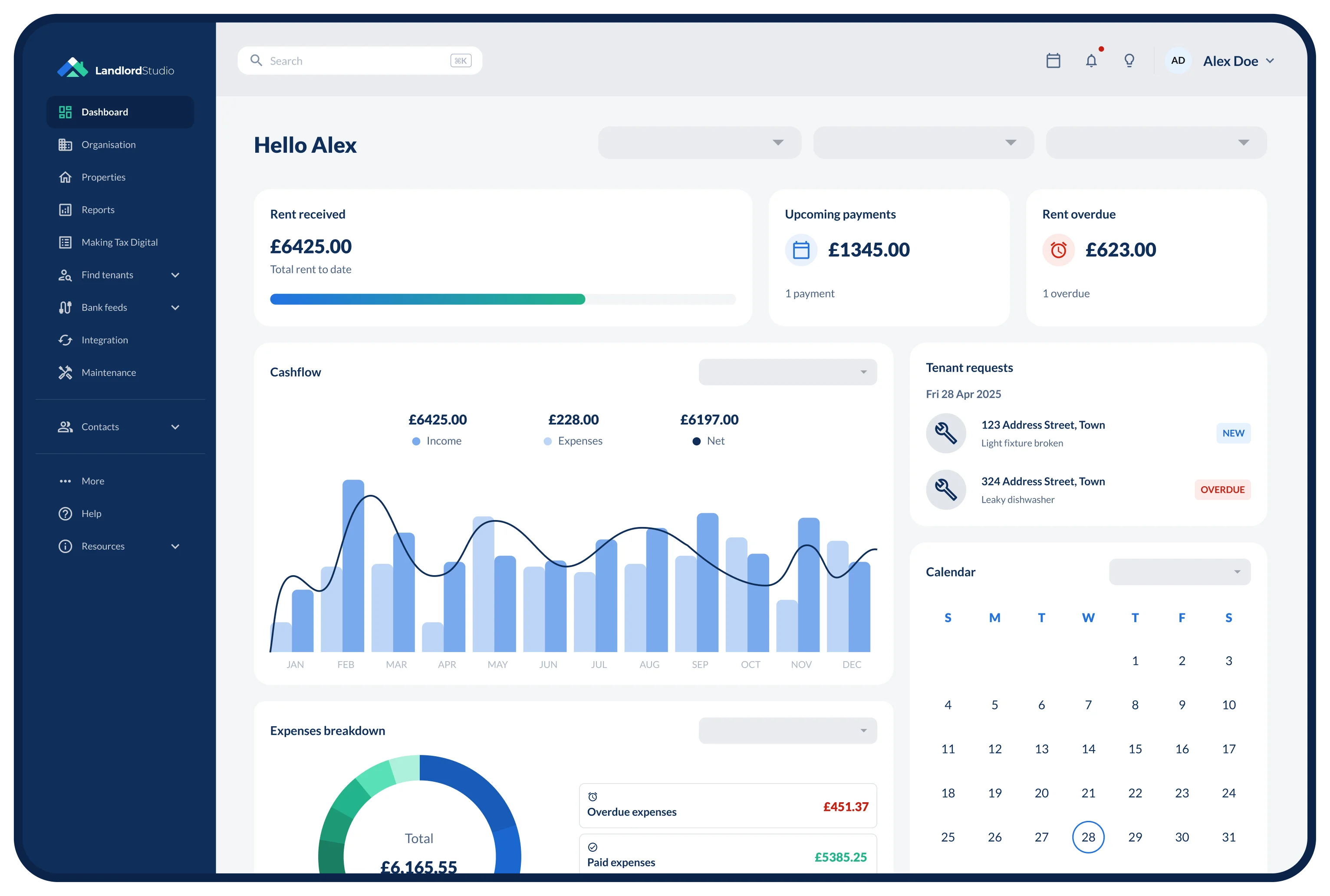
With Landlord Studio you can stay on top of your short term rental’s income and expenses and ensure you are maximizing your end of year tax deductions. There is a built in receipt scanner, a GPS mileage tracker, and integrated bank feeds for fast reconciliation, all designed to make it as easy as possible to keep accurate audit proof records.
At the end of the month you can quickly run any of over 15 reports to dig down into your short term rental’s financial performance, analyze occupancy stats, identify areas of overspend, and determine seasonal patterns. At the end of the tax year, simply send these reports on to your accountant for an accurate and easy tax season.
You can also set reminders for important events, like property inspections, safety certificate renewals, license renewals, or the arrival of new guests.

Frequently Asked Questions
How much do short-term rental managers charge?
Full-service local short-term rental managers charge 25% to 35% of gross booking revenue, per Evolve’s July 2026 fee guide, and All Property Management puts the wider short-term and vacation rental range at 20% to 40% of rental income. Lower-touch models cost less: co-hosting typically runs 10% to 20%, and tech-forward hybrid managers start around 10%. Booking platform fees of roughly 8% to 15% are charged on top, whichever model you choose.
Can I hire someone to manage my Airbnb?
Yes. There are three broad options. A full-service local management company handles everything including on-site work, at 25% to 35% of revenue. A hybrid manager such as Evolve handles the listing, pricing and guest communication for around 10% to 15% while you arrange cleaning locally. An informal co-host covers turnovers and on-site issues, typically 10% to 20%. Airbnb also runs a co-host finder for hosts looking for local help.
What is the 80/20 rule for Airbnb?
There is no official Airbnb rule by that name. Hosts use 80/20 as shorthand for the Pareto principle: roughly 80% of your results, whether that is revenue, bookings or complaints, comes from about 20% of the inputs. Applied to a short-term rental it usually means a small number of listing improvements, review-driving touches and peak-season dates produce most of your income. Treat it as a way of prioritizing your time, not as a metric or a policy.
What is the 50% rule in rental property?
The 50% rule is an investor rule of thumb, not a regulation. It assumes operating expenses, excluding mortgage principal and interest, will consume about half of gross rental income, and it is used as a quick screen when comparing deals. For short-term rentals it usually understates costs, because cleaning between every stay, higher utility use, furnishing replacement and platform fees of 8% or more push the operating ratio above 50%. Use it to reject obviously bad deals, not to underwrite good ones.
Is short-term rental management worth the fee?
Compare on net income, not on fee percentage. Evolve puts the arithmetic plainly: a company charging 15% that generates $60,000 in gross revenue leaves you $51,000, while a company charging 25% that generates $50,000 leaves you $37,500. The higher fee is worth paying when the manager demonstrably increases occupancy or nightly rate by more than the fee difference, or when you are too far from the property to handle on-site problems. Ask every company for a projected annual income figure based on comparable properties in your market before you sign.
Short Term Rental Property Management: Final Thoughts
The decision that moves your return most is not which platform you list on, it is whether you pay 25% to 35% of gross revenue for full-service management or keep that margin by self-managing. If you are local, hands-on and running one to three properties, self-managing with good software is almost always the better economics. If you are remote or scaling, the fee buys you something real.
Before either, check that your city still licenses short-term rentals at your property. Licensing has tightened materially since 2023 and in capped markets the license is harder to get than the property.
Investors also need to understand that managing short term rentals comes with higher costs and larger time requirements than a long-term tenancy, especially if you are self-managing. From managing bookings to maintaining the property to ensuring your guests have the best stay possible so they leave a glowing review.
As such it is crucial that investors employ the best possible tools, like Landlord Studio, to help them stay on top of their investment finances and maximize end-of-year tax deductions so they can run a profitable and sustainable short term rental business.
Related Articles:


About Landlord Studio

Landlord Studio is an easy to use property management and accounting software designed for landlords.
Find and screen tenants, collect rent online, track income and expenses, run reports, and more - all for free.
Create your FREE account with Landlord Studio today.

From finding tenants to filing taxes. Reduce vacancies and maximize your portfolio ROI with software designed for you.
Get started for free