According to the IRS regulations, landlords and property managers must now ensure they file form 1099 for rental income over $600.

There are a number of ways landlords can collect rent, from cash and checks to online payment platforms like Venmo or Paypal, as cash or checks, to landlord software like Landlord Studio.
Whereas it used to be possible to receive payments without reporting the earned amount during tax time, the rules have now changed. In an attempt to crack down on unreported rent, the Internal Revenue Service (IRS) has implemented a change regarding rental income reporting which will affect real estate investors from 2024 onwards.
Under these updated 1099 for rent regulations, landlords and property managers must report all rental income exceeding $5,000 for 2024 (with phased thresholds of $2,500 for 2025 and $600 from 2026 onward). This is a significant reduction from the previous threshold of $20,000.
This article explains exactly what this means and what you need to know about filing a 1099 form for reporting rent payments.
For several years, landlords and property managers faced considerable uncertainty about 1099-K reporting requirements. The American Rescue Plan Act 2021 originally planned to lower the reporting threshold dramatically, from $20,000 and 200 transactions down to just $600 with no transaction minimum.
1099 for Rent Payments, What Was Planned:
After multiple delays and widespread concern from taxpayers, small businesses, and tax professionals about the administrative burden and confusion this would create, Congress reversed course.
The One Big Beautiful Bill Act, signed into law on July 4, 2025, permanently reinstated the original 1099-K reporting threshold that existed before 2022:
For 2025 and all future years:
Both conditions must be met for third-party payment platforms to issue a Form 1099-K.
If you use online payment processors for rent collection, such as Stripe, Square, PayPal, Venmo, Zelle, or landlord-specific software like Landlord Studio, you'll only receive a Form 1099-K if your rental payments through these platforms exceed both $20,000 AND involve 200+ transactions in a calendar year.
For most landlords with small-to-medium portfolios, this means you likely won't receive a 1099-K. For example:
Critical reminder: Regardless of whether you receive a Form 1099-K, your obligation to report all rental income to the IRS remains unchanged. According to IRS regulations, all income earned through renting a property must be reported on your tax return, typically using Schedule E (Form 1040).
Services like PayPal and Venmo will provide you with a 1099-K if you cross the new threshold amount. If you use a service that doesn’t, you’ll be responsible for filing the appropriate form yourself.
Important: Regardless of whether you receive a Form 1099-K, all rental income must be reported on your tax return.
The 1099 form is a tax form that documents income from a source that isn’t an employer. Examples include rental income, earnings made as an independent contractor, and a tax refund from the state or local level. There are 20 different variations of the 1099 form, but only a few are relevant to landlords.
The 1099-MISC form, as its name implies, is intended for reporting miscellaneous income that doesn't fall under other 1099 categories. This is relevant to landlords and real estate investors who receive rental payments via physical checks or cash.
For landlords, this form has two primary applications:
The 1099-NEC form documents non-employee compensation, essentially, for payments to independent contractors and service providers. Landlords must issue a 1099-NEC to any unincorporated individual or business (such as sole proprietors or LLCs) they employ for work done on their rental property if total payments exceed the threshold.
Current thresholds:
Common examples include payments to plumbers, electricians, painters, landscapers, cleaners, or property managers who are independent contractors rather than employees.
If you use an online credit card processor for rent, such as Stripe or Square or receive funds through an online payment service platform like PayPal, Zelle, or Venmo or landlord software like Landlord Studio and the transactions for the tax year surpass the threshold the service provider must file a 1099-K reporting this income to the IRS and also send a copy to you by January 31.
Note that whether or not you receive a 1099-K, your legal obligation to report all rental income to the IRS remains unchanged.
For 2025 and all future years, a 1099-K is required only when both conditions are met:
Find out more about the 1099 forms here.
To simplify this process, landlords can use rental accounting software like Landlord Studio to automatically track rental income and expenses, generate reports, and ensure compliance with tax reporting requirements.
E-Filing Requirements:
If you file 10 or more information returns in total (including all 1099s, W-2s, etc.), you must file electronically. This threshold was lowered from 250 to 10 effective January 1, 2024, per the IRS e-filing requirements.
Extension Requests:
Extensions are not automatic and must be filed before the original deadline.
Learn more about 1099 filing deadlines on the IRS website.
According to the IRS, all income earned through the action of renting a property needs to be reported at the end of the year. For example, if you rent a unit out for $2,000 a month you would bring in $24,000 a year. This amount minus the allowable tax deductions is your taxable income and will be taxed at your current income tax rate.
In addition to rental income, there may be other sources of income you’ll need to record and report at the end of the year. For example, if you charge an additional fee for parking or keep a portion of the tenant’s deposit to cover damages at the end of the tenancy. Other sources of taxable income might include lease cancellation payments or tenant-paid owner expenses.
Related: Tax On Rental Income: How Much Tax Do You Owe?
The recent changes to 1099 requirements emphasize the importance of accurate reporting for landlords. Failing to report all rental income can lead to penalties, interest, or even audits. Keeping clear and organized records ensures that you comply with IRS regulations and claim all eligible deductions.
The best way for landlords to manage and report their rental income is to employ quality income and expense-tracking software like Landlord Studio.
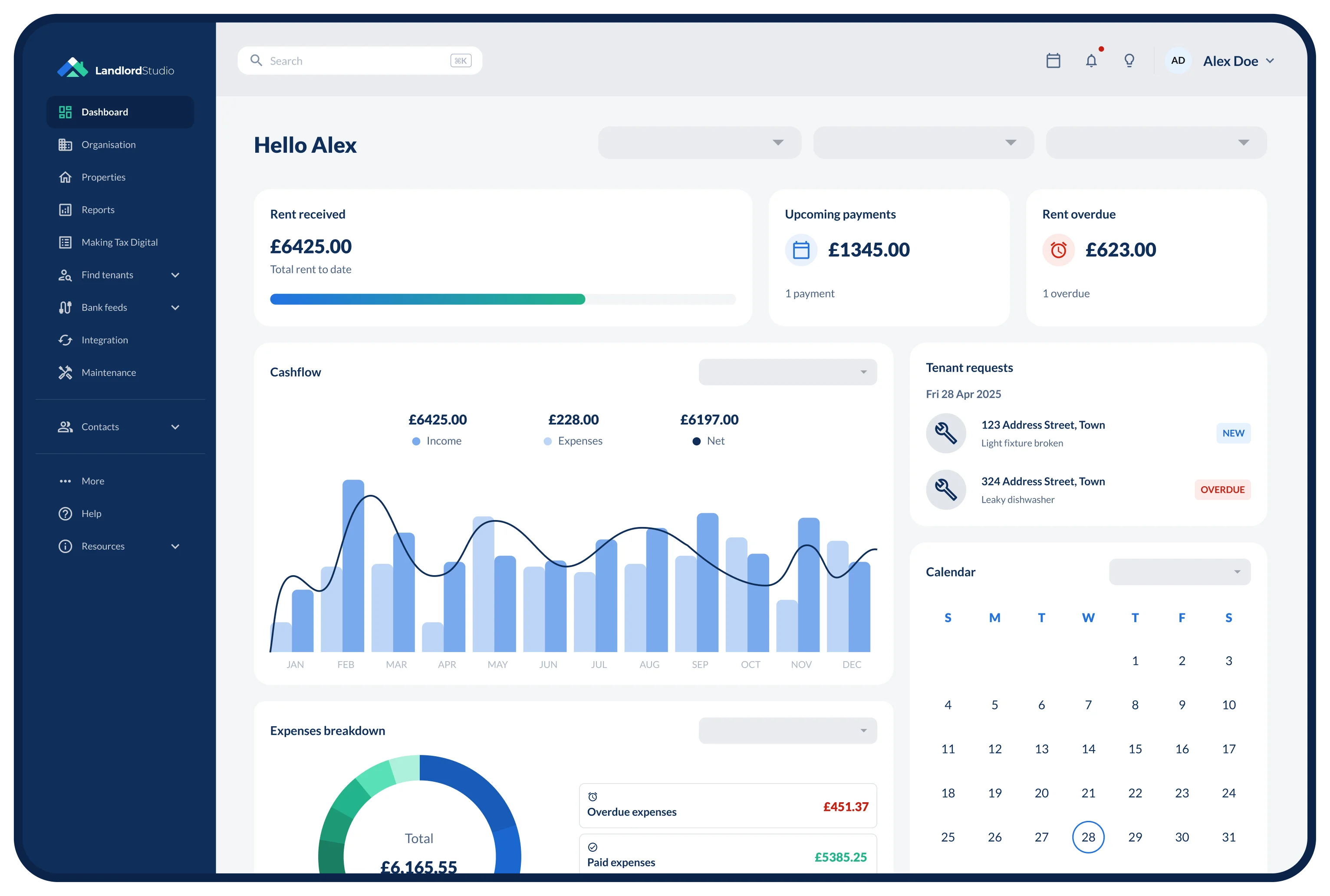
Traditional methods like spreadsheets and paper are time-consuming to keep updated and prone to errors. Landlord Studio makes it easy. Digitize receipts at the point of sale, connect your bank accounts to reconcile transactions in real time, and use our online rent collection system to automate the entire rent collection and income tracking process.
At the end of the year, you can share your rental property accounting information with a tax professional, you can export financial data in any of our accountant-approved reports including our powerful Schedule E report.
Once you reach the 1099 for rent threshold, our payments partner will provide you with a 1099-K form to simplify your tax filing preparations.

Before you do anything with your 1099 for rent payments, consider the tax deductions you may qualify for. A tax professional will ultimately determine which tax deductions make the most sense, but it’s important to be aware of those that exist. Some common deductions include:
Find out more about common landlord tax deductions
The IRS’s phased approach to the new 1099-K reporting thresholds means that landlords need to stay vigilant about their rental income reporting. Regardless of whether you receive a Form 1099-K, it’s your responsibility to report all income and comply with tax laws.
By collecting rent payments with Landlord Studio, landlords and property managers can eliminate any guesswork and streamline their end-of-year tax filing.
Our powerful rent collection tools automatically track all of your rent payments for you and easy-to-use accounting tools make expense management as simple as possible. When it comes to tax time, instantly generate any of over 15+ customizable reports including a P&L and purpose-built Schedule E report.
Make filing taxes easier than ever with property management and accounting tools designed for you. Create your free Landlord Studio account today.