Welcome! Where would you like to log in?

Sign up and get
PRO free for 14 days
Once your PRO trial is over you can continue using Landlord Studio GO completely free.
By continuing you agree to our Terms & Conditions.

Visiting from the
United Kingdom?
Please visit our United Kingdom site for a better experience
Continue
When Should a Landlord Increase the Rent?
When should you raise the rent, how do you ensure it’s legal, and how can do properly manage the rent increase with Landlord Studio?

Read summarized version with:


As a landlord raising the rent is often necessary to keep your property in line with current market rates. However, it’s important to note that landlords can’t just raise the rent whenever they want, and depending on where the property is located there may be caps on how much the rent can be raised at any one time or in any one year.
In this article, we take a look at when you can and should raise the rent, what you need to know to ensure the rent increase you implement is legal, and finally how you can properly manage your rent increase in the Landlord Studio system.
Average rent increase per year
Many landlords increase the rent every year to keep their property in line with inflation. The average amount that landlords tend to increase the rent by is somewhere between 3% and 5%. For example, if the rent amount is $1,000 per month the rent increase would be between $30 and $50 per month.
This though is of course just an average. How much you should be increasing the rent is directly related to the location that the property is in. In some locations, for example, you might actually need to decrease the rent amount depending on the current market.

Average rent prices in the US
There has been a major shift in renter demand over the last year with COVID-19 changing what many tenants are looking for. More people are working from home than ever before and tenants are more willing to commute if they can have a more affordable rent with a little more space. Cities like Boise (+12%), Fresno (+11%), and Gilbert (+8%) saw their rent prices increase over the year while more expensive cities such as San Francisco saw dramatic drops in asking rents (-26%). (Source)
Around Twenty states have average rent prices below $1,000 a month. West Virginia has the lowest average rent in the United States of $628 a month, followed by Montana with $678 and Oklahoma with $699. These are the only three states with rents below $700 a month. Wyoming and Kansas follow with $706 and $713.
Here are the 10 states with the highest average rent:
- Hawaii ($1,617)
- California ($1,503)
- Maryland ($1,392)
- New Jersey ($1,334)
- Massachusetts ($1,282)
- New York ($1,280)
- Colorado ($1,271)
- Washington ($1,258)
- Alaska ($1,244)
- Virginia ($1,234)
(Source)
Why would you choose to raise the rent?
As a landlord, you have many real estate expenses, from property taxes, landlord insurance, maintenance and repairs, and larger regular expenses such as mortgage payments. These expenses aren’t static, and when expenses go up so too should the rent to reflect this to ensure that the property can be well maintained and there is adequate financial cushion should the unexpected occur.
Additionally, you will want to make sure that your property stays at a fair market rate. If you make improvements to the property this also might be reason to increase the rent. Landlords should adjust the rent up or down to be in line with like properties in the area. As such, it’s recommended that you keep a careful eye on fluctuating rent amounts in the area where your property is situated.
A final reason you might choose to raise the rent is if you have historically been renting under market value. This might happen if you have a great tenant that stays a very long time and in order to keep them you agree to keep rent raises to a minimum. However, if they move out you will want to bring that rent up to the current market rate.

When and how can you raise the rent?
There are a number of locations in the US that have strict rent control such as New York City. This rent control is designed to help prevent rent amounts from spiralling out of control. As a landlord you need to be familiar with the laws regulating your area otherwise you might find yourself trying to implement an illegal rent raise.
When you can raise the rent also depends on the type of lease you have. For example, if your lease stipulates the rent will be $1,000 for the next year you can’t raise the rent halfway through the lease. You will need to wait until the lease expires. If you decide to offer your tenants a lease renewal you will want to propose the rent raise at this time. If however, you have a month to month lease you can raise the rent by giving the proper notice period, in most states this notice period is 30 days.
On a final note, the rent increase notice must be in writing; in some states, certified mail is required. Oral notices are ineffective in most states and, unless both tenant and landlord specifically agree to the rent increase, it can be very hard to enforce.
Find out how much rent your should be charging with Rentometer.
Rent increase and security deposits
Raising the rent may also affect the required security deposit from your tenants. Many states limit the amount a landlord can charge for a security deposit. Typically, deposits are capped as a multiple of the monthly rent—for example, the maximum deposit maybe twice the monthly rent. But this means that if the rent has gone up legally, the security deposit may also be legally increased.
Managing your rent increase in Landlord Studio
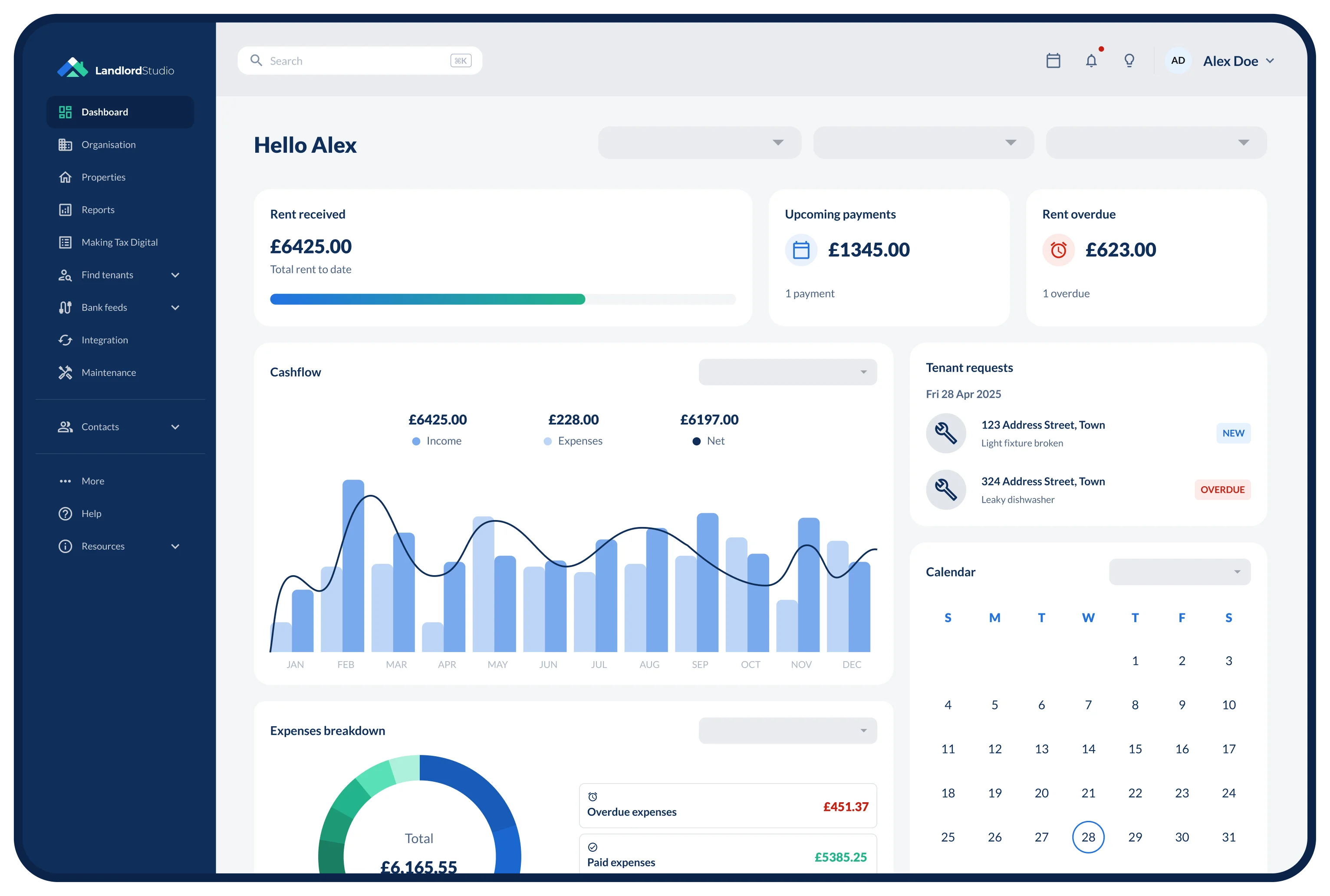
With Landlord Studio it becomes incredibly easy to track your historical and expected rental income. Plus should you implement a rent change, you can adjust the rent amount in the system to seamlessly keep track of the change.
To adjust the rent amount in Landlord Studio you have two options.
Either you can bring the current lease to an end by editing the lease end date. This is best if there are more details of the lease that are changing, such as the payment date, or if you are moving a new tenant in.
The second method is to schedule a rent change. This can be done for tenants where the rent is changing during their tenancy, such as tenants on a month-to-month lease, or if they chose to stay with a lease renewal but with a rent change.
Find out more about online rent collection with Landlord Studio →

Communicating with your tenant
If you do choose to raise the rent you need to clearly communicate this with your tenant, giving them an appropriate amount of notice. This communication should be in writing for both parties records.
In addition, it’s a good idea to state the reason you are raising the rent to ensure that there are no misunderstandings. For example, if you have done extensive market research and found that similar properties in the area are renting at an average of 3% higher than your property currently is, then let them know this.
Not stating the reason for increasing the rent could lead to questions down the line as to the legality of the rent raise. You can’t raise the rent in a discriminatory fashion, or in retaliation to a tenant exercising a specified legal right, eg. if they complain about defective conditions to a public agency. Being very clear then, as to the reason for the rent raise will help avoid any potential legal complaints.
On a final note, raising the rent is one of the principal reasons that a tenant might decide to move out. Moving is an expensive and stressful process with inherent risks for tenants. For landlords, it inevitably means a period of vacancy where no rent is being collected at all, and incurs costs to market the property and find and screen applicants. As such, if you have good tenants it’s worth being open to negotiation with them to get them to stay. This will reduce your vacancy time and associated costs, plus you get to keep a great tenant.


About Landlord Studio

Landlord Studio is an easy to use property management and accounting software designed for landlords.
Find and screen tenants, collect rent online, track income and expenses, run reports, and more - all for free.
Create your FREE account with Landlord Studio today.

From finding tenants to filing taxes. Reduce vacancies and maximize your portfolio ROI with software designed for you.
Get started for free