The Rent to Income Ratio: A Guide for Landlords

The rent to income ratio is a simple calculation that can help you assess whether a prospective tenant is a good fit for your rental.

Written by

Ben Luxon

PUBLISHED ON

UPDATED ON

READ TIME

Read summarized version with:

ChatGPT
Gemini
Claude
Grok
Add as preferred on Google

Last updated: June 2026 · Reviewed by the Landlord Studio team

A rent-to-income ratio is the share of a tenant's gross monthly income that goes to rent. Most US landlords screen against the 30% rule (rent no more than 30% of gross monthly income) or the 3x rent rule (gross income at least 3 times the monthly rent). A rent-to-income ratio at or below 30% is generally considered affordable.

Non-payment of rent is the number one concern of landlords in America. In extreme examples it can lead to lengthy and costly evictions. Even in more normal circumstances it can cause problems, from cash flow issues to a breakdown of relationships and potential communication complications.

The rent to income ratio is one calculation that landlords can use to help them assess tenants and a calculation that tenants can use to determine if they can feasibly afford a particular property. In this article, we take a look at what the rent-to-income ratio is, how it can be used, and the formulas for calculating it.

What is a good rent-to-income ratio?

A good rent-to-income ratio is generally 30% or below, meaning the tenant spends no more than 30% of their gross monthly income on rent. The rent to income ratio is a calculation used by landlords to determine if a prospective tenant is suitable for their rental. Essentially, the ratio calculates how much income the tenant makes in relation to the rent. Landlords can then quickly assess how affordable the rent for a particular property is for that tenant.

As a general rule of thumb, landlords should aim for a rent-to-income ratio of no more than 30%. Meaning the tenant should earn at least three times the rent amount. A higher rent-to-income ratio means the tenant will have less money to live off and should they come under hard times, they may have to sacrifice paying for certain essentials to continue covering living expenses. With rent taking so much of their paycheck, it is often the first payment that is sacrificed.

The 30% benchmark mirrors the federal standard for housing affordability: the US Department of Housing and Urban Development (HUD) defines housing as affordable when a household pays no more than 30% of gross income on housing costs, and treats households paying more than 30% as "cost burdened." [verify external link before citing HUD]

Related: 10 Methods for Tenants to Show Proof of Income

What is the 3x rent rule?

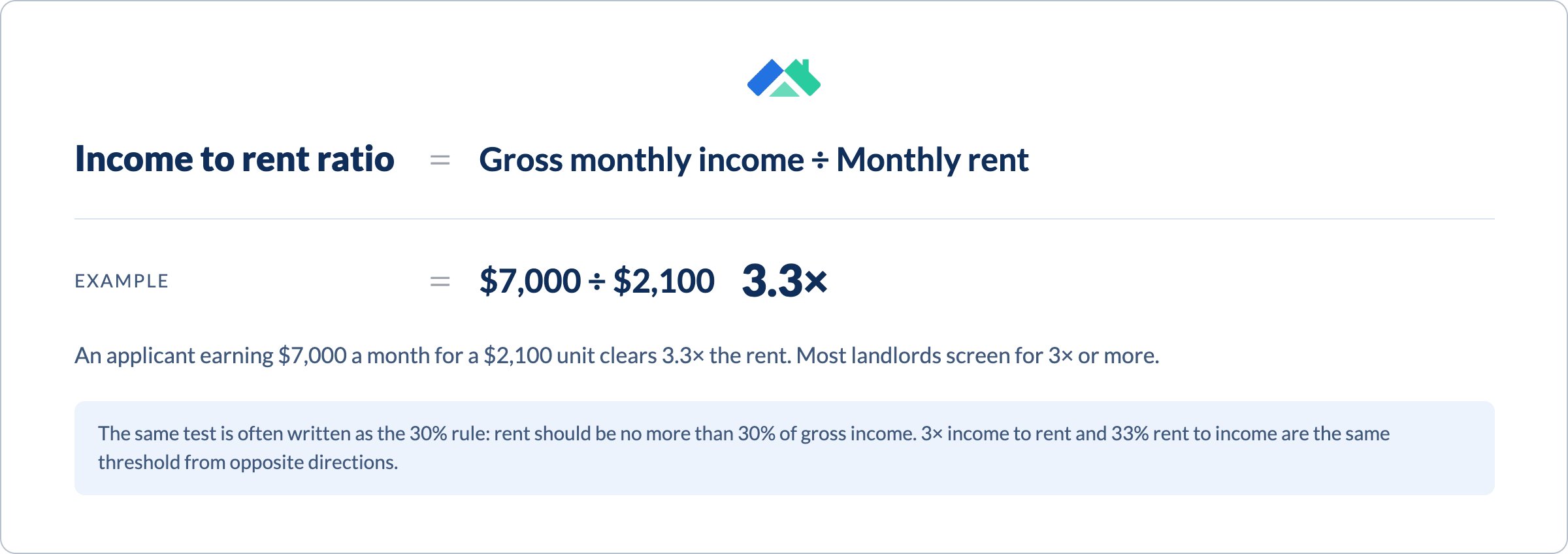
The 3x rent rule means an applicant must earn at least three times the monthly rent in gross income. It is the most common shorthand version of the 30% rule because the two are closely related: requiring income of 3x rent puts the rent-to-income ratio at roughly 33%, while the strict 30% rule requires income of about 3.33x rent. Many landlords use the 3x rent rule as a fast minimum-income screen before reviewing credit, employment, and rental history.

How do you calculate rent-to-income ratio?

To calculate a tenant's rent-to-income ratio, divide the monthly rent by the tenant's gross monthly income and multiply by 100. There are two ways to use the rent to income ratio. The first is to use the tenant's gross income to calculate whether it meets your minimum requirements. The second is to calculate how much gross income a tenant needs to meet your target.

(Rent amount / Tenant gross monthly income) x 100 = Rent to income ratio

You can also rearrange the formula to establish what the minimum tenant income requirement should be based on the rent amount and preferred rent to income ratio.

Rent amount / Target rent to income ratio = Minimum tenant income

Rent-to-income ratios are calculated on gross income (before tax), which is the standard used in tenant screening.

Worked examples

Example 1 - screening with the 30% rule. A tenant earns $5,000 per month in gross income and the rent is $1,500. Divide the rent by income and multiply by 100:

  • ($1,500 / $5,000) x 100 = a rent-to-income ratio of 30%. This applicant meets the 30% rule.

Example 2 - screening with the 3x rent rule. The rent is $2,000 per month. Under the 3x rent rule the applicant needs gross monthly income of at least:

  • $2,000 x 3 = $6,000 per month in gross income (equivalent to $72,000 per year).

If that same applicant earned only $5,000 per month, their ratio would be ($2,000 / $5,000) x 100 = 40%, which is above the 30% benchmark and below the 3x rent requirement.

Rent-to-income ratio table: income needed by rent amount

The table below shows the gross monthly and annual income an applicant needs at common rent levels under both screening standards. As a quick benchmark: at $1,500 rent the 3x rule asks for $4,500/mo and the strict 30% rule asks for $5,000/mo ($60,000 a year).

Monthly rentIncome needed (3x rule)Income needed (30% rule)Annual income (30% rule)
$1,000$3,000/mo$3,333/mo$40,000
$1,500$4,500/mo$5,000/mo$60,000
$2,000$6,000/mo$6,667/mo$80,000
$2,500$7,500/mo$8,333/mo$100,000
$3,000$9,000/mo$10,000/mo$120,000

Pros and Cons of Using the Rent-to-Income Ratio

The rent to income ratio is a simple way for both landlords and tenants to gauge the financial feasibility of a tenant signing the lease agreement.

If a tenant does not have enough income to afford the rent and all their additional living expenses, landlords can expect a high probability of late and missed rent payments. For applicants, by realistically understanding how much rent they can afford, they can better tailor their search for a new home saving both themselves and the landlord time.

With that being said, the rent to income ratio doesn't tell the whole story. For example the tenant might have other sources of income that are not reflected on the W2 or pay stubs such as:

  • Child support payments
  • Additional freelance work
  • Other sources of income

And of course, this works the other way around too. The tenant might have additional expenses and financial burdens that will mean they need to target a lower rent to income ratio.

Because of this, the rent to income ratio is just a starting point. Landlords should seek out additional financial information such as a tenant credit report as part of their comprehensive tenant screening process, to get a better picture of the applicant's overall financial situation.

What if a tenant's income is below 3x rent?

If a tenant's income is below 3x rent you do not have to reject them automatically. Consider compensating factors such as a guarantor or co-signer, a higher security deposit (where state law allows), strong savings or reserves, or a solid rental and credit history. Whatever criteria you set, apply them consistently to every applicant to stay compliant with fair-housing rules.

Man reading report

Mitigating the Risk of Late Payments

In order to reduce the chance that a tenant is late with the rent or misses a payment, you need to first of all do everything you can to ensure they have the ability and wherewithal to pay the rent on time and in full every single month. This means first and foremost setting your minimum criteria with a strict rent to income ratio. You then need to ensure you do a thorough tenant screening on all tenants with a full credit history, background check, and rental history report.

However, you won't always find a perfect tenant, and sometimes you need to fill vacancies fast. On top of this, there are always exceptions to any rule. Perhaps, as mentioned above, the tenant has additional sources of revenue that qualify them but are unstable. Or you may be renting to students who don't have a rental history and may be entirely supported by parents or loans.

In order to protect yourself and your rental under these circumstances there are a few things that you can do to mitigate risk.

Get a Lease Guarantor / Co-signer

The co-signer agrees to take on the financial responsibilities of the rent in case the primary leaseholder cannot. The landlord should vet the co-signer as thoroughly as the tenant, including a comprehensive screening.

Request a Larger Deposit (if Legal)

A simple approach is to request a larger security deposit. This will cover unpaid rent should the tenant fall behind, and also act as proof that the tenant has financial reserves they can call upon. However, several states laws specify have limits on the amount you can charge as a security deposit (often 1-2 months rent) so make sure to check your local and state deposit laws first.

Have a Fair Late Fee and Grace Period Policy

Late fees are one way that landlords encourage on-time payments. This late fee should be fair and have a reasonable grace period (usually about five days). A fair late fee acts as an incentive for tenants to make sure they get the rent in on time. However, large late fees can hinder an already struggling tenant's ability to pay further resulting in a breakdown of relationships and increased likelihood that you will have to pursue an eviction (something neither of you want).

Again some states specify limits to how much a landlord can charge as a late fee and some mandate minimum grace periods, so be sure to check your states law landlord tenant laws before setting your late fee and grace period policy.

Use Landlord Studio To Collect Rent Online

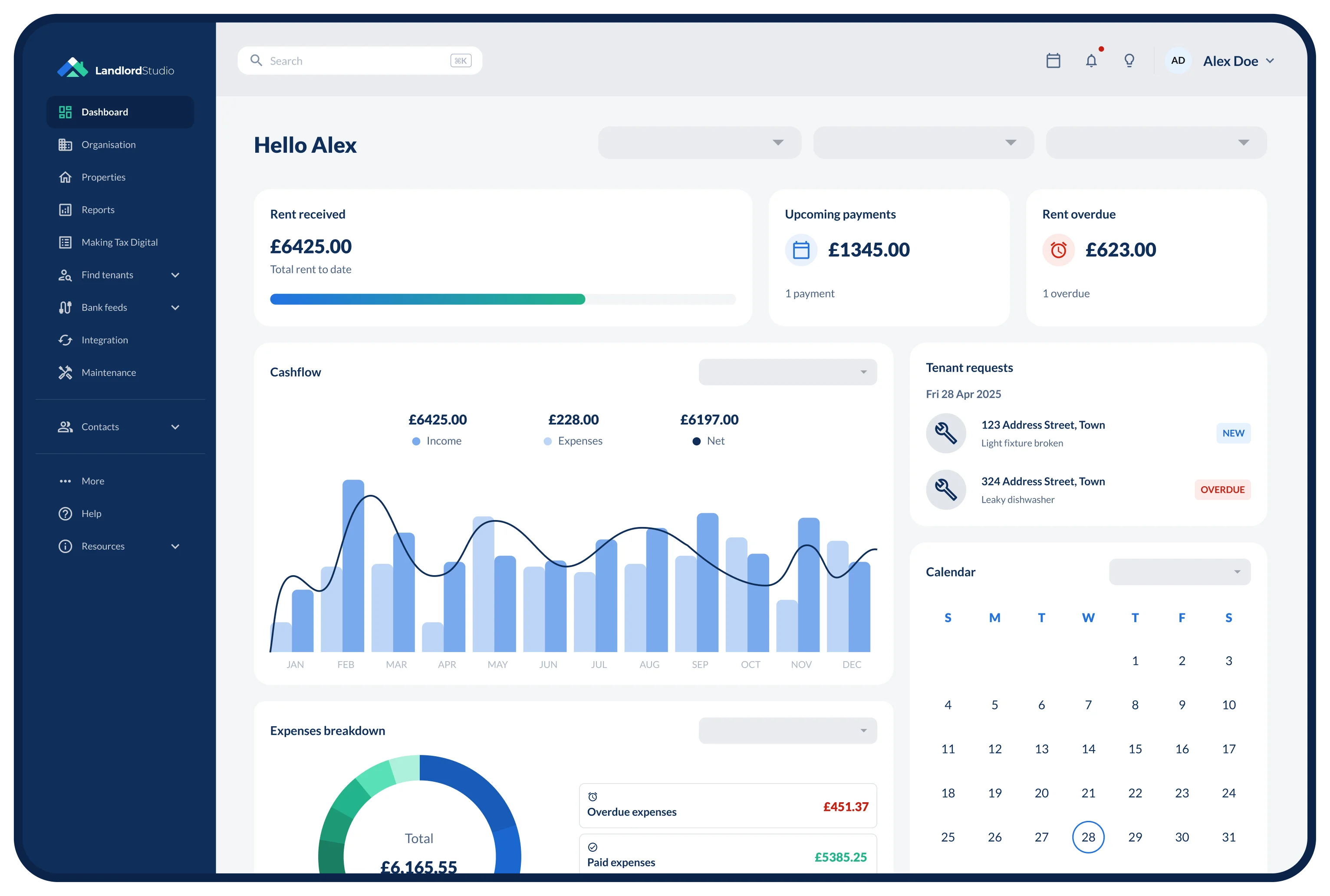
Landlord Studio offers one of the best rent collection tools on the market, built into our award-winning real estate accounting software.

Set the rent amount and invite your tenant. Your tenant can then log in to view upcoming and historical payments, set their rent to be paid automatically each month, pay tenant payable expenses, and even submit maintenance requests. This is proven to dramatically reduce the chance of late rent payments.

On top of this, income paid through this tool is automatically tracked in our income tracker, meaning all you have to do at the end of the month is generate your financial report with a few quick clicks.

Learn more about collecting rent online with Landlord Studio →

Automate Rent Reminders and Late Fees

Landlord Studio property management software also allows you to set automated rent reminder emails to go out before and after the rent due date and automatically chase late rent payments. As well as automatically applying late fees should the tenant not initiate their payment on time. These late fees will be applied in the tenant portal so that tenants have comprehensive breakdown of how much and when they paid.

Rent to Income Ratio: Final Words

Having a streamlined process and the right tools to manage rental applications is essential if you want to fill vacancies fast, and mitigate the risk of late and missed rent payments.

The rent to income ratio is one way to assess a tenant's financial viability. However, it doesn't tell the whole picture. As such, while it makes a good starting point especially if you have a lot of applicants, landlords should do additional, in depth research to ensure the tenant meets all of their minimum criteria.

With Landlord Studio, we make this as easy as possible. You can collect tenant applicants using the software and even set a selection of prescreening questions to quickly filter unqualified tenants. After tenants have seen the property, easily run a comprehensive tenant screening report from inside the app at no additional cost to yourself.

Frequently Asked Questions

What is a good rent-to-income ratio?

A rent-to-income ratio of 30% or below is the common benchmark, meaning rent takes no more than 30% of the tenant's gross monthly income.

What is the 3x rent rule?

The 3x rent rule means the applicant earns at least three times the monthly rent in gross income.

How do you calculate a tenant's rent-to-income ratio?

Divide the monthly rent by the tenant's gross monthly income and multiply by 100: (rent / gross monthly income) x 100.

Should I reject a tenant whose income is below 3x rent?

Not automatically. Consider a guarantor, co-signer, higher deposit, or other compensating factors, and apply your criteria consistently to every applicant for fair-housing compliance.

Is the rent-to-income ratio calculated on gross or net income?

Gross income, before tax, is the standard used in tenant screening.

Does the 30% rule include utilities?

Typically the 30% rule is applied to rent only, though some landlords use a 30% all-in housing-cost view that includes utilities. State clearly which version you use in your screening criteria.

__wf_reserved_inherit

You May Also Like:

Related Posts