


Buy-to-Let Deal Analyser
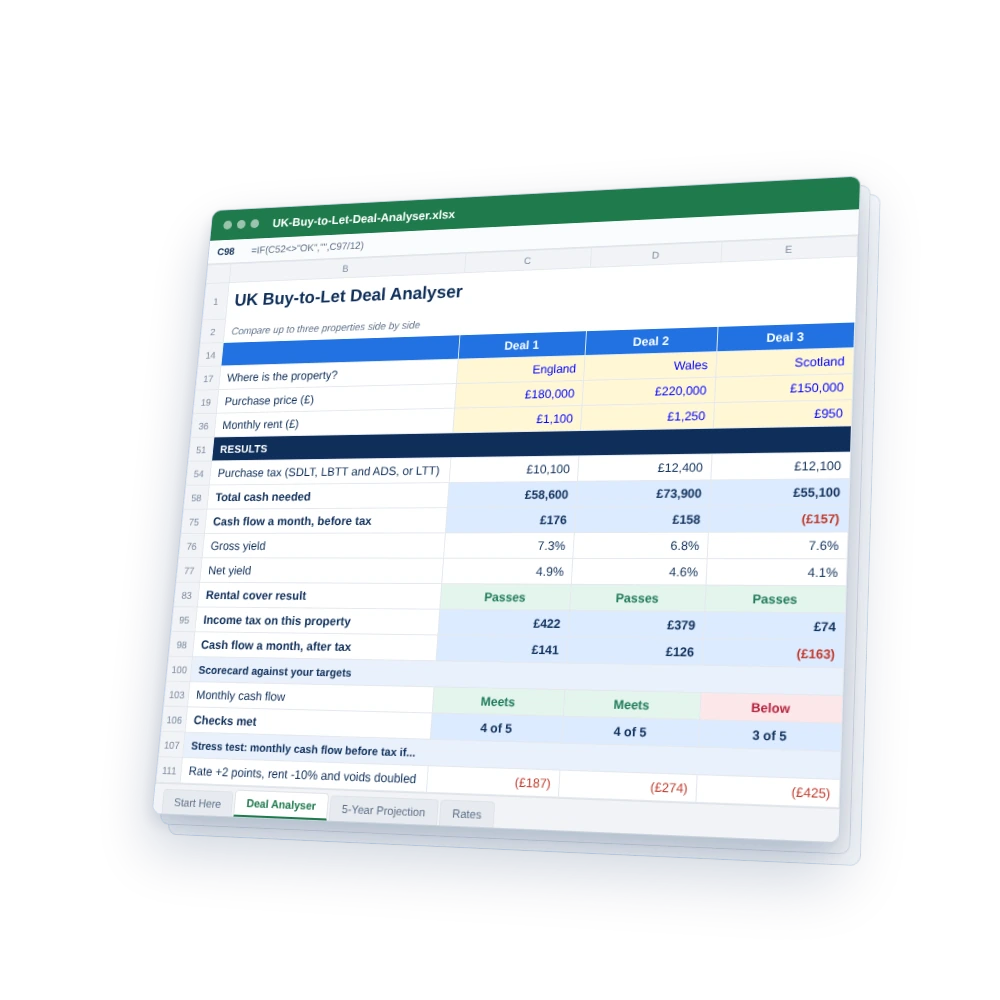
Compare up to three buy-to-let deals side by side before you make an offer. Enter the price, rent and mortgage, and the spreadsheet works out the purchase tax, the cash you need, cash flow, yields, Section 24 tax and whether a lender's rental cover test is likely to pass.

Free Buy-to-Let Deal Analyser Spreadsheet
Use this free Excel template to check whether a buy-to-let property stacks up before you commit. It works for England, Wales, Scotland and Northern Ireland, and lets you compare three deals at once.
In this free template you'll be able to:
- Work out stamp duty, LBTT or LTT, including the surcharge for additional homes
- See cash flow, gross and net yield, and cash-on-cash return for each deal
- Estimate income tax under Section 24 and check the lender's rental cover test
- Stress test higher rates, lower rent and longer voids, then project 5 years ahead
Produced by Landlord Studio
Other resources you might be interested in

Rental Accounting Spreadsheet Template
Once you have bought, track rental income and expenses by property, ready for your tax return.
Making Tax Digital Income Checker
Check when Making Tax Digital for Income Tax applies to you, based on your income from property.
Tenant Referencing Checklist Template
Check tenants before you let, from ID and immigration checks to income, credit and references.

Manage up to 3 rental properties for free!
Sign up and get PRO free for 14 days. When the trial ends, keep tracking rent, expenses and reports for up to 3 properties, free forever with Landlord Studio GO.
By continuing you agree to our Terms & Conditions · Already have an account? Log in
Go beyond rental yield

Section 24 tax, not just cash flow
Individual landlords can't deduct mortgage interest from rental profit. They get a basic-rate tax credit instead. The spreadsheet estimates the tax for your income band, so you can estimate your cash flow after tax.

The lender's rental cover test
Most buy-to-let lenders check that the rent covers the mortgage interest at a stress rate, often by 125%. The spreadsheet shows the largest loan the rent supports under that test alone, so you can see if you might need a bigger deposit.
FAQs
What is a buy-to-let deal analyser?

It's a spreadsheet that helps you assess the potential returns of a rental property before you make an offer. You enter the price, rent, mortgage and running costs. It works out the cash you need, monthly cash flow, yield and return on your cash, then scores each deal against targets you set.
What's the difference between gross and net yield?
Gross yield is a year's rent divided by the purchase price. Net yield takes off running costs and empty periods first, so it's a better guide to what the property earns. The spreadsheet shows both and lets you set your own targets, as the right figure depends on the area and your strategy.
How does the spreadsheet handle Section 24?
Under Section 24, individual landlords can't deduct mortgage interest from their taxable rental profit. They get a basic-rate tax reduction instead, limited to the lowest of the finance costs, the rental profit and income above the Personal Allowance. The spreadsheet estimates the extra income tax each deal adds based on your other income, and the 5-year projection carries unused finance costs forward. You can choose 2026/27 rates, the 2027/28 property income rates in law (22%, 42% and 47%), or the higher rates proposed at Budget 2026 (24%, 44% and 49%), which aren't law yet.
What is the lender's rental cover test?
Buy-to-let lenders usually check that the rent covers the mortgage interest at a stress rate. A common minimum interest cover ratio is 125%, and higher-rate taxpayers may need 145% or more. The spreadsheet estimates the largest loan your rent supports under that test, using the ratio and rate you enter. It isn't your overall mortgage eligibility, so check your lender's criteria with a broker.
Does it work for Scotland, Wales and Northern Ireland?
Yes. Choose the nation for each property and it applies Stamp Duty Land Tax in England and Northern Ireland, Land and Buildings Transaction Tax plus the Additional Dwelling Supplement in Scotland, or Land Transaction Tax in Wales. Your income tax depends on where you live, not where the property is. Scottish taxpayers can enter their own marginal rate for a simplified estimate.