


Buy-to-Let Mortgage Calculator
Estimate your monthly buy-to-let mortgage payments on an interest-only or repayment basis, and check whether your rent passes the lender's ICR stress test.

How to manually calculate your buy-to-let mortgage costs
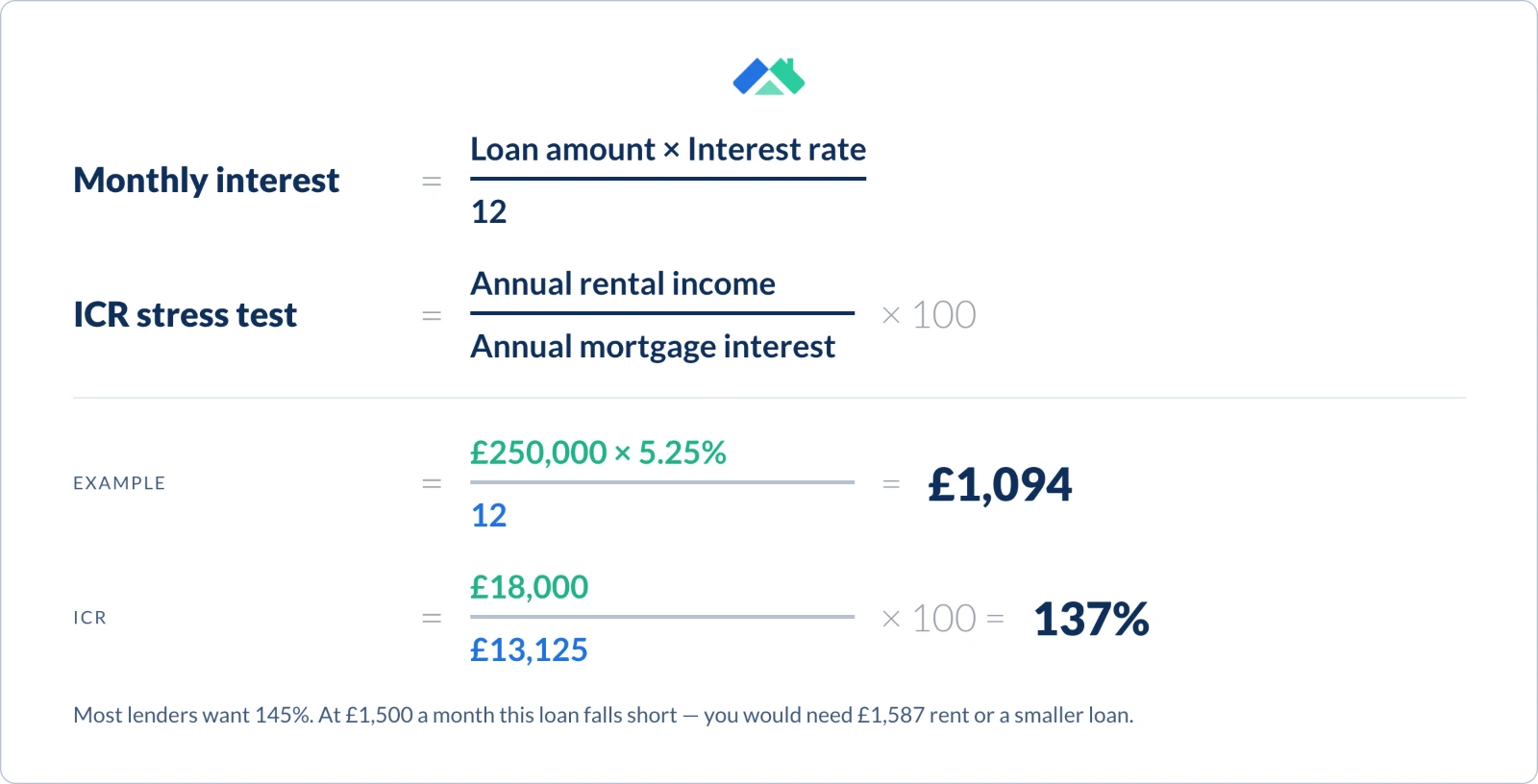
Monthly interest is the loan amount times the interest rate, divided by 12. Interest coverage ratio is annual rent divided by annual mortgage interest times 100 - most lenders want 145% or above.
Work out the annual interest
Multiply the loan amount by the interest rate, then divide by 12 for the monthly figure. Most buy-to-let mortgages are interest-only, so that monthly interest is your actual payment.
Work out your interest coverage ratio
Divide your annual rental income by the annual mortgage interest, then multiply by 100. That percentage is your ICR — the number lenders actually assess you on.
Check it against the lender's threshold
Most want an ICR of at least 145%, stress tested at a rate higher than the one you'll pay. Come in under it and you'll need either higher rent or a smaller loan.
Worked example
A £180,000 interest-only loan at 5.5%, with the property let at £1,300 per month.
Monthly interest = £180,000 × 5.5% ÷ 12 = £825
ICR = (£15,600 ÷ £9,900) × 100 = 158% - above the 145% most lenders want

Other calculators you might be interested in

Stamp Duty Calculator
Work out the stamp duty on a buy-to-let or second home across England, Wales and Scotland.
Rental Yield Calculator
Work out the gross and net yield on a rental property to see what your investment really returns.
Rental Income Tax Calculator
Work out the tax on your rental profit, including Section 24 relief and the property allowance.

Manage up to 3 rental properties for free!
Sign up and get PRO free for 14 days. When the trial ends, keep tracking rent, expenses and reports for up to 3 properties, free forever with Landlord Studio GO.
By continuing you agree to our Terms & Conditions. · Already have an account? Log in
Borrowing on a buy-to-let

Interest only is the buy-to-let norm
Most buy-to-let mortgages are interest only. You pay the interest each month and repay the capital when you sell or refinance, which keeps monthly costs low and cash flow positive.
Repayment clears the debt over the term, but the rent often won't cover it.

What the lender actually tests
Lenders decide how much you can borrow using the Interest Coverage Ratio - your rent tested against a stressed interest rate, not the rate you'll actually pay.
125% for basic-rate taxpayers and limited companies, 145% for higher-rate taxpayers.

Why should you use our buy-to-let mortgage calculator?
- Interest only and capital repayment side by side
- Runs the ICR stress test lenders actually use, at 125% or 145%
- Tells you the maximum loan your rent will support
- Shows your monthly surplus after the mortgage is paid
- Free, fast and no sign-up
