
Welcome! Where would you like to log in?

Sign up and get
PRO free for 14 days
Once your PRO trial is over you can continue using Landlord Studio GO completely free.
By continuing you agree to our Terms & Conditions.

Can You Do MTD Without an Accountant?
You don’t need an accountant for Making Tax Digital. Here’s what HMRC actually requires and how to manage MTD yourself with the right software.

Written by
Ryan Green
PUBLISHED ON
July 29, 2026
UPDATED ON
September 5, 2026
READ TIME
0 min


Read summarised version with:


The short answer is yes. There is no legal requirement to use an accountant for Making Tax Digital. What HMRC requires is that you keep digital records and submit your updates through HMRC-recognised software. Whether you or an accountant presses the button is entirely up to you.
That question has taken on some urgency. MTD for Income Tax went live on 6 April 2026 for landlords and sole traders with qualifying income over £50,000, and the first quarterly update deadline lands on 7 August 2026. If you're weighing up whether to handle it yourself or pay for professional support, here's what the decision actually involves.
What HMRC actually requires under MTD
Making Tax Digital for Income Tax replaces the single annual Self Assessment routine with an ongoing digital process. If you're within scope, you need to do three things.
Keep digital records
Every item of rental income and every expense needs to be recorded digitally, in software or in a spreadsheet connected to bridging software. Paper records and standalone spreadsheets on their own no longer satisfy the rules. If you're not sure whether your rental income puts you in scope, our guide to MTD qualifying income explains how HMRC calculates it.
Send quarterly updates
Four times a year, your software sends HMRC a summary of your income and expenses. The standard deadlines are 7 August, 7 November, 7 February and 7 May. These are running totals rather than mini tax returns, which matters more than it sounds: if you make a mistake in one quarter, the corrected cumulative figures simply flow through in your next update. Our guide to MTD quarterly updates covers the mechanics in detail.
Finalise your tax year
After the fourth quarter, you confirm your final figures, make any accounting adjustments and claim reliefs, then submit your tax return for the year through your software. This is the step that most closely resembles the old Self Assessment process.
None of these steps requires a professional. They require software that does the heavy lifting and a habit of recording things as you go.
So when is an accountant worth it?
Plenty of landlords will still choose to use one, and for good reason. Doing MTD yourself makes most sense when your affairs are simple: a small number of properties, held in your own name, with straightforward income and expenses.
An accountant starts earning their fee when complexity creeps in.
1) Jointly owned property
Joint ownership brings its own MTD rules around who reports what share of the income. It's workable on your own, but it's one of the most common places landlords trip up. We've covered the detail in our guide to MTD for jointly owned rental property.
2) Bigger tax decisions
Selling a property, incorporating, restructuring a portfolio or dealing with multiple income sources are moments where professional advice usually pays for itself many times over. MTD software reports what happened. An accountant helps you decide what should happen.
3) First-year reassurance
Some landlords use an accountant for the first MTD year to check their setup and categorisation, then take over themselves once the routine is established. A hybrid approach is also common: you keep the records digitally through the year, and your accountant reviews and submits the final year-end return. Because MTD software allows agent access, you can share your records with an accountant at any point without redoing anything.
4) The cost equation
The honest comparison is software subscription versus accountant fees, set against the value of your own time. Research suggests cost is the number one concern landlords have about MTD, something we dug into in our analysis of what Making Tax Digital is really costing landlords. For a landlord with simple affairs, purpose-built software plus a few minutes a week is typically the cheapest compliant route. For complex affairs, an accountant's fee is rarely the expensive option compared with getting it wrong.
Doing MTD yourself with Landlord Studio
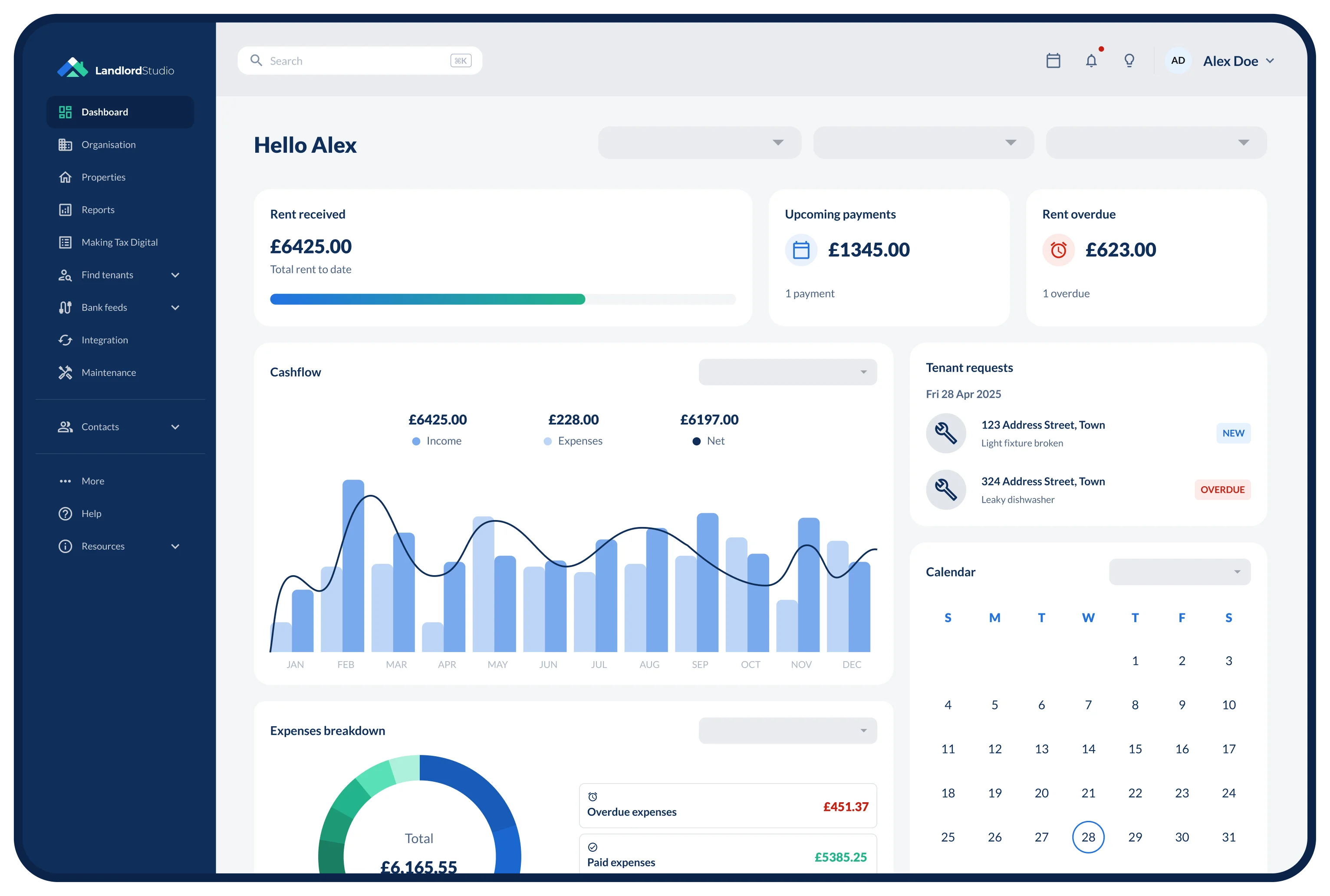
If you do decide to self-manage, the software choice does most of the work. Landlord Studio is HMRC-recognised MTD software built specifically for landlords. Bank feeds pull your transactions in automatically, expenses are categorised against HMRC's allowable expense categories, and quarterly updates are submitted directly from the app. If you later bring in an accountant, you can share access rather than handing over a shoebox.
For a step-by-step starting point, see our checklist of 8 steps to become MTD ready, or the complete MTD guide for landlords.
Create your free Landlord Studio account today and get MTD ready in minutes, not months.
FAQs
Do I legally need an accountant for MTD?
No. HMRC requires digital records and submissions through recognised software. There is no requirement to use an agent, and individuals can submit their own quarterly updates and year-end return.
Can I just use a spreadsheet?
Not on its own. A spreadsheet only satisfies MTD if it's connected to HMRC via bridging software. In practice, purpose-built software is usually simpler and less error-prone.
What if I make a mistake in a quarterly update?
Quarterly updates are cumulative, so corrections are made in your records and the right figures flow through in your next update. Mistakes are not penalised in the way a wrong tax return would be.
Do quarterly updates mean paying tax four times a year?
No. Quarterly updates are information only. Your tax is still calculated and paid on the normal Self Assessment payment dates, although you'll see an estimate of your bill as the year progresses.
About Landlord Studio
.webp)
Landlord Studio is an easy to use MTD compliant property management and accounting software designed for UK landlords.
Track income and expenses, run reports,, find and prescreen tenants, manage property maintenance, and more.
.webp)