
Welcome! Where would you like to log in?

Sign up and get
PRO free for 14 days
Once your PRO trial is over you can continue using Landlord Studio GO completely free.
By continuing you agree to our Terms & Conditions.

How Making Tax Digital Works for Jointly Owned Rental Property
Learn how MTD applies to jointly owned rental property, including spouse thresholds, quarterly reporting rules, and Form 17.

Written by
Ryan Green
PUBLISHED ON
May 4, 2026
UPDATED ON
August 4, 2026
READ TIME
0 min


Read summarised version with:


Regardless of whether you own rental property jointly with a spouse, civil partner, business partner, or sibling Making Tax Digital (MTD) will apply to you on an individual basis. Your share of the rental income, not the property's total income, decides whether you fall inside or outside each threshold. That single fact changes a lot.
This guide breaks down how Making Tax Digital applies to jointly owned property: how the £50,000, £30,000, and £20,000 thresholds work for joint owners, how HMRC decides what your share actually is, what your quarterly submissions need to look like, and the practical questions before your first deadline.
The threshold is per person, not per property
HMRC assesses each individual on their own qualifying income - not on the total income generated by a jointly owned property.
That means your share of the gross rental income is what counts.
If you and your spouse jointly own a property generating £40,000 a year and split the income 50/50, each of you has £20,000 of qualifying rental income from that property. Both of you are assessed individually against your own combined income from property and self-employment.
The phased MTD thresholds for joint owners work the same way they do for sole owners - only applied at the individual level:
- From 6 April 2026 (£50,000 threshold): Each owner's share of rental income counts toward their own threshold.
- From 6 April 2027 (£30,000 threshold): More joint owners pulled into scope as the threshold drops.
- From 6 April 2028 (£20,000 threshold): The majority of joint owners now in scope for MTD.
This means that it's entirely possible for one joint owner to be in scope for MTD while the other is not. We'll come back to that.
How HMRC decides what your share actually is
The default assumption HMRC makes about your share depends on your relationship and how the property is legally owned.
Joint tenants vs tenants in common
There are two ways to legally own property jointly in England and Wales, set out in the government's joint property ownership guidance:
- Joint tenants own the whole property together with equal rights. If one of you dies, your share automatically passes to the surviving owner(s). You cannot leave your share in a will.
- Tenants in common can own different shares, for example 70/30 or 90/10 - and your share does not automatically pass on death. You can leave it in your will.
Most married couples and civil partners hold property as joint tenants by default, which means HMRC treats the rental income as split 50/50 even if you'd prefer it weren't. Tenants in common can hold unequal shares and the rental income generally follows the deed.
If you don't know which one applies to you, you can check the title register through the Land Registry or look at the original conveyancing documents.
Does marriage automatically make a property jointly owned?
Getting married or entering a civil partnership does not change the legal ownership of property that either of you owned beforehand. If you bought a flat in your sole name before the wedding, it remains in your sole name afterwards - the marriage certificate doesn't put your spouse on the title.
That has two practical consequences for MTD:
- The rental income is still yours alone for tax purposes. If the property is in your sole name and the rent is paid into your account, you declare 100% of the income against your own qualifying income for MTD. The 50/50 default and Form 17 only apply to property that is legally jointly owned - they don't kick in just because you're married.
- Your spouse may still have a claim in family law, but that's separate from tax. In the event of divorce or death, a court can take a spouse's contribution into account when dividing assets - even if their name was never on the deeds. That's a family law and inheritance question, not a Making Tax Digital one. For day-to-day tax reporting, HMRC follows the legal title and any documented beneficial interests, not the marital status.
If you do want your spouse to share the rental income (and the threshold benefits that come with splitting it), you need to actively change the ownership. That usually means transferring the property into joint names with a solicitor - either as joint tenants or as tenants in common with whatever beneficial split you've agreed.
Married couples and civil partners: the default 50/50 rule
For married couples and civil partners specifically, HMRC applies a special rule. Income from jointly held property is automatically split 50/50 for tax purposes - even if you actually own the property in unequal shares.
That default works fine if 50/50 is what you want. But if one of you is a basic-rate taxpayer and the other sits at the higher or additional rate, splitting income equally is rarely the most tax-efficient outcome.
To override the default, you need to:
- Hold the property as tenants in common with documented unequal beneficial shares.
- File Form 17 with HMRC within 60 days of signing it, with supporting evidence of the beneficial ownership.
Form 17 only applies to married couples and civil partners. It cannot be used to split income on any basis other than your actual beneficial interest, and it cannot be backdated.
Unmarried co-owners
If you co-own with a sibling, friend, or business partner, the 50/50 default does not apply. Income is split according to actual beneficial ownership — usually whatever the deed or partnership agreement says. HMRC expects this split to reflect the reality of ownership, not a tax-optimisation preference.
How quarterly submissions work for jointly owned property
This is where most of the confusion sits.
Each joint owner who is in scope for MTD makes their own submissions for their share of the income.
HMRC does not allow one of you to file on behalf of the property as a whole. There is no joint MTD return. Each owner submits quarterly updates and a final declaration covering their share, in much the same way as if the property were two smaller properties held individually.
That said, HMRC has built in a specific easement for jointly owned property to keep the admin reasonable.
The jointly owned property easement
Under MTD for ITSA, joint owners reporting a jointly held property are allowed to:
- Submit only their share of the gross rental income in their quarterly updates.
- Defer reporting their share of expenses until the end-of-year final declaration.
This is a relaxation, not an obligation. You can still report expenses quarterly if you'd prefer - the easement just removes the requirement to do so each quarter. For most joint landlords, deferring expenses to the year-end is simpler than coordinating who claims what every three months.
You will still need to keep digital records of expenses as you go. The easement is about when you report them, not whether you record them.
What if you own some properties solely and others jointly?
If your portfolio is a mix, the easement only applies to the jointly held portion. You'd report income and expenses quarterly as normal for the solely owned properties, and only relax the expense reporting on the joint ones.
MTD-compatible software can handle this automatically by letting you assign an ownership share per property, so each owner's submission picks up the right figures without you doing the maths every quarter.
Examples of MTD ownership splits
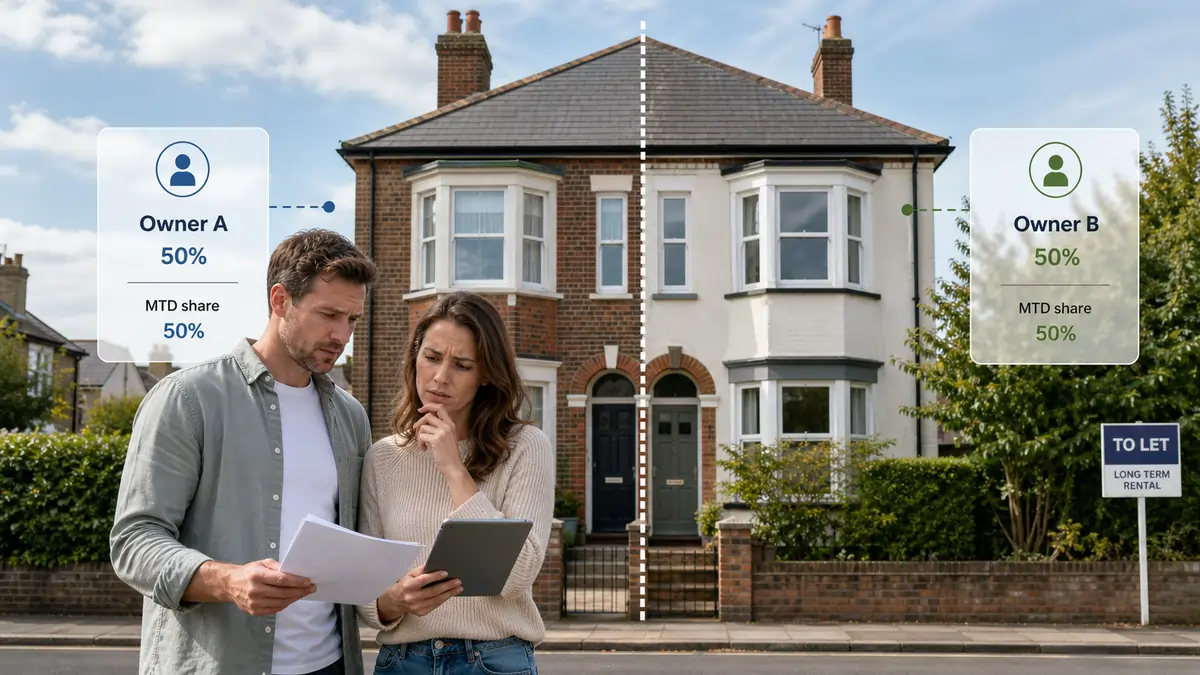
Three common scenarios show how the rules play out:
| Ownership | Income split | Owner A | Owner B | MTD scope |
|---|---|---|---|---|
| Joint tenants | 50/50 default | £40,000 | £40,000 | Both in scope from April 2027 (£30k threshold) |
| Tenants in common | 70/30 per deed | £25,200 | £10,800 | Owner A in scope April 2028 (£20k); Owner B stays on Self Assessment |
| Tenants in common | 10/90 via Form 17 | £3,000 | £27,000 | Owner B in scope April 2028 (or sooner with other income); Owner A remains out |
A quick note on terminology: "joint tenants" and "tenants in common" are legal terms for two different forms of co-ownership — they refer to owners, not to the people renting the property. Joint tenants own the whole property together with equal rights; tenants in common can hold unequal shares.
Scenario 1: Both spouses in scope, equal split
Anya and David jointly own three buy-to-let properties as joint tenants. Total gross rent: £80,000 a year. As a married couple, the 50/50 default applies, so each has £40,000 of property income.
- From April 2026 (£50,000 threshold): Total rent of £80,000, but each has £40,000 individually. Neither is in scope yet.
- From April 2027 (£30,000 threshold): £40,000 each is over the limit. Both now need to register for MTD. Each submits their own quarterly updates covering their £40,000 share of the income. Expenses can be deferred to the year-end declaration.
Scenario 2: Tenants in common with unequal shares
Priya and her brother Rohan own a buy-to-let house as tenants in common. Priya owns 70%, Rohan owns 30%. Total rent: £36,000.
- Priya's share: £25,200. Rohan's share: £10,800.
- From April 2026 and April 2027: Both below the relevant thresholds.
- From April 2028 (£20,000 threshold): Priya's share is now over the £20,000 threshold and she needs to comply with MTD. Rohan is still below it and remains on the existing Self Assessment system.
This is the classic case of one joint owner being in scope while the other is not. They each handle their own affairs.
Scenario 3: Married couple using Form 17 to optimise
Sarah and Tom are married. Sarah is a higher-rate taxpayer; Tom is a basic-rate taxpayer. They own one buy-to-let as joint tenants generating £30,000 a year.
By default, HMRC splits the income 50/50 - £15,000 each. To shift more income to Tom (the basic-rate taxpayer), they:
- Sever the joint tenancy and register as tenants in common with shares of, say, 10% Sarah / 90% Tom.
- File Form 17 declaring the new beneficial interests within 60 days.
After that, Sarah declares £3,000 and Tom declares £27,000. From April 2027, Tom would be approaching the £30,000 MTD threshold (when added to other property and self-employed income), while Sarah would sit well below it.
Form 17 has to reflect the real beneficial ownership. You can't pick the split that suits you and use Form 17 to reverse-engineer it — the legal ownership needs to change first.
Do I need a separate bank account for jointly owned property?
No, HMRC does not require a separate bank account for rental property - joint or otherwise. But MTD requires digital records of every income and expense transaction. A dedicated rental account makes this far easier because every transaction is automatically tied to your property business.
If you and your co-owner both want to draw income directly, a joint rental bank account combined with landlord accounting software that supports ownership splits is usually the cleanest setup.
What happens if our circumstances change mid-year?
If your share of the property changes - for example, you move from joint tenants to tenants in common with unequal shares - the change takes effect from the date the new ownership is in place. For the tax year in which the change happens, you'll declare two periods on different splits.
Form 17 changes follow the same logic: the new split applies from the date the form is signed, not from the start of the tax year.
"Shared ownership" is not the same thing
Shared ownership is sometimes used loosely to mean co-ownership of a buy-to-let, but in UK property law it more commonly refers to the part-rent, part-buy scheme run by housing associations. Shared ownership homes under the scheme can usually only be let in narrow circumstances and most of this article will not apply to them. If you are a buy-to-let landlord using "shared ownership" to mean joint ownership, the rules above apply. If you are a shared ownership leaseholder thinking about letting your home, talk to your housing association first.
Getting ready for your quarterly submissions
If you co-own a rental property and either of you is likely to cross the relevant threshold in the next two tax years, three things are worth doing now.
- Confirm how you legally own the property. Joint tenants or tenants in common? If you are not sure, the deeds or Land Registry will tell you. The HMRC joint property ownership guidance sets out the legal framework.
- Decide whether the default income split is right for you. If one of you is a higher-rate taxpayer and the other isn't, it may be worth speaking to an accountant about whether Form 17 makes sense for your situation.
- Pick MTD-compatible software that handles ownership splits. You'll need to record income and expenses digitally from day one of the relevant tax year. Software that assigns ownership percentages per property removes most of the manual reconciliation.
Landlord Studio is HMRC-recognised MTD-compatible software and handles joint ownership at the property level, so each owner's quarterly updates pull through their correct share automatically.
About Landlord Studio
.webp)
Landlord Studio is an easy to use MTD compliant property management and accounting software designed for UK landlords.
Track income and expenses, run reports,, find and prescreen tenants, manage property maintenance, and more.
.webp)