Welcome! Where would you like to log in?

Sign up and get
PRO free for 14 days
Once your PRO trial is over you can continue using Landlord Studio GO completely free.
By continuing you agree to our Terms & Conditions.

Visiting from the
United Kingdom?
Please visit our United Kingdom site for a better experience
Continue
Net Cash Flow For Rental Property: Formula, Examples And Benchmarks
The net cash flow formula describes income and expenses during a given period of time helping investors understand profit and loss.

Read summarized version with:


Last updated: 10 August 2026
Net cash flow on a rental property is the cash left after every cash expense is paid: rent collected minus mortgage payments, property taxes, insurance, maintenance, management fees and vacancy costs. It differs from profit because it excludes depreciation, a non-cash deduction. A rental property can show a negative taxable profit and still be cash-flow positive.
Knowing your net cash flow means accurately tracking income and expenses which is an essential part of being a landlord. For any company, tracking income and expenses is crucial. For real estate investors knowing how your business is performing financially will determine what you do next, whether or not you can refinance and reinvest equity, or whether you need to consolidate assets, raise rents or reduce overheads. This is where the net cash flow formula comes in.
What Is Net Cash Flow On A Rental Property?
Net cash flow is a measurement of the money coming in and the cash going out of your rental business during a given period of time. Knowing your cash flow can help you better understand and manage day-to-day expenses like maintenance costs and professional fees or other operating expenses. It differs from profit, which is an overall indicator of financial health after expenses have been deducted.
While negative cash flow is not always a red flag (for example, it can be caused by delayed payments or high initial costs associated with expansion or capital improvements), most landlords focus on owning rental properties with positive cash flow.
If you have periods of repeated positive cash flow after expenses, it’s a good sign that you’ll be able to further scale your portfolio by reinvesting the money you have made back into it. On the other hand, negative cash flow will limit your ability to grow your portfolio to its full potential.
The net cash flow formula can be used on individual properties or your whole portfolio to give you a tailored insight into your income and expenses. It is most commonly measured on a monthly and annual basis but can be calculated at any time.
How Is Net Cash Different From Net Cash Flow?
Net cash serves as a gauge of a company’s liquidity, indicating its ongoing ability to fulfill financial commitments, such as paying operational expenses and making debt payments.
To calculate net cash, begin by summing up all cash receipts (excluding credit transactions) during a specified period, commonly referred to as “gross cash.” Subsequently, subtract the cash outflows allocated to obligations and liabilities from the gross cash total, resulting in the net cash figure.
In the realm of real estate, “net cash” often takes on a different connotation and may refer to the net cash flow generated by a real estate investment. Net cash flow in real estate is the surplus cash that remains after deducting all operating expenses and debt service from the rental income or revenue generated by a property.
How Do You Calculate Net Cash Flow On A Rental Property?
The Net Cash Flow Formula
Net cash flow can be calculated by taking the total cash inflow of a business and subtracting the total cash outflow over a specific period of time.
Net cash flow = Total cash in – Total cash out
The total cash inflow includes rent as well as income like pet rent and laundry fees, whereas the total cash outflow includes expenses like maintenance and financing costs.
.jpg)
Worked Example: Net Cash Flow On A Single-Family Rental
The figures below are an illustration of the method, not market averages. Substitute your own numbers. The vacancy allowance is set at the national rental vacancy rate of 7.3%.
- Gross monthly rent: $1,800
- Vacancy allowance at 7.3% of rent: minus $131
- Effective rent collected: $1,669
- Mortgage payment, principal and interest: minus $1,010
- Property taxes: minus $225
- Insurance: minus $95
- Maintenance reserve: minus $120
- Property management at 8% of collected rent: minus $134
- Total cash out: $1,584
- Net cash flow: $85 per month
In this example the property produces net cash flow of $85 a month, or $1,020 a year. Note what the figure does not include: depreciation is left out because no cash leaves the account, and the mortgage principal is included in full because it does.
Net Cash Flow Vs Profit: Why They Differ For Landlords
Net cash flow and profit differ mainly because of depreciation. Depreciation is a deduction you claim on your tax return without spending any cash, so it reduces taxable profit while leaving net cash flow untouched.
The IRS requires residential rental property to be depreciated over 27.5 years under the General Depreciation System, using the straight line method (IRS Publication 527). On a building with a $220,000 depreciable basis that is $8,000 a year of deduction that never leaves your bank account.
That is why a rental property can report a taxable loss and still be cash-flow positive. The reverse also happens: the mortgage principal is a real cash outflow but is not a deductible expense, so a property can show taxable profit while cash flow is tight.
Depreciation is also recaptured when you sell the property, which is a separate calculation. See depreciation and depreciation recapture for how that works.
What Counts As Good Cash Flow On A Rental Property?
There is no single dollar figure that counts as good cash flow on a rental property, because the answer depends on the rent, the capital invested and the local market. The useful test is whether net cash flow is reliably positive after a realistic vacancy and maintenance allowance, and whether the return on the cash you invested justifies the risk.
Two screening methods do most of the work. The 1% rule checks whether monthly rent is at least 1% of the purchase price before you buy. Cash on cash return then measures annual net cash flow against the cash you actually put in, which lets you compare a property producing $85 a month against one producing $400 a month on equal terms.
Build the vacancy allowance in from the start. The national rental vacancy rate was 7.3% in the second quarter of 2026, and the median asking rent for vacant units was $1,531, according to the US Census Bureau Housing Vacancy Survey. Budgeting for twelve months of rent on a property that will realistically sit empty for part of the year is the most common way landlords overstate cash flow.
Three caveats matter. Net cash flow ignores depreciation, so it is not a measure of taxable profit. It ignores equity build-up and appreciation, so a property with thin cash flow can still be a sound investment. And a single strong month tells you nothing: judge cash flow across a full year using a rental property income statement, and compare it against how much profit you should expect to make on a rental property.
Ways To Increase Cash Flow
Positive cash flow is the goal, but you may still encounter hidden costs from time to time that may hinder it. Many of these hidden costs are beyond your control and cannot be prepared for but there are some ways to maximize cash flow in the meantime:
- Increase rent (within reason)
- Renovate and upgrade to add value
- Use online rent collection to help prevent late payments
- Enforce late fees
- Charge monthly pet rent
- Reduce tenant turnover through comprehensive screening
Ensuring you have a healthy cash flow will provide you with a safety net, should you run into trouble in the future.
Related: 11 Ways Landlords Can Increase Cash Flow With Additional Revenue Streams
Limitations Of The Net Cash Flow Formula
As useful as the net cash flow formula can be, it is not all-encompassing. Some of the drawbacks are as follows:
- It does not tell the full story
- It does not take non-cash expense deductions into account such as depreciation
- It does not assess the profitability of the business
- It’s heavily dependent on the market you are in – one size does not fit all
The 1% Rule And What This Means For Net Cash Flow
The 1% rule states the monthly rent collected on a property should be equal to or greater than 1% of the purchase price. For example, if you were to buy a property for $100,000, you should charge at least $1000 in monthly rent to cover the cost of your investment. In this sense, the 1% rule is a calculation that can help you determine whether a potential investment is going to provide you with steady cash flow.
When assessing a potential investment, you can also use the net cash flow formula to decide whether the investment is worth it. To calculate this, you will need to know the expected income and expenses of the property.
Other Useful Formulas For Landlords
Net cash flow is just one formula that can be used by landlords to measure the financial health of their rental portfolios. Some other useful metrics that landlords should be familiar with are:
- Net Operating Income (NOI)
- Capitalization Rate (Cap Rate)
- Cash on Cash Return
- Gross Rent Multiplier (GRM)
- Occupancy Rates
- Rental Yield
- After Repair Value (ARV)
- Operating Expense Ratio (OER)
While none of these formulas give you a full picture when used alone, they can be used in conjunction with each other to shed light on how your rental properties or potential investments are performing. As well as formulas, calculators for landlords can also be used to determine cash flow, net yield, rental yield, and more.
Frequently Asked Questions
How Do You Calculate Net Cash Flow On A Rental Property?
Subtract total cash out from total cash in over the same period. Cash in is rent collected plus any other income such as pet rent, parking or laundry. Cash out is the full mortgage payment, property taxes, insurance, maintenance, management fees and every other cash expense. Do not subtract depreciation, because no cash leaves the account.
What Is A Good Net Cash Flow On A Rental Property?
A good net cash flow is one that stays positive after a realistic vacancy and maintenance allowance has been deducted. A dollar figure on its own means little, because it ignores how much capital you invested, so judge it alongside cash on cash return. Use the 1% rule to screen deals before you buy.
Is Net Cash Flow The Same As Profit?
No. Net cash flow measures cash movement only, while profit also deducts non-cash items, chiefly depreciation. The IRS requires residential rental property to be depreciated over 27.5 years, so the two figures can diverge sharply. A rental property can report a taxable loss and still be cash-flow positive.
What Is Negative Cash Flow On A Rental Property?
Negative cash flow is when cash expenses exceed the cash collected over a period. It is not automatically a red flag, because it can be caused by a one-off repair, a capital improvement or a gap between tenancies. Sustained negative cash flow with no identifiable cause is the problem to act on.
Does Net Cash Flow Include The Mortgage Principal?
Yes. The entire mortgage payment, principal and interest, is a cash outflow, so the whole payment reduces net cash flow. Tax treatment is different: IRS Publication 527 states you cannot deduct your mortgage or principal payments as an expense, although mortgage interest on a rental property is deductible. This is one of the main reasons net cash flow and taxable profit diverge.
Final Words
The net cash flow formula is one of many calculations that landlords should be using. As well as working to give you a clearer picture of your business’s daily financial health, the formula can also help you decide whether or not it is a viable time to expand your rental property portfolio.
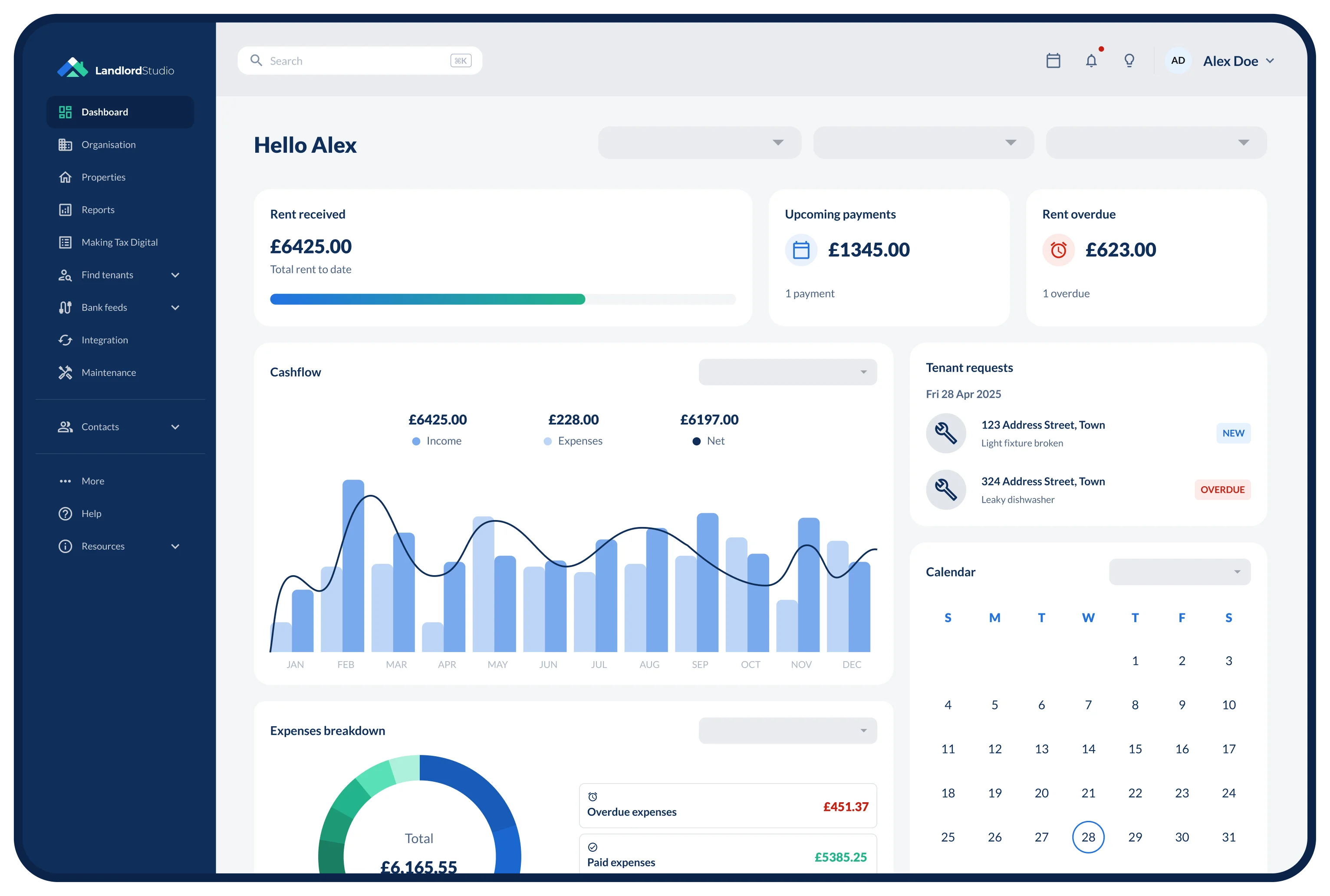
Purpose-built property management software like Landlord Studio, allows you to track your income and expenses throughout the year, collect rent online, digitize receipts, and categorize expenses. In short, by digitizing and storing your records in Landlord Studio, you can easily access the data you need to calculate net cash flow at any given time.
You Might Also Like


About Landlord Studio

Landlord Studio is an easy to use property management and accounting software designed for landlords.
Find and screen tenants, collect rent online, track income and expenses, run reports, and more - all for free.
Create your FREE account with Landlord Studio today.

From finding tenants to filing taxes. Reduce vacancies and maximize your portfolio ROI with software designed for you.
Get started for free