Pro Rata Rent Calculator

Work out pro rata rent when a tenancy starts or ends partway through a rent period. Compare the two common daily-rate methods and, in England, check your tenancy deposit against the legal cap before you take any money.

Illustration of two blue houses with a tree between them

For monthly rent. Deposit rules and legal notes are for private assured tenancies in England only.

The date the tenancy begins.
The day of the month rent is paid. If it is later than the last day of a short month, the last day is used.
Daily rate method
Use the method your tenancy agreement states. The 365-day method uses 365 even in a leap year.
Deposits (optional)
Capped at 5 weeks' rent, or 6 weeks if the annual rent is £50,000 or more.
Capped at one week's rent. Most other move-in fees are banned under the Tenant Fees Act 2019.
Estimate only. Under the Renters' Rights Act 2025, for private assured tenancies in England, you can't ask for, encourage or accept rent before the tenancy agreement is signed, and before the tenancy starts you can take no more than the rent for the first rent period. A tenant who has paid rent for days after the tenancy ends is entitled to that part back (Housing Act 1988, s.14ZC). Deposit caps come from the Tenant Fees Act 2019. Scotland, Wales and Northern Ireland have their own rules. Not legal advice.

How to manually calculate pro rata rent

Work out a daily rate from the monthly rent, then multiply it by the number of days the tenant is charged for. Use whichever daily-rate method your tenancy agreement states.
Rent in advance rules explained →
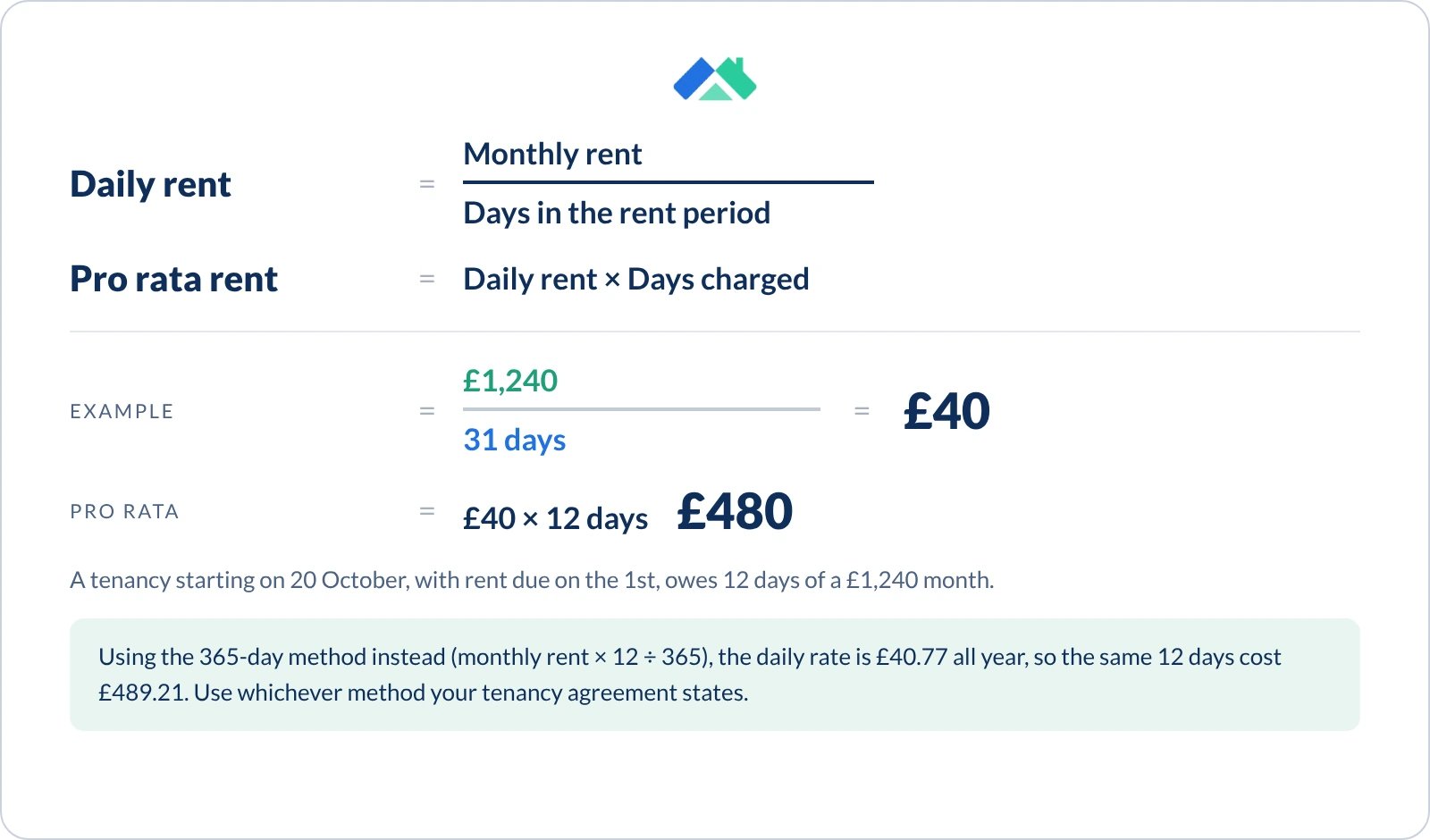
Pro rata rent formula: daily rent equals monthly rent divided by days in the rent period, then multiplied by days charged. Example: £1,240 over 31 days is £40 a day, so 12 days is £480.
Step 1

Work out the daily rate

Divide the monthly rent by the days in that rent period, or multiply it by 12 and divide by 365. Check which one your tenancy agreement uses.

Step 2

Count the days charged

For a new tenancy, count from the start date up to the day before the first rent day. For a tenancy ending, count from the last rent day up to and including the end date.

Step 3

Multiply and put it in writing

Multiply the daily rate by the days charged. Show the working in the tenancy agreement or on the first rent demand so there's no dispute later.

Worked example

‍

Rent is £1,250 a month, the tenancy starts on 20 October and rent is due on the 1st.

‍

Daily rate = £1,250 ÷ 31 = £40.32

‍

Pro rata rent = £1,250 ÷ 31 × 12 days = £483.87

‍

With the 365-day method: £1,250 × 12 ÷ 365 × 12 days = £493.15

‍

Calculator icons

Other calculators you might be interested in

Landlord Studio icon

Rent to Income Ratio Calculator

Check whether a tenant can afford the rent against a commonly used affordability benchmark.

Landlord Studio icon

Open Market Rent Calculator

Check local market rent and build defensible evidence for a Section 13 rent increase.

Landlord Studio icon

Late Rent Interest Calculator

Work out the most interest you can charge on late rent under the Tenant Fees Act.

How pro rata rent works in the UK

Icon of a document with a pound sign

Two ways to work out the daily rate

Some tenancy agreements divide the monthly rent by the actual days in that rent period, so a day in February costs more than a day in March. Others use the 365-day method: monthly rent × 12 ÷ 365, the same daily rate all year, including in a leap year.

The difference can be large. On £1,250 a month, 27 days of a 28-day period is £1,205.36 by actual days but £1,109.59 by the 365-day method. Write the method into the tenancy agreement and use it every time.

Icon of a rising data chart with a magnifying glass

Rent in advance is capped

For private assured tenancies in England, you can't ask for, encourage or accept rent before the tenancy agreement is signed. Before the tenancy starts, you can take no more than the rent for the first rent period.

If that first period is a short pro rata one, the pro rata amount is the most rent you can take up front. Collect the next full month on its due date.

Illustration of a landlord reviewing a rental performance dashboard on a phone

Why use our pro rata rent calculator?

  • Handles tenancies that start or end partway through a rent period
  • Works with any rent day, not just the 1st
  • Shows both daily-rate methods side by side, so you can see the difference
  • Checks your tenancy deposit and holding deposit against the caps in England
  • Shows the rent to repay if a tenancy ends after a full month was paid
  • Free, fast and no sign-up

‍

FAQs

What is pro rata rent?

Plus Icon

Pro rata rent is a part-period charge for a tenancy that starts or ends partway through a rent period. The tenant pays for the days the tenancy covers rather than a full month.

It comes up when the rent day differs from the day the tenancy starts, for example rent due on the 1st and a tenancy starting on the 20th, or when a tenancy ends partway through a rent period.

How do you calculate pro rata rent?

Plus Icon

Work out a daily rate, then multiply it by the days charged. The daily rate is either the monthly rent divided by the actual days in that rent period, or the monthly rent × 12 ÷ 365.

On £1,250 a month, with the tenancy starting on 20 October and rent due on the 1st, the tenant is charged for 12 days: £483.87 using the actual days in October, or £493.15 using the 365-day method.

Do I have to charge pro rata rent when a tenancy starts?

Plus Icon

Only if the rent day and the start date differ. If rent falls due on the same day of the month that the tenancy starts, every payment is a full month and there is nothing to pro rata.

If you set a different rent day, such as the 1st of the month, the first rent period is shorter and its rent is pro rata. Put the rent day and the first payment in the tenancy agreement.

How much can I take before the tenancy starts?

Plus Icon

For private assured tenancies in England, you can't ask for, encourage or accept rent until the tenancy agreement is signed. After that, you can take the rent for the first rent period before the tenancy starts, plus a tenancy deposit of up to 5 weeks' rent, or 6 weeks if the annual rent is £50,000 or more. A holding deposit is capped at one week's rent.

Asking for, encouraging or accepting rent before the agreement is signed can lead to a civil penalty of up to £5,000, or up to £30,000 for a repeat breach. Most other fees are banned under the Tenant Fees Act 2019. Scotland, Wales and Northern Ireland have their own rules.

Is rent pro rata when a tenancy ends mid-month?

Plus Icon

Yes, if the tenancy legally ends partway through a rent period. For assured tenancies in England, a tenant who has paid rent for days after the tenancy ends is entitled to have that part repaid (Housing Act 1988, section 14ZC).

Moving out does not end a tenancy on its own. Unless the landlord has agreed a shorter period in writing, a tenant must give at least two months' written notice, and GOV.UK guidance says the tenancy should then end on a rent day or the day before.