


Late Rent Interest Calculator
Work out the most interest you can legally charge a tenant in England for late rent. Enter the rent due, the due date and any payments, and the calculator applies the Tenant Fees Act cap of 3% above the Bank of England base rate, day by day.

How to work out interest on late rent
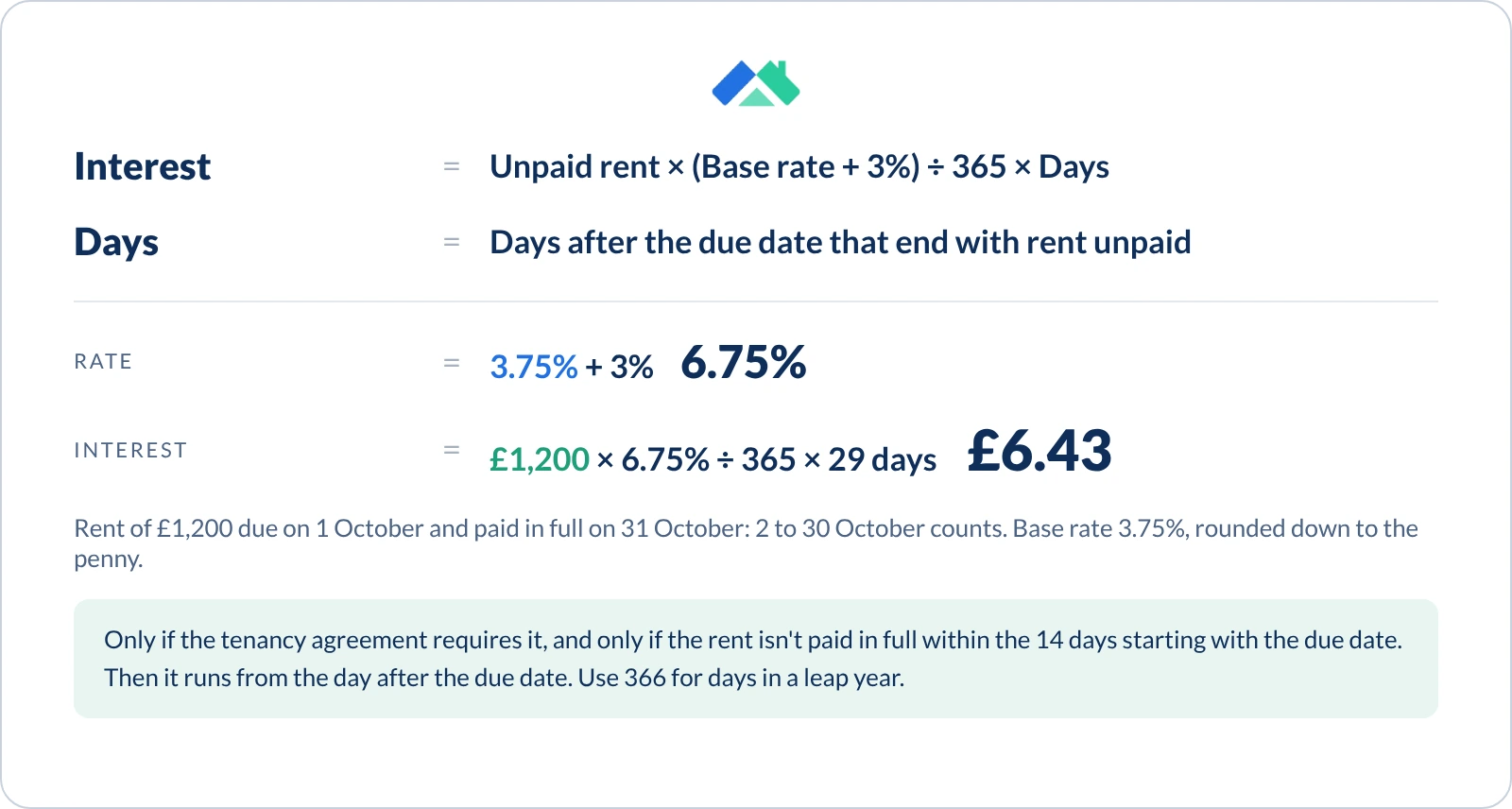
Check the 14-day rule first. If interest is allowed, apply the annual rate to the rent still unpaid at the end of each day after the due date.
Check the 14-day rule
If the tenant paid in full within the 14 days starting with the due date, stop: you can't charge interest. Check that your tenancy agreement allows it.
Find the annual rate
Add 3% to the Bank of England base rate. If your agreement sets a lower rate, use that instead. If the base rate changed, use the rate in force on each day.
Apply it day by day
For each day after the due date that ends with rent unpaid, multiply what's still owed by the rate and divide by 365 (366 in a leap year). Don't count the day the rent is paid in full. Add the days up and round down to the penny.
Worked example
Rent of £1,200 is due on 1 October and paid in full on 31 October. The base rate is 3.75%.
The 14 days from 1 October end on 14 October and the rent was still unpaid, so interest is allowed.
Days = 2 to 30 October = 29 (31 October ends with the rent paid, so it doesn't count)
Rate = 3.75% + 3% = 6.75%
Interest = £1,200 × 6.75% ÷ 365 × 29 days = £6.4356, rounded down to £6.43

Other calculators you might be interested in

Rent to Income Ratio Calculator
Check whether a tenant can afford the rent against a commonly used affordability benchmark.
Open Market Rent Calculator
Check local market rent and build defensible evidence for a Section 13 rent increase.
Pro Rata Rent Calculator
Work out the rent for a tenancy that starts or ends partway through a rent period.

Manage up to 3 rental properties for free!
Sign up and get PRO free for 14 days. When the trial ends, keep tracking rent, expenses and reports for up to 3 properties, free forever with Landlord Studio GO.
By continuing you agree to our Terms & Conditions. · Already have an account? Log in
How late rent interest works in England

Nothing for 14 days, then backdated
You can only charge interest if the rent is still unpaid at the end of the 14 days starting with the due date. Once it is, the Act lets you charge for each day after the due date that ends with rent unpaid, not just from day 14.
On £1,200 due on 1 October and paid in full on 31 October, that's 29 days (2 to 30 October): up to £6.43 at 6.75%.

Only what your agreement allows
Interest has to be written into the tenancy agreement, and only on the amount still unpaid. Anything above 3% over base rate is a banned payment.
A flat late-payment fee on top isn't allowed under the Tenant Fees Act 2019.

Why use our late rent interest calculator?
- Applies the Tenant Fees Act cap of 3% above base rate
- Checks the 14-day rule and tells you if interest can't be charged yet
- Handles part payments and base rate changes, day by day
- Caps your agreement's rate if it's above the legal maximum
- Free, fast and no sign-up
