


Rent to income Ratio (Free Calculator for Landlords)
Check whether a tenant can afford the rent against the 30x rule letting agents use, or set your own percentage. Add a guarantor to see whether they cover the shortfall, and work out the highest rent an income supports.

How to manually calculate a tenant's rent to income ratio
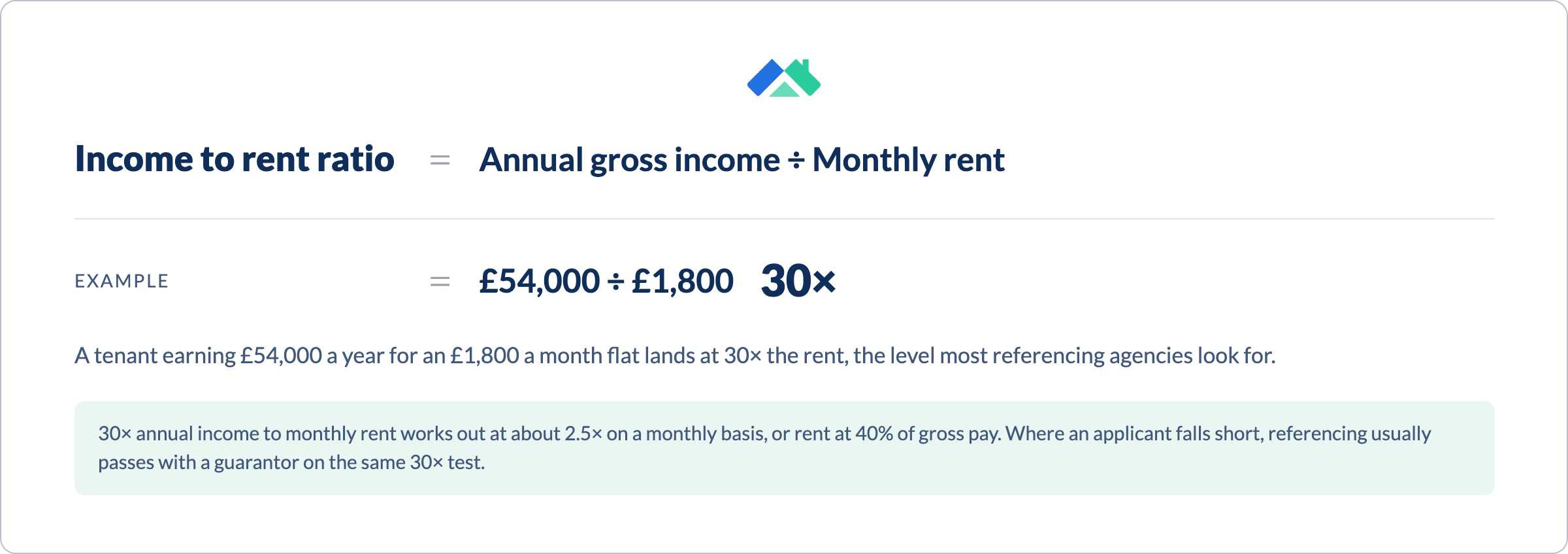
Rent to income ratio is the monthly rent divided by the tenant's gross monthly income, times 100. Most letting agents want annual income of at least 30 times the monthly rent, which puts rent at 40% of gross income.
Work out gross annual income
Income before tax, from every verified source — wages, pension, regular self-employed income and benefits. Referencing agencies check this against payslips, an employer's reference, or accounts and tax returns.
Multiply the monthly rent by 30
That is the annual income the tenant needs under the standard letting-agent rule. For a joint tenancy, use the applicants' combined income against the same figure.
Check the percentage it implies
Divide the monthly rent by monthly gross income and multiply by 100. The 30x rule works out at 40% of income. Some landlords use a tighter 3x monthly rent instead, which is 33%, so be clear which one you mean before you rely on it.
Worked example
A tenant earning £36,000 a year gross, applying for a home at £1,200 a month.
Rent to income ratio = (£1,200 ÷ £3,000) × 100 = 40%
30x the monthly rent = £1,200 × 30 = £36,000 a year — met exactly, so there is no headroom at all if the rent rises

Other calculators you might be interested in

Open Market Rent Calculator
Check local market rent and build defensible evidence for a Section 13 rent increase.
Rental Yield Calculator
Work out the gross and net yield on a rental property to see what your investment really returns.
Buy-to-Let Mortgage Calculator
Estimate monthly payments and check whether your rent passes the lender's ICR stress test.

Manage up to 3 rental properties for free!
Sign up and get PRO free for 14 days. When the trial ends, keep tracking rent, expenses and reports for up to 3 properties, free forever with Landlord Studio GO.
By continuing you agree to our Terms & Conditions. · Already have an account? Log in
What the affordability test does and doesn't do

30x is convention, not law
Most letting agents want annual income of 30 times the monthly rent. It is an industry habit rather than a legal threshold, and agencies set it slightly differently.
You will also see 3x the monthly rent quoted, which is a stricter 33% rather than 40%. The two get used interchangeably and they are not the same test.

Benefit income counts toward your threshold
Under the Renters' Rights Act 2025 it is unlawful in England to refuse a tenancy, withhold a viewing, or make renting harder because someone receives benefits or has children.
Setting an income threshold is still lawful — but benefit income counts toward it, and you must not separate applicants on those grounds once they have met it.

Why should you use our rent to income ratio calculator?
- Screens against the 30x rule, a 30% or 35% threshold, or your own percentage
- Adds a guarantor and checks them against the 36x cover agents usually ask for
- Works backwards — enter the income to get the highest rent that clears your rule
- Combines joint applicants' income, and shows the headroom or shortfall in pounds
- Free, fast and no sign-up
