BRRR Calculator

Estimate how much of your own money stays in a buy, refurbish, refinance, rent (BRRR) deal. The calculator adds stamp duty at the higher rates, refurbishment and holding costs, then estimates how much a buy-to-let lender might lend against the new value and the rent, using assumptions you can change.

Illustration of two yellow houses with a tree between them

For individuals buying in England and Northern Ireland. Figures are estimates before tax, using the assumptions you enter. Scotland and Wales use different property taxes.

1. Buy

Stamp duty has its own residence test. Buying through a company? Companies usually pay the higher rates even on a first property, and some purchases over £500,000 pay a flat 17% unless a relief applies, so get advice.
0 if you buy with cash. A bridging loan or mortgage is repaid at refinance.
Interest only, for the months before you refinance.

2. Refurbish

Some lenders want you to have owned, and sometimes let, the property for six months before lending on the new value. Check with your broker.
Council tax, insurance and utilities while the property is empty.

3. Refinance and rent

75% is an illustrative default. Lenders set their own limits.
Cash flow assumes an interest-only mortgage.
Arrangement, valuation and legal fees.
Letting fees, repairs, insurance and empty periods.
Lender's rental cover test (illustrative)
125% is a common minimum. Lenders can set higher thresholds, often for higher-rate taxpayers, or also look at your personal income.
5.5% is an illustrative assumption. Lenders may test at their product rate plus at least 2 points, and treat five-year fixes differently.
Estimate only. Stamp duty uses the England and Northern Ireland bands in force from 1 April 2025, with the 5% surcharge for additional homes that applies from 31 October 2024. The refinance loan is an estimate under the loan-to-value, rental cover and stress rate you enter; lenders make their own decisions and may also assess your income. Cash flow is before tax and assumes an interest-only mortgage. For individual residential landlords, relief for finance costs is generally given as a basic-rate tax reduction, subject to limits (Section 24). Not financial advice.

How to work out the money left in a BRRR deal

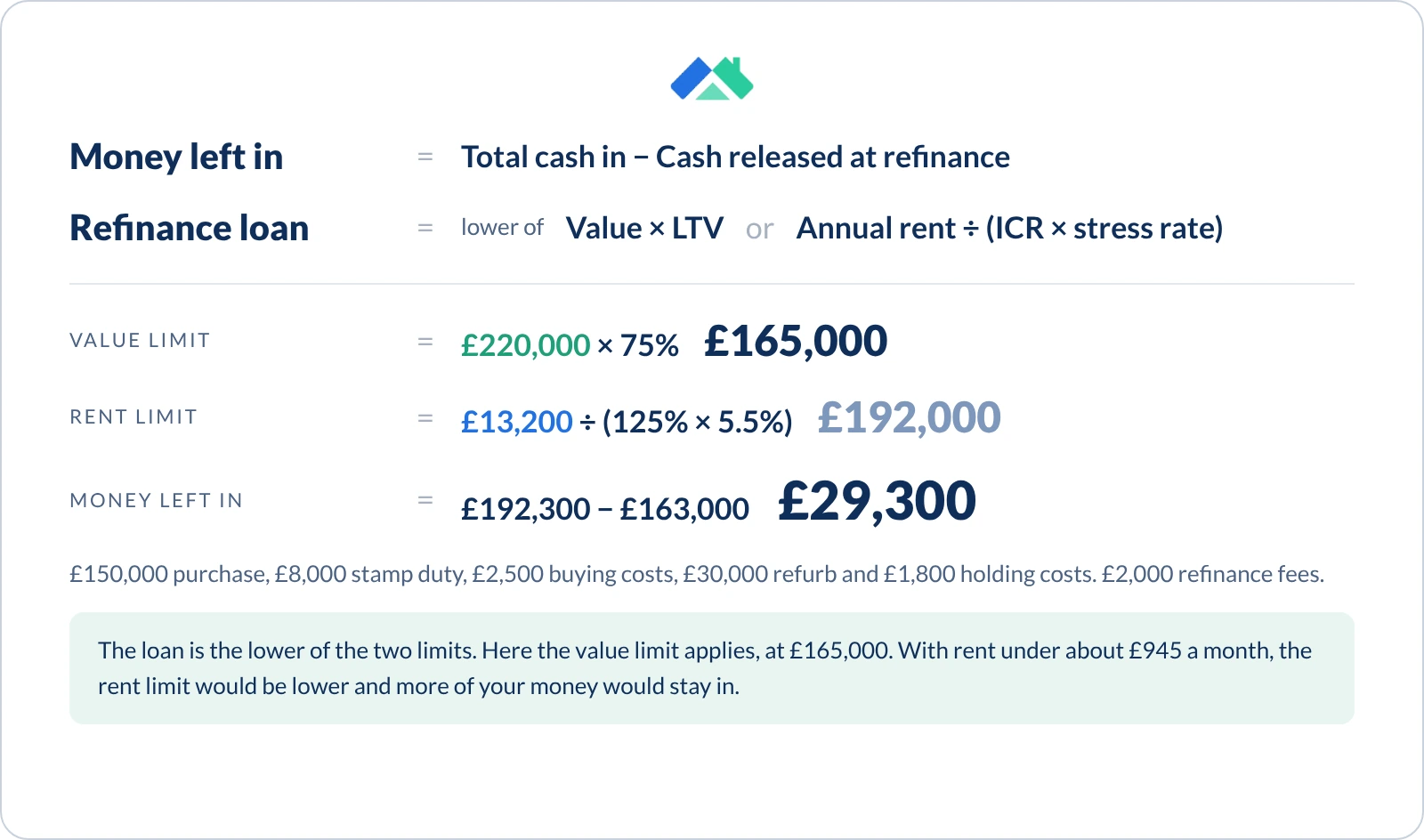
Add up everything you put in, then take away what the refinance gives back. The refinance loan is the lower of the loan-to-value limit and the most the rent will support.
Check your buy-to-let mortgage →
BRRR formula: money left in equals total cash in minus cash released at refinance. Example: £192,300 minus £163,000 leaves £29,300 in the deal.
Step 1

Add up everything you put in

Purchase price, stamp duty, legal and survey fees, the refurbishment, and the holding costs and loan interest until you refinance. Take off anything you borrowed to buy.

Step 2

Work out the refinance loan

Multiply the new value by the lender's loan-to-value. Then divide the annual rent by the interest cover ratio times the stress rate. The loan is the lower of the two.

Step 3

Take away what the refinance releases

Subtract any purchase loan it repays and the refinance fees. What's left of your cash in the deal is the money left in.

Worked example

‍

£150,000 purchase, £8,000 stamp duty at the higher rates, £2,500 buying costs, £30,000 refurbishment and £300 a month holding costs for 6 months.

‍

Total cash in = £192,300

‍

Value limit = £220,000 × 75% = £165,000. Rent limit = £13,200 ÷ (125% × 5.5%) = £192,000. Loan = £165,000

‍

Cash released = £165,000 − £2,000 fees = £163,000

‍

Money left in = £192,300 − £163,000 = £29,300

‍

Calculator icons

Other calculators you might be interested in

Landlord Studio icon

Buy-to-Let Mortgage Calculator

Estimate monthly payments and check whether your rent passes the lender's ICR stress test.

Landlord Studio icon

Stamp Duty Calculator

Work out the stamp duty on a purchase, including the higher rates for additional homes.

Landlord Studio icon

Rental Yield Calculator

Work out the gross and net yield on a rental property to see what your investment really returns.

What decides a BRRR deal in the UK

Icon of a rising data chart with a magnifying glass

The rent can cap your refinance

Lenders don't only look at the value. Many test that the rent covers a set share of the mortgage interest at a stressed rate, for example 125% at 5.5%.

On those illustrative figures, £1,100 a month supports a loan of about £192,000, however much the property is worth.

Icon of a document with a pound sign

Stamp duty is higher on a second home

If you already own a home, you'll usually pay the higher rates: 5% on top of every band in England and Northern Ireland. On a £150,000 purchase that's £8,000, against £500 at standard rates.

Plan for it in the money you need up front, because the refinance doesn't give it back.

Illustration of a landlord reviewing a rental performance dashboard on a phone

Why use our BRRR calculator?

  • Adds stamp duty at the higher rates, plus the 2% non-resident surcharge if it applies
  • Includes bridging interest and holding costs while you refurbish
  • Estimates the refinance against both loan-to-value and a rental cover test you can adjust
  • Shows the money left in, monthly cash flow on an interest-only mortgage and the return on the money left in
  • Free, fast and no sign-up

‍

FAQs

What is the BRRR strategy?

Plus Icon

BRRR stands for buy, refurbish, refinance, rent. You buy a property below its potential value, refurbish it to add value, then refinance onto a buy-to-let mortgage based on the new valuation.

The aim is to pull most of your money back out and keep a let property. In the US it's often called BRRRR, with an extra R for repeat.

How much money will I leave in a BRRR deal?

Plus Icon

Add up the purchase price, stamp duty, buying costs, refurbishment and holding costs. Take away what the refinance releases after repaying any purchase loan and fees.

A £150,000 purchase with £8,000 stamp duty, £2,500 buying costs, a £30,000 refurb and £1,800 holding costs comes to £192,300. Refinancing at 75% of a £220,000 value raises £165,000, or £163,000 after £2,000 fees, leaving £29,300 in the deal.

How long do I have to wait before I can refinance?

Plus Icon

It depends on the lender. Some buy-to-let lenders want you to have owned the property, and sometimes let it, for six months before they'll lend on a new, higher valuation; others will do it sooner.

Check with a mortgage broker before you buy, because the wait adds to your holding costs.

Will the rent limit how much I can refinance?

Plus Icon

It can. Many buy-to-let lenders test that the rent covers a set share of the mortgage interest at a stressed rate, for example 125% at 5.5%. Some test at their product rate plus 2 points, ask higher-rate taxpayers for more cover or look at your personal income.

If the rent is too low, the loan may be capped below the loan-to-value limit and more of your money stays in. The calculator's figures are illustrative, so you can change them.

Do I pay higher-rate stamp duty on a BRRR purchase?

Plus Icon

Usually. If you'll own more than one residential property once you've bought it, the higher rates apply: 5% on top of each band in England and Northern Ireland.

Properties under £40,000 don't attract the higher rates or the non-resident surcharge, and companies buying residential property usually pay the higher rates. Scotland and Wales have their own taxes.