


What Happens If You Don’t Declare Your Rental Income (UK)?
Undeclared rental income: HMRC penalty bands, how far back HMRC can go, and how the Let Property Campaign works for UK landlords in 2026.

.webp)
Read summarised version with:

ChatGPT

Gemini

Claude

Grok

Add as preferred on Google
Quick answer: If you do not declare rental income, HMRC can recover the unpaid tax, charge daily interest on it, and add a penalty calculated as a percentage of that unpaid tax. The percentage depends on why the income went undeclared: 0% to 30% for a non-deliberate failure, 20% to 70% for a deliberate one, and 30% to 100% where income was deliberately concealed. Telling HMRC before it contacts you gives you the lower end of each range.
Last updated: 10 August 2026. Rates and thresholds on this page apply to the 2025 to 2026 UK tax year unless stated otherwise. HMRC tax rules apply UK-wide, covering England, Wales, Scotland and Northern Ireland. This guide is general information, not tax advice. Speak to a qualified tax adviser about your own circumstances.
Renting out property in the UK can be lucrative but it also comes with an array of legal obligations. From routine property inspections to safety certificate renewals to, perhaps the most critical of these for landlords, ensuring they report all rental income to HMRC.
Failing to declare rental income can lead to substantial repercussions, including financial penalties and legal action, though the latter is generally reserved for instances of deliberate deception.
This guide aims to shine a light on the potential penalty for not declaring rental income, how landlords can stay compliant, and how to declare rental income accurately to avoid issues further down the line.
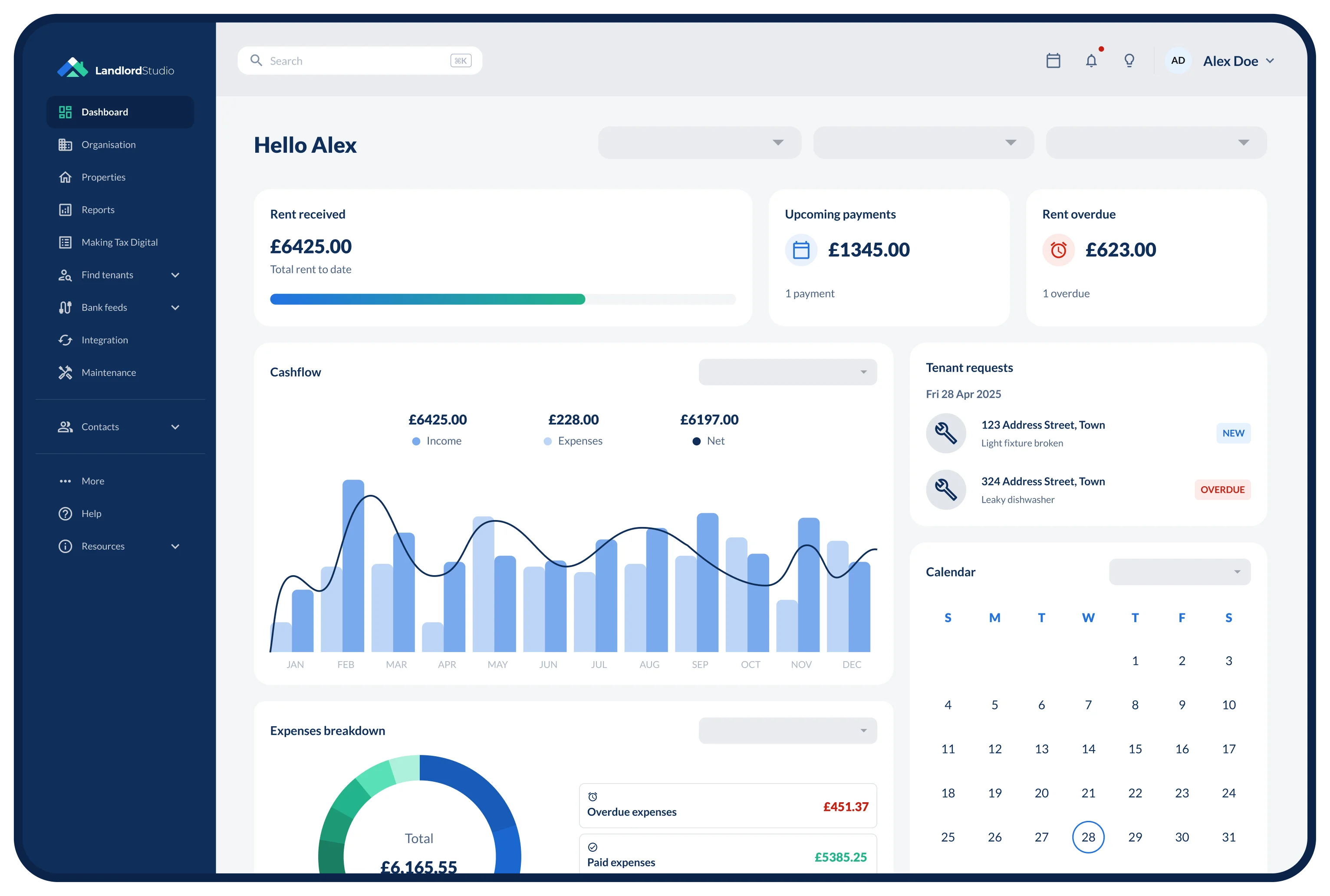
Landlord Tip: Dedicated property management tools such as Landlord Studio can be a godsend for landlords, enabling you to remain tax compliant while minimising risks and maximising efficiency.
What Is Rental Income?
When you earn income from renting out a property, it qualifies as taxable income under the Income Tax Act 2007. In the UK, the tax system demands that landlords report this income to HMRC via a Self-Assessment tax return. Failing to do so can lead to hefty penalties at best and legal consequences at worst.
No matter the scale of your rental property business, understanding the nuances of how to declare rental income is fundamental to your success, as it ensures you remain compliant and avoid potential fines. Ignorance of tax obligations is not a legal excuse. How far back HMRC can go depends on why the income was not declared: 4 years where you took reasonable care, 6 years where you were careless, and up to 20 years where you never told HMRC about the letting income or the failure was deliberate. The assessment time limits sit in the Taxes Management Act 1970, and the section on how far back HMRC can go below sets out each limit.
Penalty for Not Declaring Rental Income (UK)
Failing to declare rental income can result in severe penalties from HMRC. The penalty for not declaring rental income (UK) largely depends on how long the income has gone unreported and whether the failure was deliberate or accidental.
Types of Penalties
- Late Filing Penalties:
- £100 fine for missing the Self Assessment deadline (31 January for online submissions).
- After 3 months, daily penalties of £10 per day, up to a maximum of £900.
- After 6 months, a further penalty of 5% of the tax due or £300, whichever is greater.
- After 12 months, another 5% or £300, whichever is greater.
- Failure to Notify Penalties:
- 0% to 30% of the unpaid tax where the failure was non-deliberate.
- 20% to 70% where the failure was deliberate.
- 30% to 100% where the failure was deliberate and concealed.
- Penalties can reach 200% where the liability is an offshore one.
- Late Payment Penalties:
- 5% of the tax still unpaid at 30 days, again at 6 months, and again at 12 months.
- Interest Charges:
- HMRC charges interest on unpaid tax from the date it was due until the date it is paid, worked out on a daily basis. Late payment interest is set in legislation at the Bank of England base rate plus 4%, which gave a rate of 7.75% from 9 January 2026. Because the rate moves with the base rate, check the current figure on GOV.UK before working out what you owe.
What Are the Penalty Bands for Undeclared Rental Income?
The penalty is a percentage of the tax you should have paid, which HMRC calls the "potential lost revenue". The band you fall into depends on two things: HMRC’s view of your behaviour, and whether your disclosure was unprompted or prompted. The table below reproduces HMRC’s published penalty ranges for a failure to notify.
| Behaviour | Disclosure | Penalty range (% of unpaid tax) |
|---|---|---|
| Non-deliberate | Unprompted, within 12 months of the tax being due | 0% to 30% |
| Non-deliberate | Unprompted, 12 months or more after the tax was due | 10% to 30% |
| Non-deliberate | Prompted, within 12 months of the tax being due | 10% to 30% |
| Non-deliberate | Prompted, 12 months or more after the tax was due | 20% to 30% |
| Deliberate | Unprompted | 20% to 70% |
| Deliberate | Prompted | 35% to 70% |
| Deliberate and concealed | Unprompted | 30% to 100% |
| Deliberate and concealed | Prompted | 50% to 100% |
Stated in prose: for a non-deliberate failure the penalty range is 0% to 30% of the unpaid tax, rising to 10% to 30% once you are 12 months or more past the due date, and to 20% to 30% if the disclosure is prompted and more than 12 months late. For a deliberate failure the range is 20% to 70% unprompted and 35% to 70% prompted. For a deliberate and concealed failure it is 30% to 100% unprompted and 50% to 100% prompted. HMRC will not charge a penalty at all for a non-deliberate failure where you had a reasonable excuse and put things right without unreasonable delay.
This is where the unprompted-versus-prompted distinction matters most. HMRC calls a disclosure unprompted if you tell it about the failure before you had any reason to believe HMRC was about to find it, and prompted at any other time. The maximum is the same either way. What changes is the floor: for a deliberate failure, coming forward first sets the minimum at 20% rather than 35%, and for a deliberate and concealed failure at 30% rather than 50%. Where you land inside the range then depends on the quality of your disclosure, which HMRC scores as "telling, helping and giving". HMRC also notes that if you take a long time to come forward, usually 3 years or more, it will normally restrict your reduction to 10 percentage points above the minimum of the range.
Example Scenarios
Because penalties are a percentage of the unpaid tax rather than of the rental income, the size of the penalty depends on your tax rate as well as on the amount you failed to report. The figures below are illustrative only.
- Non-deliberate omission: you fail to declare £5,000 of rental profit as a basic rate taxpayer, so the unpaid tax is around £1,000. If HMRC contacts you first and the tax was due more than 12 months ago, the penalty range is 20% to 30%, giving a penalty of roughly £200 to £300 on top of the £1,000 tax and the interest.
- Deliberate and concealed omission: you deliberately hide £10,000 of rental profit as a higher rate taxpayer, so the unpaid tax is around £4,000. If HMRC contacts you first, the penalty range is 50% to 100%, giving a penalty of roughly £2,000 to £4,000 on top of the £4,000 tax and the interest.
Your actual tax rate depends on your total income for the year, so these numbers will not match your own position. A qualified tax adviser can work out the real figures with you.
Read the HMRC guide to penalties on undeclared income here. HMRC’s full published penalty ranges are in its factsheet Compliance checks: penalties for failure to notify (CC/FS11).
How Far Back Can HMRC Go?
It depends on why the income was not declared. HMRC can go back 4 years where you registered for Self Assessment on time and took reasonable care, 6 years where you registered on time but were careless, and up to 20 years where you failed to tell HMRC you had letting income at all, or where the failure was deliberate.
- Reasonable care, registered on time (4 years): you registered by the deadline and took care to get your tax right but still paid too little. HMRC says you will only have to pay what you owe for a maximum of 4 years, and that it does not expect many people to fall into this category.
- Careless, registered on time (6 years): you registered by the deadline but paid too little because you were careless. The maximum is 6 years.
- Failed to notify HMRC at all (20 years): the latest you should tell HMRC you have started receiving letting income is 5 October after the end of the tax year in which it started. If you missed that deadline, the maximum is 20 years.
- Deliberate (20 years): if you deliberately paid too little tax, the maximum is 20 years.
HMRC states that it expects most landlords making a disclosure to pay for a maximum of 6 years, with longer periods reserved for people who either told HMRC they earned less than they did or told HMRC nothing at all about the income. Where a year produced a rental loss rather than a profit, HMRC says you do not need to include it in a disclosure because no tax is due, though losses can usually be carried forward against future rental profits.
How to Declare Rental Income to Avoid Penalties
Avoiding penalties is easy once you understand how to declare rental income correctly. Here are the steps you will need to take:
- Register for Self-Assessment: How landlords must register with HMRC for Self Assessment by 5th October following the end of the tax year in which they started renting out a property.
- Keep Accurate Records: Maintain detailed records of all rental income and allowable expenses.
- File Your Self-Assessment Tax Return: Submit your Self-Assessment tax return by 31st January for online submissions.
- Pay the Tax Owed: Ensure you pay any outstanding tax by the same deadline (31st January).
- Report Accurately: When declaring rental income, include all payments received from tenants, such as rent, service charges, and any additional fees.
You can estimate what you are likely to owe before you file using our free rental income tax calculator, and check what you can legitimately deduct in our guide to allowable expenses for landlords.
.jpeg)
How Does HMRC Find Out About Undeclared Rental Income?
HMRC has statutory powers to require third parties to hand over bulk data about other people. Under Schedule 23 to the Finance Act 2011, HMRC’s Data Acquisition and Exchange team acquires bulk third-party data from UK data-holders, and HMRC’s own Compliance Handbook gives rental income paid by letting agents to landlords of let properties as an example of exactly that.
Alongside that, HMRC states in its Let Property Campaign guidance that it may get information about you from others and may check what it receives against what is already in its records, including information held by other government departments and agencies and by overseas tax and customs authorities. It also states that it continues to look for new information after a disclosure has been accepted, and uses it to identify cases where a disclosure should have been made or where the disclosure does not match what HMRC holds.
The practical point for a worried landlord is simple. HMRC does not rely on you volunteering the information, and the passage of time is not protection. That is the argument for disclosing on your own terms while the disclosure still counts as unprompted.
Rectifying Missed Declarations Through the Let Property Campaign
If you wake up sweating in the night, and realise you have forgotten to declare rental income, you can go through HMRC’s Let Property Campaign, which allows you to rectify the mistake voluntarily. Being proactive and going through this official channel can help reduce penalties significantly.
The campaign remains open. HMRC’s disclosure guidance was last updated on 6 April 2026 and the mechanics are unchanged: you tell HMRC you intend to disclose, and you then have 90 days to work out and pay what you owe.
It is open to individual landlords letting residential property in the UK or abroad, including a single property, multiple properties, holiday lets, an inherited property you now let, a room in your main home let above the Rent a Room threshold, and UK property let while you live abroad. It does not cover non-residential property such as a shop, garage or lock-up, and it cannot be used to disclose on behalf of a company or a trust.
Steps to Disclose Undeclared Income:
- Notify HMRC: Tell HMRC you intend to make a disclosure as soon as you become aware that you owe tax on your letting income. At this stage you only need to say a disclosure is coming. You do not need to provide any figures. HMRC writes back with a unique disclosure reference number and a payment reference number. One disclosure covers one person, so joint owners each notify and disclose separately for their share.
- Submit Your Disclosure: You have 90 days from the date on your notification acknowledgement to submit. Work out the rental income and allowable expenses for each year you failed to report, the tax on the resulting profit, the interest, and the penalty. HMRC requires you to include all other income you have not previously declared, not only the letting income. HMRC provides a calculator covering up to the previous 20 years.
- Pay the Tax and Penalties: Send your payment at the same time as your disclosure, quoting your payment reference number, so HMRC receives both by the 90-day deadline. If you cannot pay in full, contact the Let Property Campaign helpline before you submit anything so payment arrangements can be agreed. Your offer plus HMRC’s acceptance letter form a legally binding contract.
Benefits of Voluntary Disclosure
- A lower minimum penalty: an unprompted disclosure carries a lower minimum penalty percentage than a prompted one, and coming forward gives you the chance to earn the maximum reduction for the quality of your disclosure.
- Certainty of the campaign’s terms: a disclosure made and paid within the 90-day window is considered under the terms of the campaign. HMRC says it anticipates the vast majority of disclosures will be accepted.
- Your details are not published: HMRC states it will not publish your details as a deliberate defaulter if you notify, make a full and accurate disclosure with full payment by the deadline, and co-operate fully with any further questions.
- You set the terms rather than reacting: disclosures are unlikely to be accepted under the campaign if HMRC has already notified you that it intends to open an enquiry or compliance check, so acting first matters.
Voluntary disclosure does not guarantee any particular outcome. HMRC cannot offer immunity from prosecution, and it may charge significantly higher penalties if it later finds a disclosure was materially incorrect or incomplete. Get independent professional advice before you disclose, particularly if the amounts are large or the position is complicated.
Related: Understanding Tax On Rental Income: A Guide For Landlords
What Does Making Tax Digital Mean If You Have Undeclared Rental Income?
Making Tax Digital for Income Tax went live on 6 April 2026. Landlords already registered for Self Assessment whose combined self-employment and property turnover was over £50,000 on their 2024 to 2025 tax return must now keep digital records, send quarterly updates through compatible software, and then submit a tax return. It replaces the single annual return as the only point at which HMRC hears about your property income.
The thresholds step down over the next two years:
- Qualifying income over £50,000 on your 2024 to 2025 return: start 6 April 2026.
- Qualifying income over £30,000 on your 2025 to 2026 return: start 6 April 2027.
- Qualifying income over £20,000 on your 2026 to 2027 return: start 6 April 2028.
Qualifying income is your total turnover from self-employment and property combined, before any expenses or allowances are deducted, taken from the tax return you submitted for the previous tax year. Rental income counts gross, so a landlord with a large mortgage and a small profit can still be over the threshold.
For the first year, quarterly updates for a 5 April accounting period are due by 7 August 2026, 7 November 2026, 7 February 2027 and 7 May 2027, with the tax return and payment due by 31 January 2028. Quarterly updates are summaries, not tax returns. HMRC has confirmed it will not apply penalty points for late quarterly updates for the 2026 to 2027 tax year, though the updates still have to be sent before you can submit your return.
Two things follow if you have undeclared rental income. First, Making Tax Digital only applies to people already registered for Self Assessment who have submitted a return, so it does not automatically pull in a landlord who has never declared at all. That is not a reason to wait. It means the gap between your position and HMRC’s records is about to become the exception rather than the norm. Second, once you regularise and fall above the threshold, you move from reporting once a year to reporting five times a year, so any future gap in reported rental income shows up far sooner than it used to.
The practical consequence is that digital record keeping stops being optional. Landlord Studio tracks rental income and allowable expenses per property as they happen, which is the record you need both to build a Let Property Campaign disclosure for past years and to file quarterly updates going forward. Read our full guide to Making Tax Digital for landlords for the detail.
Common Mistakes Landlords Make When Declaring Income
- Misclassifying Expenses: Repairs are deductible, but improvements are not.
- Forgetting to Record Rental Income: Ensure all payments (e.g., rent, fees) are recorded promptly.
- Missing Deadlines: Late filings incur automatic penalties.
- Mixing Personal and Rental Finances: Use a separate bank account for rental transactions. Landlord Studio can sync your transactions automatically.
- Assuming a penalty is a percentage of the rent: HMRC penalties are a percentage of the unpaid tax, not of the rental income. Landlords often over-estimate their exposure badly enough to put off dealing with it.
- Filing correctly going forward and leaving earlier years alone: registering now does not resolve previous undeclared years. Those need a disclosure.
Frequently Asked Questions About Undeclared Rental Income
1. What Is the Penalty for Not Declaring Rental Income UK?
HMRC penalties are a percentage of the tax you failed to pay, not of the rental income. For a non-deliberate failure to notify the range is 0% to 30%. For a deliberate failure it is 20% to 70%. Where income was deliberately concealed it is 30% to 100%. The minimum in each range is lower if you tell HMRC before it has any reason to believe it was about to find the failure. Interest is charged on the unpaid tax on top of any penalty.
2. How to Declare Rental Income for the First Time?
Register for Self Assessment by 5 October following the end of the tax year in which you started receiving letting income, track your rental income and expenses, and file a tax return and pay by 31 January. If you also have undeclared income from earlier years, use the Let Property Campaign for those years rather than only filing going forward.
3. Can HMRC Investigate Old Rental Income?
Yes. How far back depends on the behaviour involved. HMRC can go back 4 years where you registered on time and took reasonable care, 6 years where you were careless, and up to 20 years where you failed to tell HMRC about the letting income at all or where the failure was deliberate.
4. How Far Back Can HMRC Investigate Rental Income?
Up to 20 years in the most serious cases, but that is not the default. The 20-year limit applies where a landlord never told HMRC they had letting income, or where the failure was deliberate. Where you registered on time, the limit is 6 years if you were careless and 4 years if you took reasonable care. HMRC states it expects most landlords making a disclosure to pay for a maximum of 6 years.
5. Will I Go to Prison for Not Declaring Rental Income?
Criminal prosecution is possible but it is not the usual route. HMRC deals with most undeclared rental income through its civil powers: the unpaid tax, interest and a financial penalty. HMRC states it may carry out a criminal investigation with a view to prosecution where someone has deliberately done something wrong, such as knowingly giving HMRC information they know is untrue. HMRC also states that it cannot offer immunity from prosecution, but that whether a person has made a complete and unprompted disclosure is an important factor in deciding whether a civil rather than criminal investigation is appropriate. If you are worried about your position, speak to a qualified tax adviser before you contact HMRC.
6. How Does HMRC Find Out About Rental Income?
HMRC has statutory data-gathering powers under Schedule 23 to the Finance Act 2011 that let it require third parties to hand over bulk data about other people. HMRC’s own Compliance Handbook gives rental income paid by letting agents to landlords of let properties as an example of the bulk third-party data it acquires. HMRC also states it may receive information about you from other government departments and agencies and from overseas tax and customs authorities, and that it continues to look for new information even after a disclosure has been accepted.
7. Do I Need to Declare Rental Income Under the Rent a Room Scheme?
For the 2025 to 2026 tax year the Rent-a-Room limit is £7,500, reducing to £3,750 if someone else also receives income from letting accommodation in the same property. If your gross receipts from letting a furnished room in your only or main home are at or below the limit, you are automatically exempt from tax on that income. Above the limit you must report it and choose whether to pay tax on your actual profit or on your gross receipts above the limit. Letting a room above the Rent a Room threshold falls within the scope of the Let Property Campaign. See our guide to the Rent a Room Scheme for more.
8. How Can Landlord Studio Help with Declaring Rental Income?
Landlord Studio helps landlords track income and expenses, scan and digitise receipts, generate financial reports, and set reminders for deadlines, making it easier to stay compliant.
Simplify Your Finances with Landlord Studio
The administrative workload that comes with managing rental properties can quickly become overwhelming, or quite simply, a pain. Landlord Studio has been designed to remedy this problem by streamlining the entire process of property management. It deals with every element of property management from tracking income to managing expenses, and staying on top of tax regulations.
Not only does this make life easier for landlords, but it also ensures that you remain compliant with HMRC requirements at all times. Here’s some areas in which Landlord Studio can be of assistance:
- Automated Bank Feeds: Sync transactions with your bank account.
- Receipt Scanning: Snap photos of receipts and store them digitally.
- Custom Financial Reports: Generate profit and loss statements, expense summaries, and more.
- Compliance Tools: Track EPC certificates, gas safety checks, electrical safety, and receive automated reminders.
- MTD Preparation: Stay compliant with Making Tax Digital through Xero integration.
If you feel like you’re drowning in paperwork, or you want to know without a shadow of a doubt that you are tax compliant, Landlord Studio can help you simplify your operations so you spend less time second-guessing yourself. Create your free account today to discover how Landlord Studio can help you streamline you rental property income and expense management this tax season.
You Might Also Like
- Making Tax Digital For Landlords: What You Need To Know
- Tax Saving Strategies For UK Landlords
- Do I Pay Tax On Rental Income If I Have A Mortgage?
- About the Rent a Room Scheme and How It Works
- New Landlord Checklist: 15 Steps To Successfully Let Your Property
- The Landlord’s Property Inspection Checklist
- Understanding The Replacement Of Domestic Items Relief
- The 5 Best Landlord Software for UK Property Investors
About Landlord Studio
.webp)
Landlord Studio is an easy to use MTD compliant property management and accounting software designed for UK landlords.
Track income and expenses, run reports,, find and prescreen tenants, manage property maintenance, and more.
Stay Updated on Property Insights

Get weekly tips, tax updates, and landlord strategies straight to your inbox.
How to Submit your Second Quarterly MTD Submission
Missed your first MTD submission or unsure what changed? Learn how to file your second quarterly update correctly before the 7th November HMRC deadline.
Details:
Free
Hosted by:
Logan Ransley
When:
October 15, 2026
12:00pm BST
Duration:
45 minutes
Guest:
Logan Ransley, co-founder of Landlord Studio