A cross icon (x)

Welcome! Where would you like to log in?

Landlord Studio
Tenants
Nexus
Landlord Studio
Tenants
A cross icon (x)
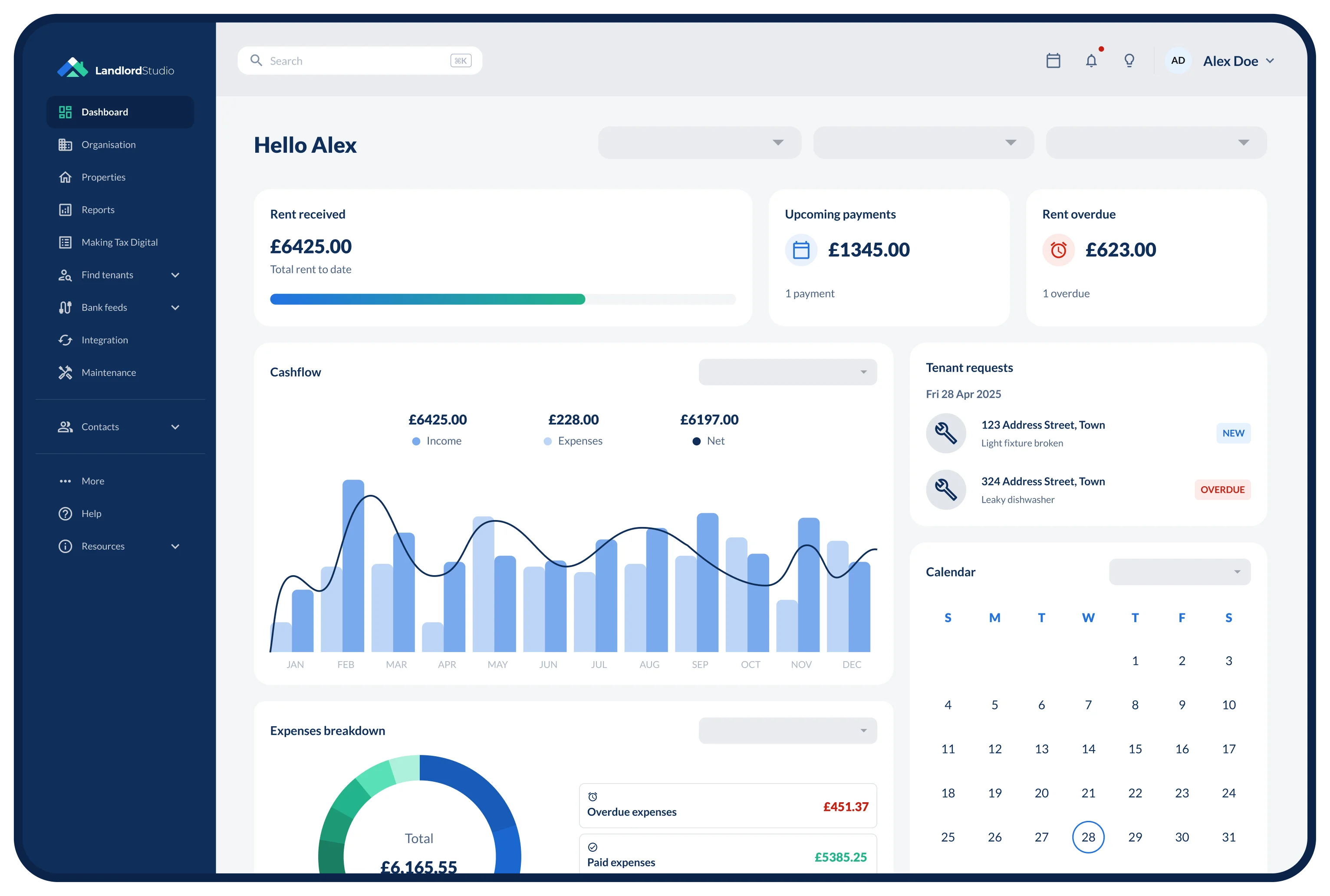
Mobile dashboard showing rent, payments, expenses, property listing, cashflow chart, and maintenance alert.Landlord Studio dashboard showing rent, payments, cashflow chart, tenant requests, expenses, and calendar.

Sign up and get
PRO free for 14 days

Once your PRO trial is over you can continue using Landlord Studio GO completely free.

Thank you! Check your email for confirmation.
Oops! Something went wrong while submitting the form.

By continuing you agree to our Terms & Conditions.

Already have an account? Log in

Looking for Nexus? Log in here →

Landlord Studio Logo with Text
Features
Polygon pointing up
Chart line icon
Rental accounting
Receipt icon
Making Tax Digital
Credit card icon pink
HMRC tax reporting
Hammer icon
Property maintenance
User Icon Circle Pink with Tick
Tenancy management
Red icon warning with exclamation mark
Landlord compliance
E-signature icon
Electronic signatures
Landlord Studio UK dashboard greeting 'Hello Logan' with rent received, upcoming payments, a cashflow chart and top expense categories
See it in action
Watch the Landlord Studio demo
PricingNexus for LandlordsNexus for AgentsAccountants
Education
Polygon pointing up
Open book icon
Blog
Shield icon
Academy
Graph icon
Resources
Dollar icon
Webinars
Maths icons
Calculators
Bookmark icon
Definitions
Question mark icon
Renters' Rights
Laptop on desk displaying UK government page for filing Self Assessment tax return online.
Featured resource
Making Tax Digital (MTD)
for UK Landlords: The Complete
Hub
Log inGet StartedGet started
We surveyed 500 UK Landlords and Letting agents about Making Tax Digital. Read the report →

Do I Pay Tax on Rental Income If I Have a Mortgage?

Yes. UK landlords pay Income Tax on full rental income and get a 20% tax reduction on mortgage interest. Updated for 2026/27, plus MTD rules.

Reporting & Tax

Written by

Ben Luxon

PUBLISHED ON

January 2, 2025

UPDATED ON

August 10, 2026

READ TIME

0 min

Facebook IconTwitter IconLinkedIn Icon

Read summarised version with:

ChatGPT Logo
ChatGPT
gemini logo
Gemini
Claude Logo
Claude
Grok logo
Grok
Google Icon
Add as preferred on Google

Last updated 10 August 2026. Figures apply to the 2026/27 UK tax year and to England, Wales and Northern Ireland unless stated. Reviewed by Ben Luxon, Head of Real Estate Education & Editorial at Landlord Studio.

Yes. If you own a rental property in your own name you pay Income Tax on your full rental income, and mortgage interest is not deductible from that income. Instead you receive a basic rate tax reduction worth 20% of your finance costs. Basic rate taxpayers are broadly unaffected, because 20% matches their tax rate. Higher and additional rate taxpayers get less relief than a deduction would have given them. Landlords who own through a limited company can still deduct mortgage interest as a business expense.

Key Takeaways

  • Mortgage interest is not an allowable expense for individual landlords. It is relieved as a 20% reduction to your Income Tax bill instead.
  • Only the finance element qualifies. Capital repayments of the mortgage get no relief at all.
  • The reduction is 20% of the lowest of your finance costs, your property business profits, and your income above the Personal Allowance. It cannot create a refund.
  • Limited companies sit outside these rules and deduct finance costs before paying Corporation Tax.
  • Making Tax Digital for Income Tax has applied since 6 April 2026 to landlords with qualifying income over £50,000 before expenses.
  • From 6 April 2027 property income gets its own rates of 22%, 42% and 47%, and finance cost relief rises from 20% to 22%.

As a landlord in the UK, understanding your tax obligations is important if you want to avoid a massive headache with HMRC, especially if you have a mortgage on your rental property. Rental income tax can appear complicated at first, but with the right knowledge and tools, it can quickly become manageable. Understanding the nuances will help you maximise deductions, boost your efficiency, and perhaps most importantly, remain compliant with HMRC requirements. 

This guide explains everything you need to know about paying tax on rental income, how mortgage interest affects your tax bill and strategies to optimise your finances. 

What Exactly Is Rental Income Tax?

Rental income tax is the tax you pay on profits generated from renting out property. These profits are calculated by subtracting allowable expenses from your total rental income. All landlords must declare rental income to HMRC and pay the applicable income tax rates, which depend on your total taxable income:

  • Personal Allowance: 0% on the first £12,570
  • Basic rate: 20% on taxable income from £12,571 to £50,270
  • Higher rate: 40% on taxable income from £50,271 to £125,140
  • Additional rate: 45% on taxable income above £125,140

These are the 2026/27 rates and bands for England, Wales and Northern Ireland. Income Tax bands are different in Scotland. Your Personal Allowance falls by £1 for every £2 of income above £100,000 and is nil once your income reaches £125,140. To sanity check your own numbers, use our free rental income tax calculator.

How Does Mortgage Interest Tax Relief Work Now?

Individual landlords cannot deduct mortgage interest from rental income. Since the 2020/21 tax year all residential finance costs have been relieved as a basic rate tax reduction worth 20% instead. This is simply how the tax works now, not a transitional arrangement.

In practice HMRC taxes your full rental profit before any interest is taken into account, then reduces your final Income Tax bill by 20% of your finance costs. Finance costs include mortgage interest, interest on loans to buy furnishings, and fees incurred when taking out or repaying a mortgage. There is no relief for capital repayments.

The reduction is 20% of the lowest of three figures: your finance costs for the year plus any brought forward, your property business profits, and your total income above the Personal Allowance. It cannot create a tax refund, and finance costs you cannot use are carried forward to a later year. HMRC sets out the calculation and its own worked examples in its guidance on tax relief for residential landlords.

Worked Example: A Higher Rate Landlord With £6,000 of Mortgage Interest

Take a landlord with £15,000 of annual rental income, £6,000 of mortgage interest and no other allowable expenses, whose employment income already uses up the Personal Allowance and puts all of the rental profit in the 40% band. This table compares the old deduction with the current 20% reduction.

FigurePre-2020 (full deduction)2026/27 (20% reduction)
Rental income£15,000£15,000
Mortgage interest deducted£6,000£0
Taxable rental profit£9,000£15,000
Income Tax at 40%£3,600£6,000
Less 20% finance cost reductionNone£1,200
Tax due£3,600£4,800

Stated in prose, in case the table does not render: under the old deduction the taxable rental profit was £9,000 and the tax bill was £3,600. Today the taxable profit is the full £15,000, tax at 40% is £6,000, and the 20% finance cost reduction is £1,200, leaving £4,800 to pay. The same landlord with the same mortgage pays £1,200 more. A basic rate taxpayer in the same position would pay £3,000 less a £1,200 reduction, or £1,800, which is the same result the old deduction gave. These figures are illustrative and assume no other allowable expenses.

What Changes for Mortgage Landlords in April 2027?

From 6 April 2027 property income is taxed at its own rates: a property basic rate of 22%, a property higher rate of 42% and a property additional rate of 47%. Relief for residential finance costs moves with it and will be calculated at the property basic rate of 22% rather than 20%. HMRC confirms both points in its technical note on the change to tax rates for property, savings and dividend income. These property rates apply to England, Wales and Northern Ireland.

A Short Note on the 2017 to 2020 Phase-In

Until April 2017 landlords could deduct 100% of their mortgage interest from rental income, which was worth most to higher and additional rate taxpayers. Section 24 withdrew that deduction in four steps: 75% deductible in 2017/18, 50% in 2018/19, 25% in 2019/20 and 0% from 2020/21 onward. The phase-in finished six years ago, so for 2026/27 only the 20% reduction applies. For the wider picture see our guide to landlord tax relief rules and changes and our landlord's guide to tax on rental income.

Who Is Affected by the 20% Finance Cost Reduction?

The reduction leaves basic rate taxpayers in broadly the same position and costs higher and additional rate taxpayers real money. When the measure was introduced HMRC expected around 1 in 5 individual landlords to receive less relief as a result.

  1. Higher Tax Bills for Higher-Rate Taxpayers: relief given at 20% against tax charged at 40% or 45% is worth less than a deduction. This reduces net income and profitability for many landlords. 
  2. Impact on Cash Flow: Landlords with substantial mortgages may encounter tighter cash flows due to higher tax bills. Proper planning and expense management can help mitigate this impact.
  3. Limited Benefits for Basic-Rate Taxpayers: Basic-rate taxpayers are largely unaffected, as the 20% reduction aligns with their tax rate.
  4. You Can Be Pushed Into a Higher Band on Paper: because tax is charged on the full rental income before the reduction is applied, the extra income can take your total income over the £50,270 higher rate threshold even though your real profit has not changed.
  5. Impact on Portfolio Growth: Higher tax liabilities can have a negative effect on business growth, as less capital means less investable capital. 
__wf_reserved_inherit

Allowable Expenses: Maximising Your Deductions

To optimise your tax position, you’ll want to claim all the allowable expenses available to you. These deductions reduce your taxable profit and can help offset the loss of mortgage interest relief.

Common Allowable Expenses Include:

  • Maintenance and Repairs: Costs for property upkeep (e.g., fixing a leaky roof, repainting).
  • Insurance Premiums: Landlord insurance policies, including building, contents, and liability insurance.
  • Property Management Fees: Fees paid to letting agents for managing your property.
  • Legal and Accounting Fees: Costs for professional services related to tenancy agreements and financial management.
  • Travel Costs: Mileage and travel expenses incurred when visiting your property.
  • Utilities and Council Tax: If paid by the landlord and not reimbursed by the tenant.
  • Ground Rent and Service Charges: For leasehold properties.

Illustrative Example: What Claiming Every Expense Is Worth

A landlord with five rental properties who tracks expenses in Landlord Studio through the year and claims a further £5,000 of allowable expenses reduces taxable rental profit by £5,000. For a higher rate taxpayer that is worth £2,000 in tax at 40%; for a basic rate taxpayer it is worth £1,000 at 20%. The figures are illustrative and depend on your own income and expenses.

Record-Keeping: Best Practices for Compliance

Accurate record-keeping is crucial for staying compliant with HMRC and is now a legal requirement under Making Tax Digital (MTD) for Income Tax, which has applied since 6 April 2026 to landlords whose qualifying income from property and self-employment is over £50,000 before expenses.

Best Practices:

  • Dedicated Bank Account: Separate your rental income and expenses from personal finances.
  • Digital Receipts: Scan and store receipts digitally to avoid losing paper copies.
  • Real-Time Tracking: Use property management software to log expenses and income as they occur.

Read more Landlord Bookkeeping Best Practices

How Long Must Landlords Keep Records?

You must keep your records for at least 5 years after the 31 January submission deadline for the tax year they relate to. That applies to Self Assessment records and to digital records kept under Making Tax Digital for Income Tax. HMRC can charge penalties of up to 100% of the tax due where rental income has not been declared, plus interest, and can prosecute in serious cases.

Landlord Studio’s mobile app and automated bank feeds make it easier to adhere to these best practices. Learn more about rental accounting with Landlord Studio and create your free account today.

Get started for free

Personal Ownership vs Limited Company: How Is Mortgage Interest Treated?

The finance cost restriction applies to individuals, not to companies. HMRC's policy paper on restricting finance cost relief for individual landlords states that the measure affects individuals who receive rental income on residential property. A limited company therefore deducts mortgage interest as a business expense and pays Corporation Tax on the profit that remains.

FactorPersonal ownershipLimited company
Mortgage interestNot deductible; 20% tax reductionFully deductible as a business expense
Tax on profitIncome Tax at 20%, 40% or 45%Corporation Tax: 19% up to £50,000, 25% above £250,000, Marginal Relief between
Getting the money outProfit is yours after taxSalary or dividends, taxed again personally
Tax on saleCapital Gains Tax on the individualCorporation Tax on the company's gain
Mortgage availabilityWider choice of productsFewer lenders, usually higher rates and fees
Admin burdenSelf Assessment, plus MTD if over the thresholdCompany accounts, Company Tax Return, Companies House filings

Stated in prose, in case the table does not render: the headline difference is that a company deducts its mortgage interest in full and an individual does not. Against that, a company pays Corporation Tax at 19% on profits up to £50,000 and 25% on profits above £250,000, with Marginal Relief in between, and you pay personal tax again when you take money out as salary or dividends. Company mortgages usually carry higher rates and fees, and moving an existing property into a company is a disposal that can trigger Capital Gains Tax and Stamp Duty Land Tax.

Incorporation is a consequential and hard-to-reverse decision, and the right answer depends on your income, your portfolio and your plans for the property. Landlord Studio does not give tax advice. Speak to a qualified accountant or tax adviser before you incorporate.

Making Tax Digital for Income Tax: What Mortgage Landlords Must Do From April 2026

Making Tax Digital for Income Tax has applied since 6 April 2026 to sole traders and landlords registered for Self Assessment whose qualifying income is over £50,000. If that is you, you must keep digital records, send HMRC quarterly updates through compatible software, and submit your tax return by 31 January following the end of the tax year.

Qualifying income is measured before expenses. HMRC defines it as your total income from self-employment and property, which is the amount before expenses, also known as turnover, taken from the tax return you submitted in the previous tax year. Employment income, partnership profit shares, dividends and pensions do not count towards it. This matters for mortgage landlords in particular: a landlord with £55,000 of rent and £30,000 of costs is above the threshold on the £55,000, not below it on the £25,000 of profit.

The thresholds step down over three years:

  • 6 April 2026: qualifying income over £50,000 in the 2024/25 tax year
  • 6 April 2027: qualifying income over £30,000 in the 2025/26 tax year
  • 6 April 2028: qualifying income over £20,000 in the 2026/27 tax year

When Are the Quarterly Updates Due?

Quarterly updates are summaries of income and expenses, not tax returns, and each one runs cumulatively from the start of the tax year. If you use standard update periods aligned to the tax year, the deadlines are:

  • 6 April to 5 July: due 7 August
  • 6 April to 5 October: due 7 November
  • 6 April to 5 January: due 7 February
  • 6 April to 5 April: due 7 May in the following tax year

You then finalise the year and submit your tax return by 31 January following the end of the tax year, the same deadline as before. HMRC will not apply late submission penalty points for quarterly updates during the 2026/27 tax year, though penalty points still apply to late tax returns. After 2026/27, reaching four points brings a £200 penalty.

Your mortgage interest still has to be recorded. If you receive UK residential property income you must categorise a restricted finance cost separately from your other expenses in your digital records, even if your property turnover is below £90,000 and you use simpler categorisation.

Read more: Making Tax Digital for landlords and the best MTD software for landlords. HMRC's own guidance is at find out if and when you need to use Making Tax Digital for Income Tax.

Tax Mitigation Strategies for Landlords

To mitigate the impact of the finance cost restriction, consider these strategies:

Incorporate as a Limited Company

  • Landlords operating as limited companies pay Corporation Tax rather than Income Tax. The small profits rate is 19% on profits up to £50,000 and the main rate is 25% on profits above £250,000, with Marginal Relief in between.
  • Mortgage interest remains fully deductible for companies.‍
  • Considerations: Higher mortgage rates for limited companies, administrative costs, and potential stamp duty liabilities when transferring property.

Refinance Your Mortgage

  • Switching to a mortgage with a lower interest rate can reduce overall costs.
  • Consider fixed-rate mortgages to stabilise payments during periods of rising interest rates.

Use the Let Property Campaign

  • If you have undeclared rental income, HMRC’s Let Property Campaign allows voluntary disclosure, potentially reducing penalties.

Optimise Expense Management

  • Ensure all allowable expenses are claimed.
  • Use Landlord Studio’s expense tracking and receipt scanning features to stay organised.

Consult a Tax Advisor

  • Engage a qualified tax advisor to develop a tailored strategy. Platforms like UK Property Accountants offer specialised services for landlords.

Navigating Future Tax Changes and Market Trends

The property rental market is constantly evolving, and staying ahead of these changes is essential for long-term success. Alongside the finance cost restriction, landlords should be aware of the changes already legislated and the trends that could affect their finances:

  1. Upcoming Legislation and Policies: Keep an eye on potential government policy changes regarding property taxation, rent controls, and landlord responsibilities. Making Tax Digital (MTD) for Income Tax went live on 6 April 2026 for landlords with qualifying income over £50,000, and the separate property income tax rates arriving on 6 April 2027 are the next change already legislated.‍
  2. Interest Rate Fluctuations: The Bank of England's monetary policy directly affects mortgage rates. Understanding how interest rate changes impact your mortgage payments can help you plan better and consider refinancing options when rates are favourable.‍
  3. Environmental and Energy Efficiency Standards: The government is increasingly focusing on energy efficiency for rental properties. Meeting EPC (Energy Performance Certificate) requirements and improving property energy efficiency could be a future expense, but tax relief or grants may be available.‍
  4. Market Demand and Rental Trends: Understanding market trends, such as demand for specific types of properties or locations, can inform your investment strategy. Staying flexible and responsive to tenant needs will help ensure your properties remain profitable.

By staying up to date, leveraging technology like Landlord Studio, and seeking professional advice where appropriate, landlords can work through these challenges and continue to grow their portfolios.

Related: 6 Best Free MTD Software For Landlords

Do I Pay Tax on Rental Income If I Have a Mortgage?: Final Thoughts

If you’re still wondering, ‘Do I pay tax on rental income if I have a mortgage?’ Yes, you do. You pay Income Tax on the full rental income and receive a 20% reduction on your finance costs rather than a deduction, which makes it more important than ever that you understand the rules and stay compliant. 

The administrative tasks that come with managing rental properties can quickly add up to become overwhelming, particularly when managing larger portfolios. Landlord Studio simplifies this process, helping landlords manage their finances effortlessly while remaining compliant with HMRC’s requirements. 

Here’s some areas of work that Landlord Studio can assist with:

  • Custom Financial Reports: Generate profit and loss statements, expense summaries, and more.
  • Compliance Tools: Track EPC certificates, gas safety checks, and receive automated reminders.
  • Maintenance Tracking: Record maintenance tasks and expenses.
  • Lease Management: Manage tenant details, leases, and send automated rent reminders.
  • MTD Preparation: Stay compliant with Making Tax Digital through Xero integration.
  • Automated Bank Feeds: Sync transactions directly with your bank account.
  • Receipt Scanning and Storage: Snap photos of receipts with the mobile app and store them digitally.
  • Mileage Tracking: Log travel expenses and claim allowable deductions.

With Landlord Studio, you no longer need to puzzle yourself with the question ‘Do I pay tax on rental income if I have a mortgage?’ Instead, you can let the app do the work for you, keeping your finances organised and compliant, without any unnecessary hassle. Optimise your rental property business today. Visit Landlord Studio for more information.

FAQs on Rental Income Tax and Mortgages

1. Can I Still Deduct Mortgage Interest in Full?
No. Mortgage interest is no longer deductible from rental income if you own the property personally. You receive a 20% basic-rate tax reduction instead.

2. Will Making Tax Digital Affect Me?
Yes, if your qualifying income from property and self-employment is over £50,000 before expenses. Making Tax Digital for Income Tax has applied since 6 April 2026 and requires digital records, quarterly updates and a tax return by 31 January. The threshold falls to £30,000 from April 2027 and £20,000 from April 2028.

3. What Are the Penalties for Not Declaring Rental Income?
Penalties can reach 100% of the tax due, plus interest charges. In severe cases, you could face prosecution. Penalties are usually lower if you come forward voluntarily through the Let Property Campaign.

4. Should I Incorporate My Rental Business?
Incorporation can be beneficial but comes with costs and complexities. Always consult a tax advisor before making this decision.

5. Do I Get Tax Relief on My Whole Mortgage Payment or Only the Interest?
Only the finance element. Finance costs include mortgage interest, interest on loans to buy furnishings, and fees for taking out or repaying a mortgage. No relief is available for capital repayments of the loan.

6. Does the 20% Reduction Apply If I Am a Basic-Rate Taxpayer?
Yes, the reduction is 20% for every individual landlord. Because 20% matches the basic rate, a basic-rate taxpayer usually ends up in broadly the same position as under the old deduction. The risk is that taxing the full rental income can push your total income over the £50,270 higher-rate threshold.

7. Do I Need to Report Rental Income Quarterly Now?
Only if you are within Making Tax Digital for Income Tax. If you are, you send four quarterly updates a year through compatible software, due 7 August, 7 November, 7 February and 7 May. These are summaries, not tax returns, and you still submit a tax return by 31 January.

8. What Happens If My Mortgage Interest Is More Than My Rental Profit?
The reduction is capped at 20% of the lowest of your finance costs, your property business profits, and your income above the Personal Allowance, and it cannot create a refund. Any finance costs you could not use are carried forward to a later tax year.

You Might Also Like

  • What Is Fair Wear and Tear In A Rental Property?
  • Rental Property Expenses Checklist
  • Should You Track Allowable Expenses For Landlords With A Buy To Let Spreadsheet?
  • Everything Landlords Need To Know About Rental Income Tax

About Landlord Studio

Hand holding phone displaying rental payment and expense dashboard with amounts and progress bars.

Landlord Studio is an easy to use MTD compliant property management and accounting software designed for UK landlords.
‍
Track income and expenses, run reports,, find and prescreen tenants, manage property maintenance, and more.

Learn more
Stay Updated on Property Insights
Get weekly tips, tax updates, and landlord strategies straight to your inbox.
Thanks for subscribing.
Check your inbox, your first update is on the way.
Oops! Something went wrong while submitting the form.

Costly MTD Mistakes & How to Fix Them

Worried woman sitting on colored blocks, reading a long bill receipt labeled 'BILLS'.

94% of landlords feel ready for MTD. Only a third have moved to digital software. Join our live panel on the costliest MTD mistakes and how to fix them.

Details:

Free

Hosted by:
Logan Ransley
Kate Faulkner
Martin Wardle
When:

August 11, 2026

12PM

Duration:

45 mins + Q&A

Format:

Live Panel Discussion

Guest:

Co-host Logan Ransley, Landlord Studio Co-Founder

Kate Faulkner OBE, the UK's Leading Property Expert

Martin Wardle, UK Property Tax Specialist

Register nowWatch now

Create your FREE account with Landlord Studio today.

Bar graph showing UK income and expenses by month with a pie chart breakdown of expenses by category.Get started for free

Get started with
Landlord Studio now.

Get started for free
Contact Us
help@landlordstudio.com(270) 671 9733
FEATURES
Rental accountingHMRC reportingMaking Tax DigitalFind tenantsProperty maintenanceElectronic signatures
RESOURCES
BlogHelp centerResourcesWebinarsGuidesCalculators
About Us
Our storyContact usCareersFacebook groupFeature request
COMPARE
Arthur Online
Hammock
Landlord Vision
QuickBooks
Sage
Partners
AgentsAccountants
Landlord Studio Logo without Text
Copyright 2026 Landlord Studio. All rights reserved.
Privacy PolicyTerms & ConditionsCookies
Facebook IconInstagram logoTwitter IconLinkedIn IconYouTube Icon
Propertymark Logo Industry Supplier badgeXero LogoApp store download badgeGoogle Play badge
Landlord Studio UK Limited (trading as “Landlord Studio”) is an agent of Plaid Financial Ltd., an authorised payment institution regulated by the Financial Conduct Authority under the Payment Services Regulations 2017 (Firm Reference Number: 804718). Plaid provides you with regulated account information services through Landlord Studio as its agent.