




Read summarised version with:

ChatGPT

Gemini

Claude

Grok

Add as preferred on Google
Quarterly digital tax reporting is adding hundreds of pounds a year to landlords' compliance bills and new research shows cost pressure of exactly this kind feeds through to rents. Letting agents are uniquely placed to bring that cost down at scale, for every landlord they manage at once.
For landlords, the headline change isn't just the reporting rhythm. It's the bill. And new research commissioned by Landlord Studio, surveying 500 landlords and letting agents across the UK, shows how much pressure that bill is already creating and why letting agents are the ones best placed to relieve it.
The rising cost of staying compliant
The research found landlords and agents already spend an average of 13.6 hours a month on tax and financial admin, at an estimated cost of £3,181 a year - and 53% say the burden has grown in the last 12 months, before quarterly filing has fully bitten.
MTD raises the baseline. One annual tax return becomes four quarterly updates plus a final declaration, and the traditional route through that, handing everything to an accountant is getting more expensive to match.
Industry fee guides put the quarterly update element alone at £75–£125 per quarter, with the final declaration adding £150–£300 on top.
Overall, MTD is expected to add roughly £250–£400 a year to a typical landlord's accountancy bill, and some practices have announced far steeper rises. For a landlord with a modest portfolio, compliance can now easily run to £500–£800+ a year in professional fees alone - for work that is, at its core, administrative rather than advisory.
The same research found 89% of landlords say they're likely to increase rents as a result of rising admin and compliance costs. Cost pressure in a landlord's business doesn't stay in the landlord's business - it flows through the whole chain. And in a market where tenant affordability is already stretched, nobody in that chain benefits from compliance costs becoming another input to the rent conversation. The healthiest outcome for landlords, tenants and agencies alike is for the cost to come out of the system, not get passed along it.
Why does the traditional MTD accounting route cost so much?
Look at what those accountancy fees are actually paying for and the inefficiency is obvious - much of the quarterly work is reconstructing records that already exist.
For a managed landlord, the accurate, categorised version of their rental income and expenses - every rent payment, management fee and maintenance deduction is already sitting in your client accounting system.
The monthly statement you send is a human-readable summary of it. The billable hours each quarter go on turning that summary back into structured data: downloading PDFs, re-keying figures into spreadsheets or software, chasing missing expenses, reconciling the result.
Landlords are paying professional rates for duplication. Accountants, to be fair, aren't the villains here - they can only work with what they're given, and what they're given is a PDF. The fix isn't a cheaper accountant. It's removing the duplicated work entirely, which only the party holding the source data can do.
That's you.
The scale advantage letting agents have
This is where agents have something no accountant, software vendor or landlord acting alone can match: scale.
An individual landlord solving MTD solves it once. An agency that connects its client accounting system to MTD-compatible software solves it for every managed landlord simultaneously - same integration, same conversation template, same workflow, repeated across the book.
The economics transform accordingly. Instead of each landlord independently paying £500–£800 a year in quarterly accountancy fees, an agent-enabled software route typically costs a landlord £10–£15 a month - with the data flowing automatically, and the accountant's role (where landlords keep one) shrinking back to genuine advisory work like reliefs and year-end planning rather than data entry.
That's a compliance cost cut of several hundred pounds per landlord per year, delivered through infrastructure you already run.
The research suggests landlords are ready to move too - 97% say they're likely to invest in digital tax and compliance tools in the next 12–24 months, with meeting MTD requirements and reducing admin time as the top drivers. The spend is coming either way.
Agents can be the ones who direct it somewhere dramatically cheaper for the landlord — and be seen to do it.
What offering this at scale looks like
1. Map the exposure across your book
Flag managed landlords likely to be over £50,000 in gross rental income now, and those the £30,000 threshold will catch in April 2027. Your client accounting data makes this a filtering exercise, not a research project.
2. Lead with the cost comparison
Most landlords haven't priced the two routes side by side. A short note showing "quarterly accountant route: £500–£800+/year; agent-connected software route: ~£120–£180/year, with your data synced automatically" does more persuasion than any feature list. You're not selling software - you're showing them several hundred pounds a year.
3. Standardise the rollout
The scale advantage only materialises if the offer is systematised: one integration, one explainer email or one-pager, one sign-up link process, mentioned at every statement, renewal and onboarding. For the full breakdown of service models and pricing approaches, see our guide to MTD for letting agents.
4. Keep accountants in the loop, not out of it
Position the service as removing the data-entry layer, not the adviser. Landlords with accountants can invite them into the software to review and support submissions - which usually reduces the accountant's bill while keeping the relationship intact. Agents who frame it this way avoid any perception of stepping into tax advice.
Where Nexus fits
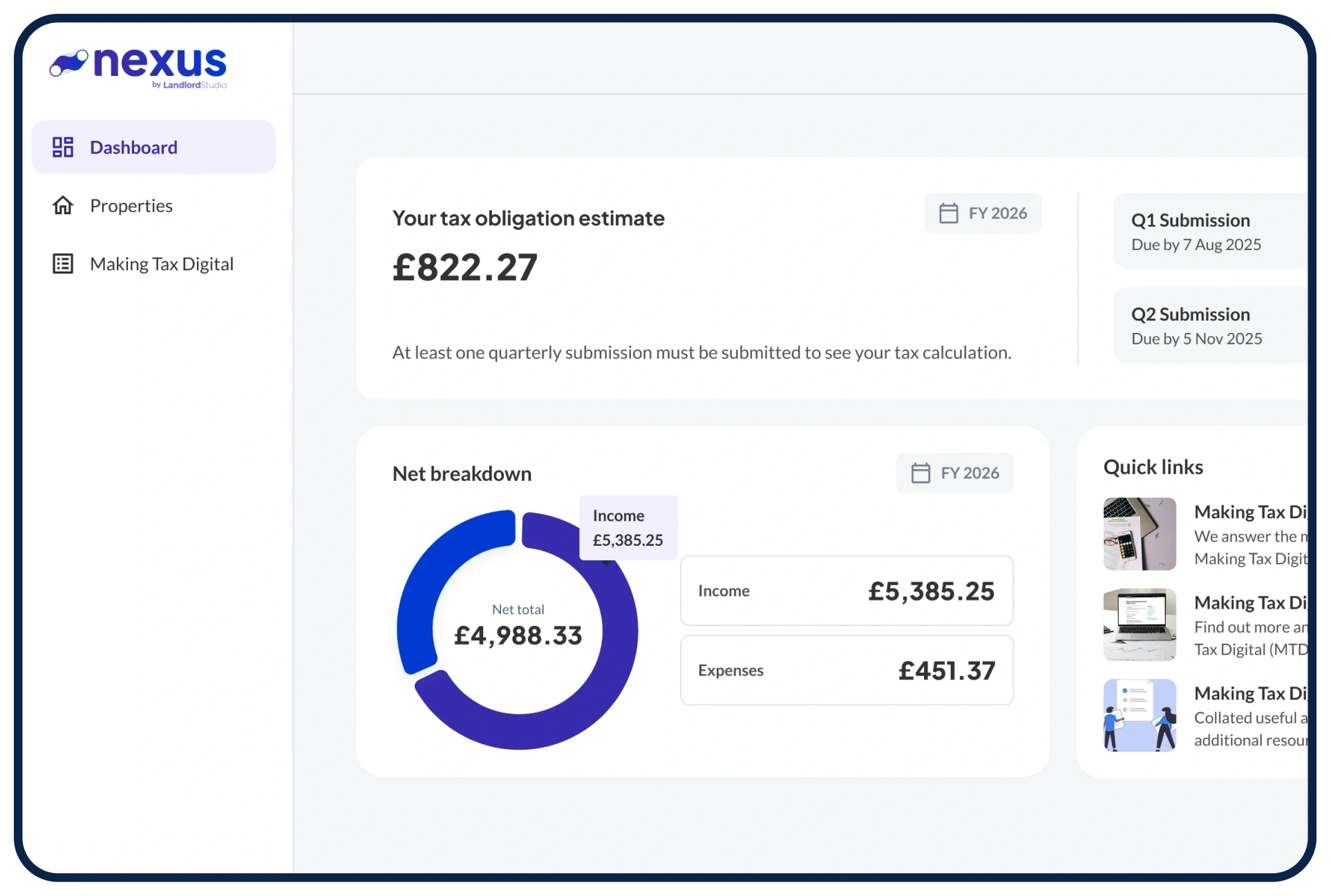
This is exactly the model Nexus delivers. Nexus connects directly to your existing client accounting platform - including Reapit, PayProp, SME Professional, Alto and LettsPay - and automatically syncs each landlord's rental income, fees and expenses into an HMRC-recognised portal where they review and submit their quarterly updates in a few clicks.
For the landlord, it costs £12 a month (or £120 a year) plus VAT - a fraction of the quarterly accountancy route - with no re-keying, no spreadsheets and no statement reconstruction.
They can add self-managed properties, connect bank feeds for non-agent expenses, and invite their accountant in for review. For your team, nothing changes: you continue recording rents and expenses exactly as you do today, send each landlord a unique sign-up link, and stay well clear of tax advice. Landlord Studio handles billing and support, and your agency earns a commission on every active subscription.
The result is the rare arrangement where every party's costs move in the right direction: the landlord's compliance bill drops by hundreds of pounds a year, the agency adds a revenue line and a retention hook, and the cost pressure that would otherwise be looking for somewhere to go - quietly comes out of the system.
Want to cut the cost of MTD across your whole landlord book? Book a quick demo and see how Nexus makes compliance affordable at scale.