
Void Period Calculator

Work out what a void period really costs you. The calculator adds up the rent you lose, the council tax and bills you pay while the property is empty and the cost of finding a new tenant, then shows your void rate and what letting one week sooner is worth.

Illustration of two yellow houses with a tree between them

For landlords anywhere in the UK, one property at a time. Enter your own figures. Council tax, letting fees and insurance terms vary by council, agent and insurer.

1. Rent and empty days

From the day the last tenancy ended to the day the new one started.
If you typically have one void every two years, enter 0.5.

2. Costs you only pay while it’s empty (optional)

Only if your tenant normally pays it. Divide the yearly bill by 12. Northern Ireland has domestic rates instead.
Only extra costs from being empty: standing charges, water, empty-property insurance cover. Not your usual landlord insurance.
Optional. Shown as cash you fund while it’s empty, not as a void cost.

3. Re-letting costs, each void (optional)

Tenant-find or set-up fee. 0 if you let it yourself.
In England and Wales you can’t pass these on to the tenant.
To get it ready and listed. Leave out improvements and unrelated maintenance.
Estimate only. Daily rent is the monthly rent × 12 ÷ 365. Bills while empty use the same daily rate for the days empty. Mortgage payments are shown separately and aren’t counted as a void cost, because they’re due whether or not the property is let. Figures are before tax. Council tax or rates, bills and letting fees you pay between tenancies are generally allowable expenses while the property is still part of your rental business. Lost rent isn’t deductible: it’s income you didn’t receive. Not financial advice.

How to work out the cost of a void period

Turn the empty days into lost rent, add the bills you pay while the property is empty, then add the cost of finding the next tenant.
See void periods by region →
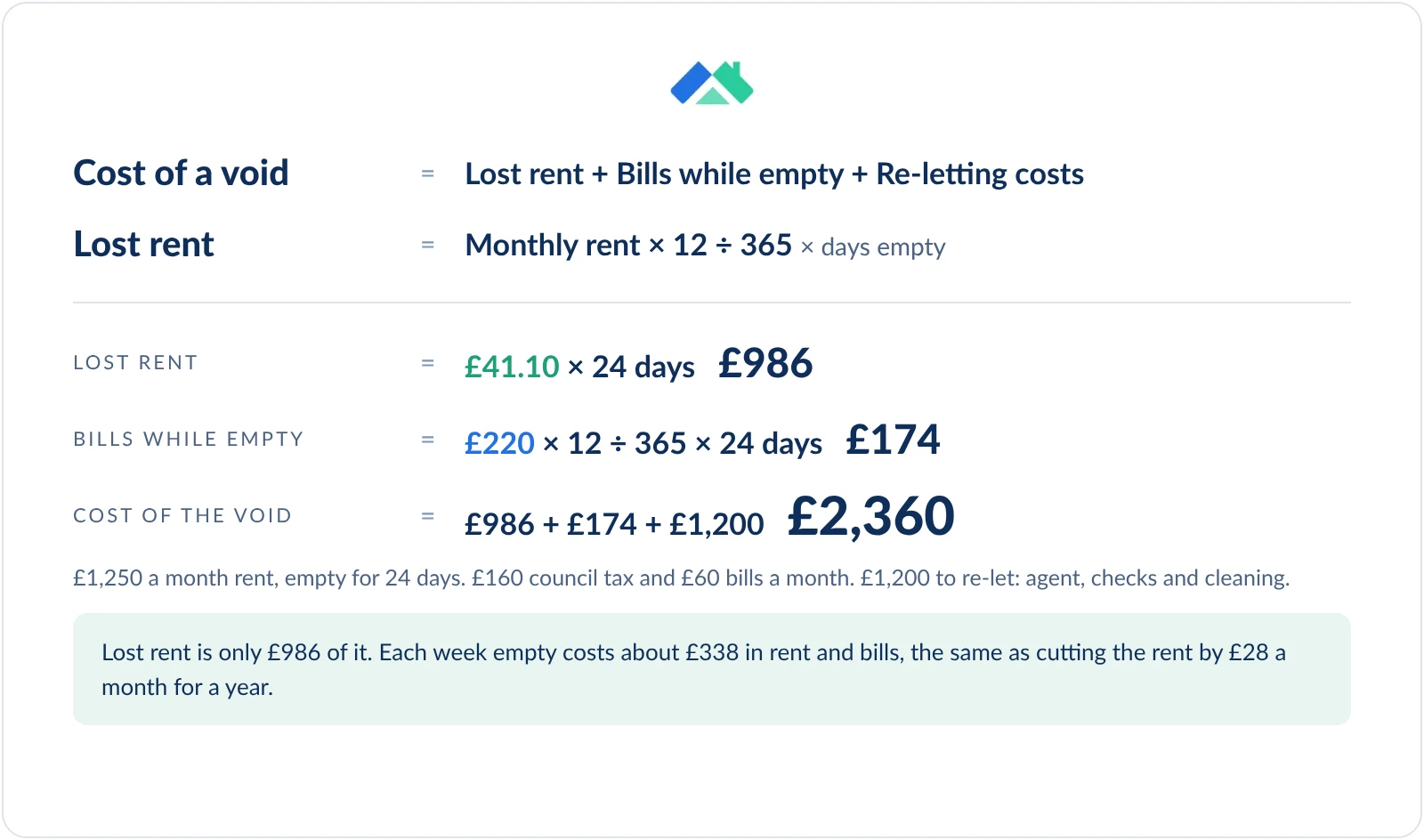
Void period formula: cost of a void equals lost rent plus bills while empty plus re-letting costs. Example: £986 + £174 + £1,200 = £2,360.
Step 1

Work out the lost rent

Multiply the monthly rent by 12 and divide by 365 to get the daily rent. Multiply that by the days the property was empty.

Step 2

Add the bills while it's empty

Council tax, energy standing charges, water and any extra insurance, for the same number of days.

Step 3

Add the re-letting costs

Agent fees, referencing, inventory, check-in, cleaning and advertising for the new tenancy.

Worked example

‍

£1,250 a month rent, empty for 24 days. £160 council tax and £60 bills a month. £750 agent fee, £200 referencing and inventory, £250 cleaning.

‍

Daily rent = £1,250 × 12 ÷ 365 = £41.10

‍

Lost rent = £41.10 × 24 = £986

‍

Bills while empty = £220 × 12 ÷ 365 × 24 = £174

‍

Cost of the void = £986 + £174 + £1,200 = £2,360

‍

Calculator icons

Other calculators you might be interested in

Landlord Studio icon

Open Market Rent

Estimate what your property could rent for and build a defensible Section 13 evidence pack.

Landlord Studio icon

Rental Yield Calculator

Work out the gross and net yield on a rental property to see what your investment really returns.

Landlord Studio icon

Rental Income Tax Calculator

Estimate the Income Tax on your rental profit after expenses, including costs from void periods.

What a void period really costs

Icon of a document with a pound sign

Lost rent is only part of it

While the property is empty you usually still pay council tax, standing charges and insurance, and re-letting adds agent, referencing and cleaning costs.

On £1,250 a month, a 24-day void loses £986 of rent but costs about £2,360 once those are added.

Icon of a rising data chart with a magnifying glass

When your property empties matters

Across UK landlords using Landlord Studio, homes that emptied in September re-let in a median 14 days. Homes that emptied in December took 34.

Marketing as soon as notice arrives, and fixing small jobs during the notice period, keeps voids short.

Illustration of a landlord reviewing a rental performance dashboard on a phone

Why use our void period calculator?

  • Puts a pound figure on every void, not just the lost rent
  • Adds the council tax and bills you pay while the property is empty
  • Includes agent, referencing, inventory and cleaning costs to re-let
  • Shows what letting one week sooner is worth, so you can weigh up a rent cut
  • Free, fast and no sign-up

‍

FAQs

What is a void period?

Plus Icon

A void period is the time a rental property sits empty between tenancies, earning no rent. It runs from the day one tenant moves out to the day the next tenancy starts.

It costs more than the lost rent. While no one lives there you're usually liable for council tax and bills, and finding the next tenant brings agent, referencing, inventory and cleaning costs.

How do you calculate the cost of a void period?

Plus Icon

Work out your daily rent (monthly rent × 12 ÷ 365) and multiply it by the days the property was empty. Add the council tax and bills you paid for those days, then the cost of re-letting.

A £1,250 a month property empty for 24 days loses £986 of rent. Add £174 of council tax and bills and £1,200 to re-let it, and the void costs about £2,360.

How long is a typical void period in the UK?

Plus Icon

Across UK landlords using Landlord Studio, the median void between April 2023 and March 2026 was 24 days. It varies a lot by region and by the month the home empties: see void periods by region for the breakdown.

Do landlords pay council tax when a property is empty?

Plus Icon

Usually, yes. When no one lives in a property the owner is normally liable, and many councils charge the full rate from the day it empties.

In England, councils can add a premium once a home has been empty and substantially unfurnished for a year, starting at up to 100% on top of the normal bill. Wales and Scotland set their own rules, so check with your council. Northern Ireland has domestic rates instead of council tax, and rates are due on empty rental homes too. Read more in do landlords pay council tax when a property is empty?

How can I reduce void periods?

Plus Icon

Start marketing as soon as your tenant gives notice. In England, tenants usually give two months' notice under the Renters' Rights Act, unless the tenancy agreement allows less. That's time to arrange viewings and small repairs, with the tenant's agreement and proper notice.

Price it right first time. Since 1 May 2026 you have to advertise a rent in England and can't accept offers above it, so check the open market rent before you list. Keeping a good tenant is cheaper still: no void at all.