




Read summarised version with:

ChatGPT

Gemini

Claude

Grok

Add as preferred on Google
The Renters’ Rights reforms don’t just change how tenancies work - they also introduce a new layer of oversight across the private rented sector (PRS).
Two of the most significant changes are:
- The introduction of a PRS Ombudsman
- A national database for landlords
Together, these measures aim to standardise how landlords operate, improve tenant protections, and increase accountability across the sector.
For landlords, this represents a shift towards a more formal, regulated system. Here’s what you need to know ahead of the expected 2028 rollout.
What Is the PRS Ombudsman?
The PRS Ombudsman will be an independent body designed to resolve disputes between landlords and tenants.
Its core function is to provide a formal, accessible route for tenant complaints without immediately resorting to the courts.
This includes disputes relating to:
- Property condition
- Repairs and maintenance
- Communication or conduct
- Compliance with legal obligations
Historically tenants renting directly from landlords had limited routes to escalate complaints. The main option was often court action (slow, expensive, adversarial)
The government’s goal is to:
- Provide a free, independent route for tenants to resolve disputes
- Reduce pressure on courts
- Improve landlord standards and accountability
There’s also a clear policy shift from reactive enforcement (courts, councils) to ongoing oversight and early dispute resolution.
Who it applies to
The scheme is expected to apply to all private landlords in England, regardless of:
- Portfolio size
- Whether you use a letting agent
- Whether you manage properties yourself
This marks a shift from voluntary or limited complaint schemes (redress) to a mandatory, sector-wide system.
What Is the PRS Database for Landlords?
Alongside the Ombudsman, a new PRS database will require landlords to register themselves and their properties.
While full details are still being finalised, the database is expected to include:
- Landlord identity and contact details
- Property addresses
- Key compliance information (e.g. safety certifications)
The database is intended to act as a single source of truth for regulators, tenants, and local authorities.
In practice, this means:
- Easier enforcement of legal standards
- Greater transparency across the sector
- A clearer record of whether landlords are meeting their obligations
When Will the PRS Ombudsman and Database Launch?
The PRS Ombudsman and database are expected to be introduced as part of the wider Renters’ Rights reforms, with full implementation targeted for 2028.
While exact timelines are still subject to confirmation, it is likely the rollout will be phased, allowing:
- Time for landlords to prepare
- Gradual onboarding of properties
- Adjustment of enforcement processes
The new requirements are expected to apply broadly across the private rental sector.
What Complaints Will the Ombudsman Deal With?
The scope is intentionally broad. According to government guidance, complaints can include:
- Property condition (e.g. disrepair)
- Delays or failures in repairs
- Landlord behaviour or communication
- Failure to meet legal obligations
Complaints relate to “actions, inactions or behaviours of a landlord which has caused harm or inconvenience.” Gov.uk
How the PRS Ombudsman Will Work
The Ombudsman will act as a formal dispute resolution body between tenants and landlords.
Tenants will be able to:
- Raise a complaint
- Have it reviewed independently
- Receive a decision without going to court
Common complaints may include:
- Delays in repairs
- Poor property conditions
- Failure to meet legal obligations
The Ombudsman will have powers to put things right, including compelling landlords to issue an apology, provide information, take remedial action, and/or pay compensation of up to £25,000.
The Ombudsman is expected to have the authority to:
- Issue binding decisions
- Require landlords to take corrective action
- Award compensation in some cases
This introduces a new layer of accountability outside of the court system.
Who Can Go to the PRS Ombudsman?
Tenants only (current, former, and in some cases prospective) - not landlords.
What Can the PRS Ombudsman NOT Do?
- Cannot act before the landlord has had a chance to resolve the issue
- Does not replace the courts entirely (tenants can still pursue legal action)
- Does not deal with tenant complaints against other tenants
- Cannot be used by landlords to complain about tenants
How Does This Compare to Existing Ombudsman Schemes?
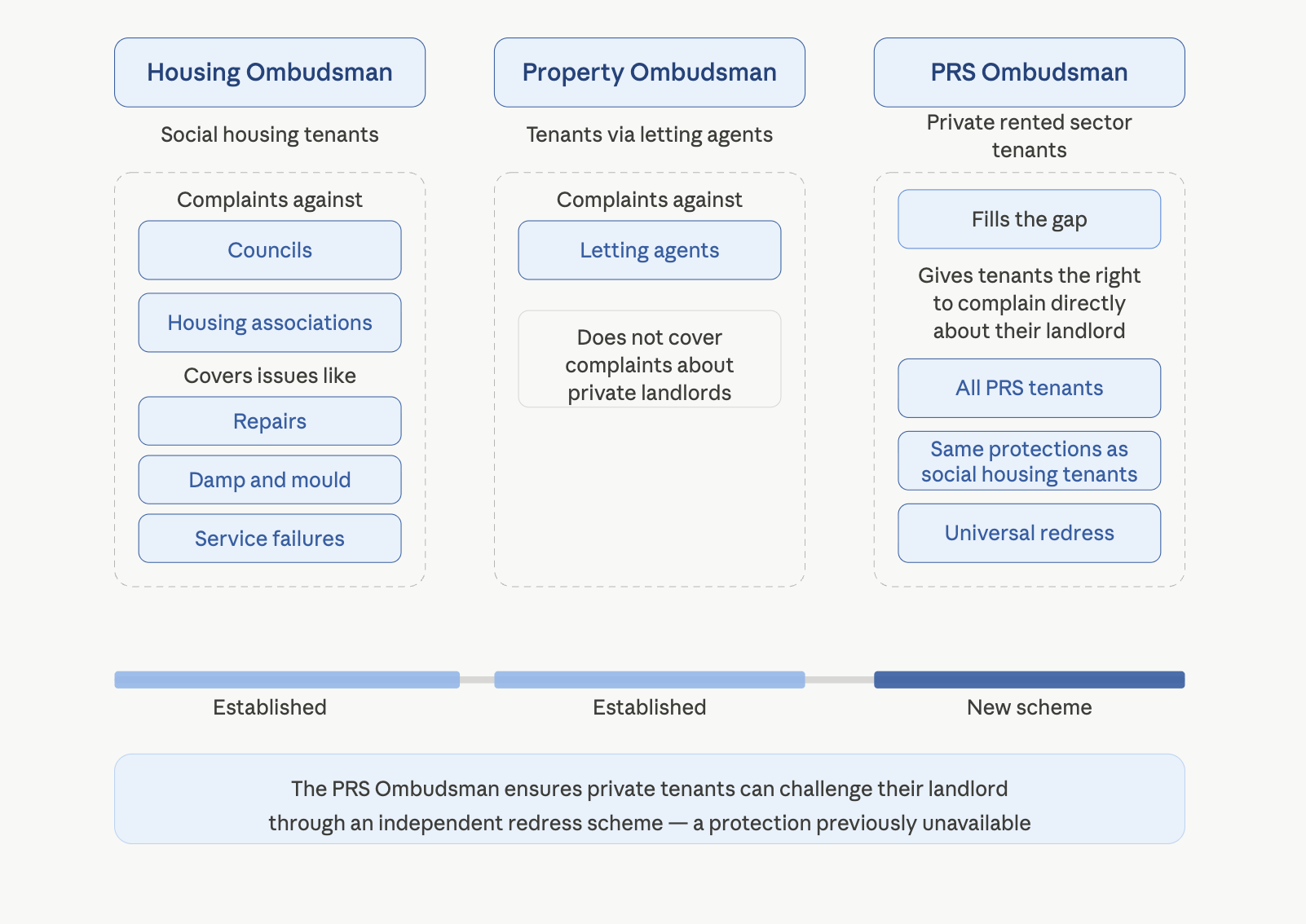
This diagram shows how redress schemes have traditionally operated across the housing sector. While social housing and letting agents are already covered, private landlords have not been part of a universal system - something the PRS Ombudsman is designed to address:
How This Fits Into Wider Renters’ Rights Reforms
The PRS Ombudsman and database are part of a broader shift in how the rental sector is regulated. These measures sit alongside:
- The removal of Section 21
- The introduction of open-ended tenancies
- Stronger tenant protections
How Landlords Can Prepare Now
While 2028 may seem some time away, preparation is largely about getting organised early.
Organising records
Ensure you have easy access to:
- Property details
- Safety certificates
- Tenancy documentation
Digitising property data
Moving away from paper records or scattered systems will make registration and compliance significantly easier. You can try tools like Landlord Studios for free for up to three properties.
Staying ahead of regulatory changes
Keeping up to date with changes will help you:
- Avoid last-minute pressure
- Reduce the risk of non-compliance
- Adapt processes gradually
Where to Find Official Government Information
The Shift Towards a Fully Regulated Private Rental Sector
The introduction of the PRS Ombudsman and landlord database reflects a clear direction by the government.
The private rented sector is becoming:
- More structured
- More transparent
- More accountable
For landlords, this doesn’t necessarily mean more difficulty - but it does mean less room for informal or inconsistent processes.