





Read summarised version with:

ChatGPT

Gemini

Claude

Grok

Add as preferred on Google
Ask a room full of landlords why they bought their first buy-to-let and one answer comes up again and again: “it’s my pension.” Bricks and mortar feel tangible in a way a pension statement never will, and decades of house price growth have rewarded that instinct. But very few landlords ever test the assumption.
As property expert Kate Faulkner put it on our Making Tax Digital webinar:
“A lot of people invest in property for a pension. That’s fine - but are you comparing how your property return is net versus a pension? I don’t think most landlords are. And that’s really dangerous when inflation can erode your money like that.”
So let’s do the comparison properly. This guide looks at how property and pensions stack up on returns, tax, risk, and flexibility in 2026 - and, more importantly, how to work out what your portfolio is actually returning after tax.
Property vs pension at a glance
The short answer: pensions win on tax at almost every stage, property wins on leverage and immediate income - and the right answer for you depends on your net return, not the gross yield. Here’s how the two compare in 2026/27:
How does property perform as a retirement investment?
The headline numbers for buy-to-let still look healthy.
The average gross buy-to-let rental yield across the UK was 7.21% in Q1 2026, according to UK Finance, up from 6.93% a year earlier. On top of the income, the average UK house price rose 2.7% in the year to May 2026 to £271,000, while private rents grew 3.3% in the year to June 2026 (ONS).
Property also offers something a pension cannot: leverage.
A 25% deposit controls 100% of an asset, so a 2.7% rise in the property’s value is a much larger return on the cash you actually put in. Rental income arrives every month rather than being locked away, and you keep direct control over the asset.
But gross yield is not what you retire on. From that 7.21% you need to deduct mortgage interest, letting agent fees, maintenance, insurance, licensing, compliance costs, void periods - and then tax. For a full breakdown of what those add up to, see our guide to the real costs of being a landlord.
How do pensions perform in comparison?
A pension is less exciting and considerably more tax-efficient. Four features do the heavy lifting:
1) Tax relief on the way in
Contributions receive relief at your marginal rate of income tax - a £100 contribution effectively costs a basic-rate taxpayer £80 and a higher-rate taxpayer £60. You can contribute up to the £60,000 annual allowance in 2026/27 (tapered for very high earners).
2) Tax-free growth
Investments inside a pension grow free of income tax and capital gains tax.
3) A tax-free lump sum
You can normally take 25% of the pot tax-free from age 55 (rising to 57 from 2028), with the rest taxed as income when drawn.
4) No day-to-day effort
Nobody phones a pension fund at 11pm about a broken boiler.
There’s also the state pension underpinning it all: the full new state pension is £241.30 a week (around £12,548 a year) in 2026/27 - worth checking your forecast before deciding how much more you need.
The trade-offs are real, though. Your money is locked away until at least 55, you can’t leverage it, and returns depend on markets you don’t control. And rental income has one quirk worth knowing: it doesn’t usually count as “relevant earnings” for pension purposes, so if property is your only income you can normally only contribute £3,600 gross a year to a pension with tax relief.
What does the last decade of data show?
Put £100,000 into each in 2016 and the gap is stark - on capital growth alone.
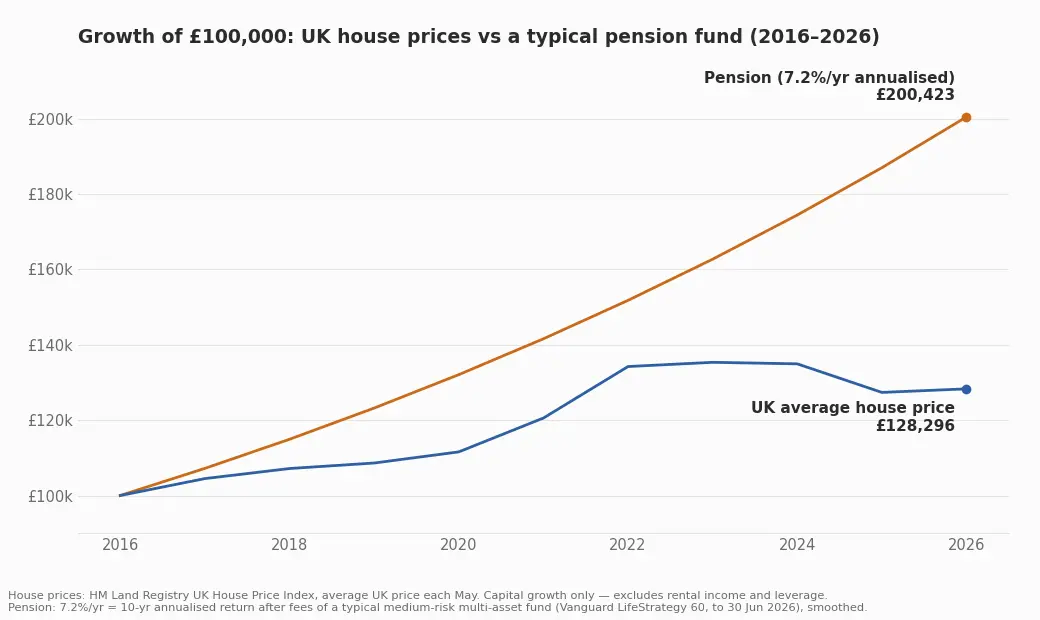
£100,000 tracking the UK average house price would have grown from £211,230 in May 2016 to around £128,000 by May 2026 - total growth of 28%, or roughly 2.5% a year (HM Land Registry UK House Price Index).
The same £100,000 compounding at the 7.2% annualised 10-year return of a typical medium-risk multi-asset fund (after fees) would have roughly doubled to around £200,000.
Before landlords despair, two big caveats run in property’s favour. The house price line is capital growth only - it excludes rental income, and with average gross yields at 7.21% that income is most of a landlord’s return. It also ignores leverage: if that £100,000 was a 25% deposit on a £400,000 property, the same price growth produced a much larger return on your actual cash. And the pension line is smoothed - real funds fall as well as rise (the same fund dropped over 7% in 2022).
Unleveraged capital growth alone hasn’t come close to a pension over the last decade. Property’s case rests on rental income and leverage, which is exactly why knowing your true net rental profit matters so much.
Where does property lose ground on tax?
Over the past decade, tax policy has consistently favoured the pension wrapper over the rental property:
1) Income tax on rent, with restricted mortgage relief
Since Section 24 was fully phased in, individual landlords get only a 20% tax credit on mortgage interest rather than deducting it in full — a significant squeeze for higher-rate taxpayers.
2) Capital gains tax on sale
Residential property gains are taxed at 18% (basic rate) or 24% (higher rate), and unlike pensions or ISAs there’s no wrapper to shelter the gain. See our guide to capital gains tax on rental property.
3) Stamp duty on the way in
Additional dwellings carry a 5% SDLT surcharge on top of standard rates.
4) Compliance costs
Making Tax Digital, the Renters’ Rights Act, EPC requirements and licensing all add ongoing admin and cost that pensions simply don’t have.
One historic advantage of pensions is about to shrink, however. From 6 April 2027, unused pension funds will be included in your estate for inheritance tax, removing the “pass your pension on IHT-free” planning strategy many savers relied on. Pensions remain highly tax-efficient while you’re alive — but the gap between the two on death is narrowing.
That’s the full picture behind the at-a-glance table above: property is taxed on the way in, on the income, and on the way out; a pension is only taxed on the way out — and partly not even then.
What is your property actually returning after tax?
Most landlords can’t answer this question, because they’ve never separated their property finances well enough to calculate it.
To compare like-for-like with a pension, you need your net yield on equity (annual rental profit after all expenses and tax), plus realistic capital growth, divided by the equity you have tied up in the property - not the price you paid for it years ago.
Worked example
Two habits make the comparison possible:
- Track every property’s income and expenses digitally: so your profit figure is real rather than estimated. If you’re in the first wave of Making Tax Digital, you’re now doing this quarterly anyway - use the data.
- Review rents annually: Kate Faulkner again: “Two thirds of landlords still don’t increase rents while a tenant is in a property - and over a five-year period that could reduce your real income by about 20%.” A static rent quietly erodes the very return you’re relying on for retirement.
Do you have to choose between property and a pension?
The strongest retirement plans usually hold both. A pension gives you tax relief, hands-off growth and diversification away from UK housing; property gives you leverage, monthly income and an asset you understand. Problems tend to arise at the extremes - landlords with everything in property and no pension, or savers who dismiss property without ever calculating what their portfolio actually earns.
Kate’s advice from the webinar applies to both camps: “If you’ve got property wealth, you should have a financial advisor and a property tax expert. There are lots of ways of mitigating tax that nobody will tell you about if you don’t have one.”
FAQs
Is property a better investment than a pension?
It depends on your net return, not the gross yield. Property offers leverage and rental income but is taxed more heavily at every stage; pensions offer tax relief and tax-free growth but lock your money away. Run both sets of numbers (ideally with a financial adviser) before deciding.
Can I pay rental income into a pension?
You can, but rental income doesn’t normally count as “relevant UK earnings” for pension tax relief. Without other earned income, your tax-relieved contributions are usually capped at £3,600 gross a year.
Should I sell my rental property to fund my pension?
Selling triggers capital gains tax at 18% or 24% and gives up future rental income, so it’s rarely a decision to make on tax grounds alone. Model the after-tax proceeds and what they’d earn inside a pension against your current net rental return, and take regulated advice first.
Do pensions still avoid inheritance tax?
Only until April 2027. From 6 April 2027, unused pension funds will be included in your estate for inheritance tax purposes, removing much of the pension’s advantage as an estate planning tool.
Know your numbers, whichever way you lean
Whether property ends up being your pension or just part of it, the decision only works if it’s based on real figures. Landlord Studio gives you a property-by-property view of income, expenses and profit with digital records that meet Making Tax Digital requirements - so you always know exactly what your portfolio is returning.
This article is for general information only and is not financial advice. Speak to a regulated financial adviser before making retirement planning decisions.