




Read summarised version with:

ChatGPT

Gemini

Claude

Grok

Add as preferred on Google
If you missed a Making Tax Digital (MTD) for Income Tax quarterly update, you can catch up with the next one. Every update is cumulative, covering 6 April to the end of the latest quarter, so a later update also meets the earlier obligation. HMRC does not give penalty points for late quarterly updates in the 2026 to 2027 tax year. From 6 April 2027, it does.
The rule works for any quarter, but Q1 is the one most likely to slip, because it is the first time you use the system. HMRC's own figures suggest roughly 1 in 4 people signed up had not sent a first update a few days after the 7 August 2026 deadline.
How does catching up on an MTD quarterly update work?
A later quarterly update catches up a missed one because each update is a running total from 6 April, not three separate months. When your next update reaches HMRC, it carries the figures HMRC did not receive and clears the missed obligation (the update HMRC was still expecting) at the same time.
Source: GOV.UK, Send quarterly updates. Calendar periods apply only if you chose them in your software.
If you want the full background on what goes into each submission, our guide to MTD quarterly updates for landlords covers it.
Missed your first quarterly update? Catch up in Q2
If you missed the Q1 deadline of 7 August, send your Q2 update by 7 November. HMRC's guidance for software developers confirms the second update "will satisfy the obligations for both Q1 and Q2".
Your Q2 submission covers 6 April to 5 October. You can still send a separate Q1 update first if you want to clear it sooner, but you do not have to.
The same guidance says the customer "may incur a penalty point" for the missed first deadline. Whether one lands depends on the tax year, covered below.
What if you missed a later quarterly update?
A missed Q2 or Q3 update is caught up by the next quarter's update in the same way. Q4 is the exception, because nothing comes after it:
- Missed Q2 (7 November): your Q3 update, due 7 February, covers 6 April to 5 January and meets both obligations.
- Missed Q3 (7 February): your Q4 update, due 7 May, covers the full tax year and meets both.
- Missed Q4 (7 May): send it as soon as you can. HMRC says you must send your quarterly updates before you can submit your tax return.
HMRC's developer guide shows one update covering Q3 and Q4 being accepted "with a possible penalty". Catching up clears the obligation. From 2027 to 2028, it does not clear the point.
What happens if you miss an MTD deadline?
In the 2026 to 2027 tax year, a late quarterly update brings no penalty point. HMRC's penalties guidance states: "There are no penalties for missing a quarterly update deadline for the 2026 to 2027 tax year." You still have to send every update before you can file your tax return.
That waiver covers quarterly updates only. The new points-based penalties already apply to a late tax return in 2026 to 2027, and the new late payment penalties apply too.
From the 2027 to 2028 tax year, late quarterly updates earn points as well:
- One point per missed quarterly deadline. Catching up in the next quarter still earns a point for the one you missed.
- A £200 penalty at four points. Each further missed deadline while you are at the threshold costs another £200.
- Points expire after 24 months if you stay below the threshold.
- Four points means a reset period. You need 12 months of on-time submissions, plus any outstanding returns from the previous 24 months, before the points clear.
Our breakdown of MTD penalty points for landlords walks through each trigger.
Do the £30,000 and £20,000 groups get the same waiver?
No. The waiver belongs to the 2026 to 2027 tax year, and HMRC's August 2026 update confirms that "from 6 April 2027 onwards, points-based penalties will apply where taxpayers miss a quarterly deadline."
That matters if your qualifying income (your total self-employment and property income before expenses) is over £30,000 and you join in April 2027, or over £20,000 and you join in April 2028. If you join in 2027 and miss 7 August 2027, the Q2 catch-up still works, but you still take a point for Q1.
How do you catch up on a missed update?
Catching up takes five steps. Most of the time goes on getting your records current, while the submission itself takes minutes.
- Check whether HMRC has signed you up. Since September 2026, HMRC has been signing up people who needed MTD for 2026 to 2027 but had not joined. It confirms by letter, in your HMRC online account or by post. If you have had that letter, GOV.UK sets out what to do next. If you have not, and you know you are required to use MTD, sign up yourself.
- Authorise your software. Link MTD-compatible software to your HMRC account so it can see your outstanding updates.
- Bring your digital records up to date from 6 April. Record every rent payment, repair, letting agent fee and mortgage cost from the start of the tax year, including the quarter you missed.
- Check each business. HMRC's guidance says your software adds up your records "for each business that you have", and UK property and foreign property are treated as separate businesses. A landlord with both, or with rental and self-employed income, may have more than one update to catch up.
- Send the next update by its deadline. It will show as meeting both obligations.
If you are unsure which costs belong in the totals, our guide to allowable expenses for landlords sets out what HMRC accepts.
What if an earlier update was wrong?
Correct the records in your software, and your next update's totals replace the wrong figures. Because HMRC uses the latest running totals, you do not file a separate amendment during the year.
How common is missing the first MTD deadline?

Missing Q1 is common. HMRC reported on 12 August 2026 that 436,000 sole traders and landlords had sent their first quarterly update, out of more than 570,000 signed up. That leaves roughly 134,000, or about 1 in 4, without a first update five days after the deadline.
Sign-ups have kept coming since then, but slowly. HMRC figures on property businesses show this:
Source: HMRC, in response to a Freedom of Information request. A landlord with both UK and foreign property may appear in both rows.
Around 7,900 more UK property businesses signed up in the six weeks after 7 August, a slow trickle, not a rush. Software authorisations, from the same FOI response, grew by a similar margin, from 285,227 at 10 August to 304,817 at 21 September 2026 (+6.9%). One landlord can authorise more than one product, so that figure is the looser guide of the two.
Frequently asked questions
What happens if I miss my first MTD quarterly update?
You catch up with your next update. Your Q2 update, due 7 November, covers 6 April to 5 October and meets both obligations. In the 2026 to 2027 tax year no penalty point applies. From 2027 to 2028, you get one point for the missed deadline even after catching up.
When is the MTD Q2 deadline?
The second quarterly update is due by 7 November each year. It covers 6 April to 5 October on standard periods, or 1 April to 30 September if you chose calendar periods.
Do I need to send the missed update separately?
No. Your next cumulative update meets both the missed and the current obligation. The exception is Q4, which has no later update to cover it, so send it as soon as possible.
How many penalty points before HMRC charges a fine?
For quarterly updates the threshold is four points. Reaching it brings a £200 penalty, and each further missed deadline adds another £200. Points below the threshold expire after 24 months.
Does MTD mean I pay tax every quarter?
No. Quarterly updates are summaries of income and expenses, not payments. Your tax is still worked out through your tax return and paid on the usual Self Assessment dates.
Can I appeal an MTD penalty point?
Yes. HMRC writes to you when it gives a point or a penalty, and you can appeal if you disagree. HMRC's list of reasonable excuses includes a serious illness, a software failure and problems with HMRC's online services. Finding the system too difficult to use does not count.
Get back on track with your next update

A missed quarterly update can be fixed. Bring your records up to date from 6 April, send your next cumulative update on time, and both obligations are met. Treat 2026 to 2027 as a practice year, because from April 2027 every missed deadline adds a point.
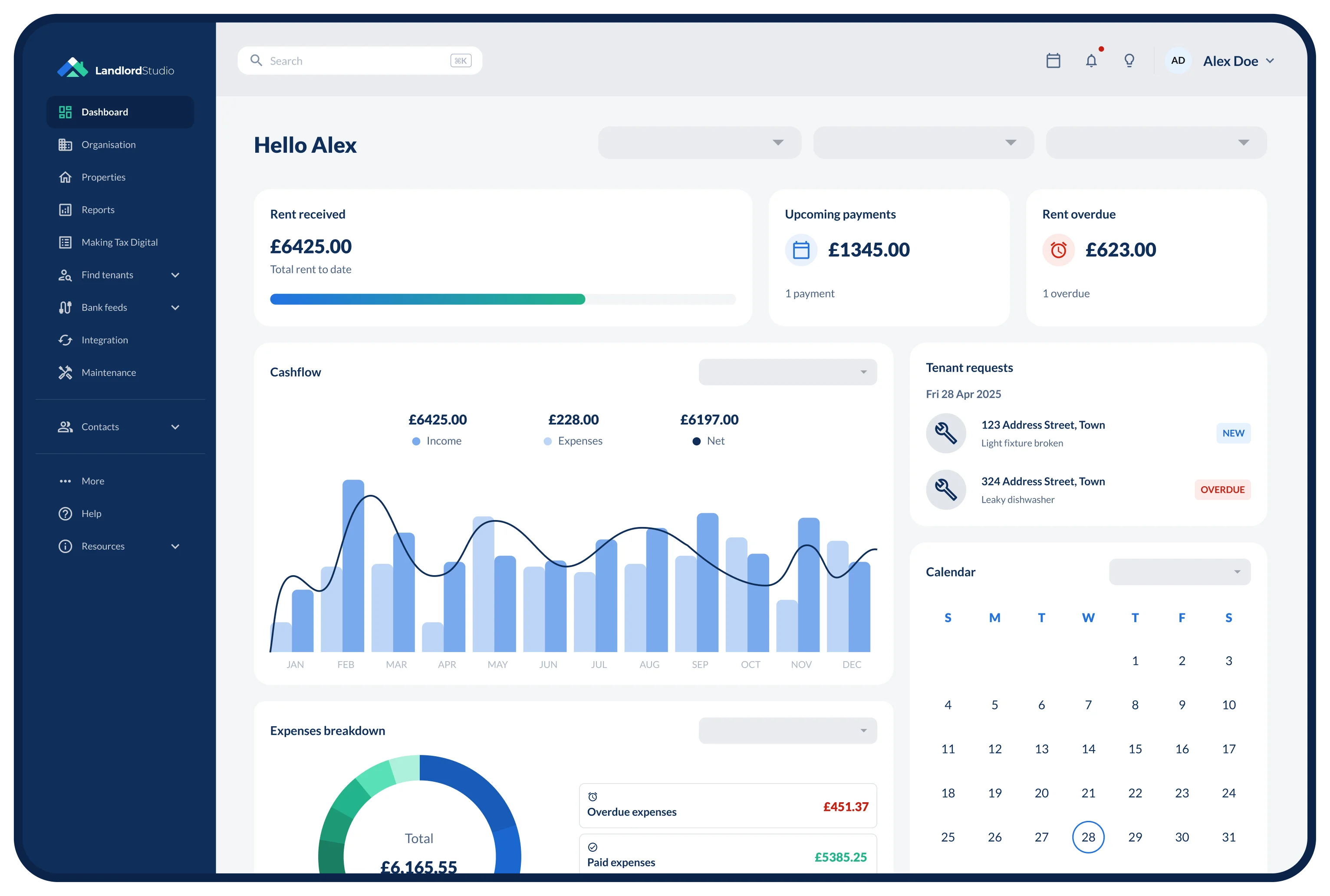
Landlord Studio is MTD-compatible software built for landlords. It records rent and expenses by property and sends your quarterly updates to HMRC. See how it works on our Making Tax Digital page, or watch our free on-demand webinar on how to submit your second quarterly MTD submission, which covers what to do if you missed your first.
This article explains HMRC's published rules and is not personal tax advice. If you are unsure how the rules apply to you, speak to an accountant or tax adviser.