




Read summarised version with:

ChatGPT

Gemini

Claude

Grok

Add as preferred on Google
If you're a letting agent that manages landlords, MTD has quietly become your problem too. The most accurate rental income and expense data your clients need for their quarterly submissions already sits in your client accounting system - which means the questions come back to you, not their accountant.
The good news is that a short, structured conversation with each landlord tells you almost everything you need to plan your support (and spot the revenue opportunity).
Here are the ten questions worth asking, why each one matters, and what to do with the answer:
1. Do you know which MTD threshold you fall into and when it starts for you?
MTD for Income Tax is phased by qualifying income: it began in April 2026 for landlords with combined gross property and self-employment income above £50,000, extends to £30,000 from April 2027, and drops to £20,000 from April 2028. Many landlords genuinely don't know which wave they're in.
What to do with the answer: Use it to segment your client base. Your £50k+ landlords are already in scope and need help now; the £30k and £20k tiers let you size the wider opportunity and plan conversations ahead of each deadline.
2. How are you keeping digital records of your rental income and expenses right now?
This is the fastest way to surface a compliance gap. If the answer is "a spreadsheet," "a shoebox," or "my agent sends me statements," they're not MTD-ready. HMRC won't accept submissions typed into the government website, and spreadsheets only work when they're linked to compatible bridging software with unbroken digital links.
What to do with the answer: Anyone still on paper or loose spreadsheets is a priority conversation and a strong candidate for a done-for-you approach rather than another tool they have to run themselves.
3. Where are you getting your income, fee and expense figures from at the moment?
Ask this and most landlords will point straight back at you: your monthly or quarterly statements. That's the key insight behind the whole MTD-for-agents opportunity - the data landlords need already exists in your system before the statement is generated.
What to do with the answer: It reframes your role. You're not being asked to become a tax adviser; you're the source of the cleanest data in the chain. That's a position worth building a service around, as we cover in how to deliver MTD services at scale.
4. Have you already started looking at MTD software on your own?
If a landlord has gone off and picked a generic, self-serve accounting tool, they've effectively signed up to re-key the very data you already hold - most of those tools assume a self-managing landlord entering their own transactions and reconciling from bank feeds. This question tells you whether a client is about to create duplicate work for themselves (and more queries for you), or whether they're still waiting for direction.
What to do with the answer: Either way, it's your cue to lead. A landlord can't set up an agent-managed solution on their own - you enable it and the data flows to them automatically - so the sooner you offer that route, the less likely they are to lock into a tool that fights your workflow. That's exactly how Nexus works: it's switched on by you inside your existing platform, not something landlords sign up to separately. If you're still weighing up which platform to run it on, the best letting agent software for handling MTD compares the options built for agent-managed portfolios.
5. Who will actually file your quarterly updates - you or your accountant?
Clarifying this early saves confusion later. Some landlords will submit themselves; others will lean entirely on an accountant. Either way, whoever files needs access to accurate, MTD-ready records four times a year.
What to do with the answer: If an accountant is in the picture, look for a platform that lets them collaborate directly rather than chasing exports from you.
6. Are you (or your accountant) re-typing figures from our statements each period?
This question exposes the hidden cost of the current setup. Under annual filing, re-keying statement data once a year was tolerable. Under quarterly filing, the same manual rebuild happens every three months and every re-entry is a chance for errors that eventually bounce back to your team as queries.
What to do with the answer: If they're rebuilding accounts from PDFs, that's precisely the friction letting agent tools like Nexus removes - transaction data syncs automatically from your client accounting platform into a landlord portal, so there's nothing to retype. If you're not ready to provide a service yet, you could recommend using the list of HMRC-recognised software for self-serving MTD.
7. Do you own any properties we don't manage, or use another agent as well?
MTD is reported at the landlord level, aggregated across their whole portfolio - not per property or per agent. A landlord who looks simple on your books may have a self-managed flat or a second agent elsewhere, and all of it needs to land in one submission.
What to do with the answer: This is where fragmentation bites. A landlord juggling multiple sources is exactly who benefits from consolidation. Letting agent tools like Nexus let them add self-managed and other-agent properties for one MTD-ready portfolio view, with your managed data flowing in automatically.
8. Do you have any income outside your rental portfolio, such as self-employment?
Qualifying income for MTD combines property and self-employment, so this affects both which threshold a landlord hits and what they ultimately report. It's an easy detail to miss in a property-only conversation.
What to do with the answer: It helps you place borderline clients in the right MTD wave, and flags landlords who'll want everything tracked in one place rather than across separate systems.
9. How do you feel about moving from once-a-year to four-times-a-year reporting?
This one is less about logistics and more about temperature. Quarterly reporting quadruples the number of touchpoints - and the anxiety. Landlords who feel unsure are telling you there's demand for support, and that you're the trusted party they'd rather turn to.
What to do with the answer: Nervous clients are your clearest signal of a service (and retention) opportunity. Regular, proactive contact around each quarter is the kind of relationship builder we explore in 3 ways letting agents can support landlords with MTD.
10. Would it help if the figures we already hold flowed straight into your submission?
End the conversation with the offer that ties it all together. Almost every landlord will say yes - because it removes the re-keying, the reconciliation and the quarterly scramble in one move. It's also your natural bridge from "helpful chat" to "here's the service we provide."
What to do with the answer: This is where Nexus comes in. You enable it inside your existing platform, the landlord opts in, and the rental data you already manage syncs automatically into their MTD-ready portal - where they (or their accountant) submit to HMRC in a few clicks.
Why the manual approach runs out of road
Handling MTD by hand feels manageable at first - a few exports here, a spreadsheet there. But three things change under quarterly filing. The volume of requests multiplies, because every in-scope landlord now needs figures four times a year instead of once. The error risk multiplies with it, since each manual re-entry is another opportunity for numbers to drift out of line with your records. And the queries all flow back to your team, because you're the one holding the source data.
Answering the ten questions above usually makes the same point clear on its own: the effort isn't in creating the data (you already have it) it's in getting it into a compliant format, reliably, at scale.
Turning landlord conversations into a scalable MTD letting agent service
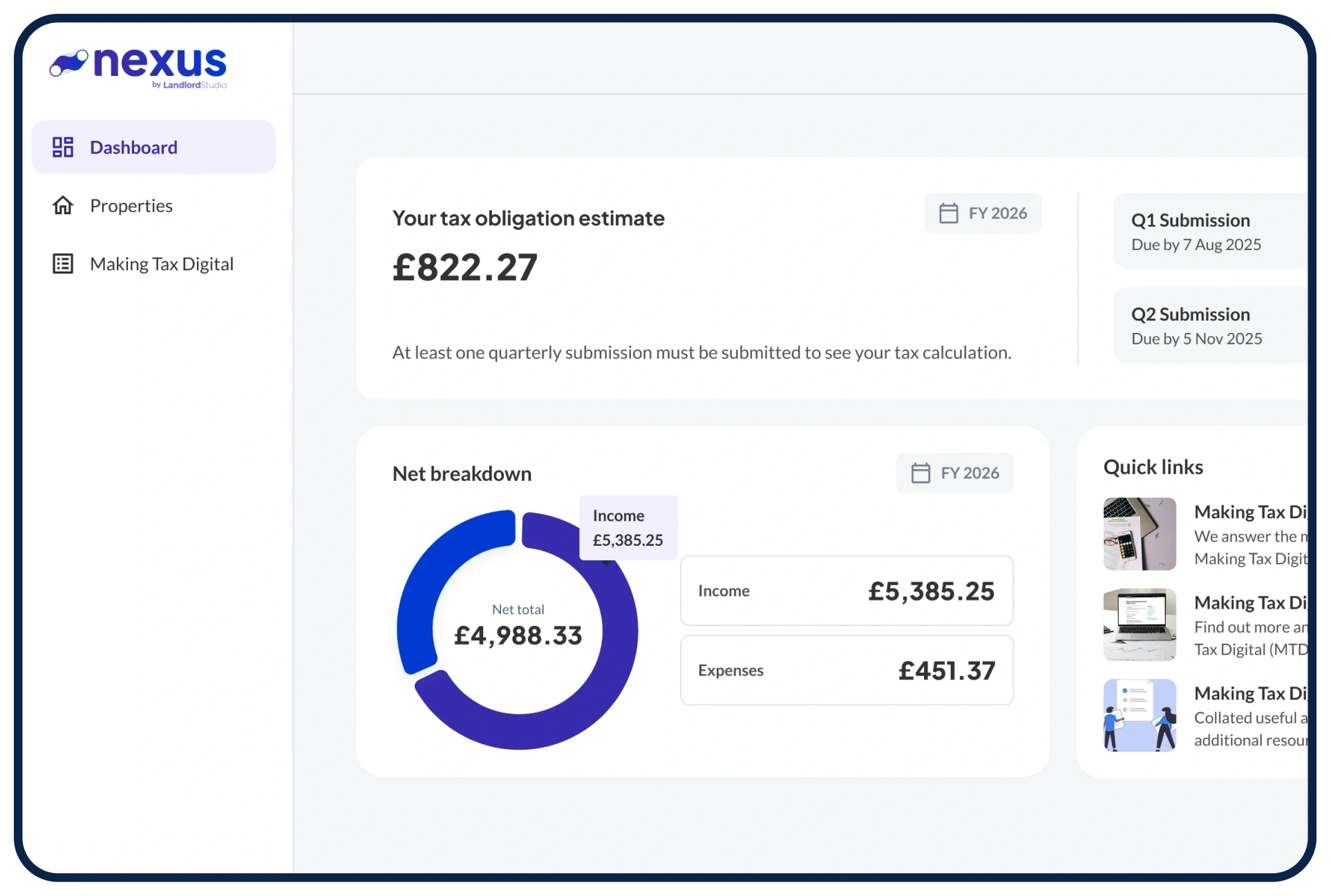
That's the shift worth making - from fielding MTD as ad-hoc admin to offering it as a defined service. Because the underlying data already lives in your client accounting system, the heavy lifting can be automated rather than repeated by hand every quarter.
Nexus is built for exactly this. It connects to platforms like Reapit, PayProp, SME Professional, LettsPay and Alto, syncs your landlords' transaction data into a secure portal, and lets them (or their accountant) submit quarterly updates directly to HMRC.
Your team keeps working exactly as it does today - no new bookkeeping steps, no tax responsibility - and you earn a recurring revenue share for every active landlord.
If you'd like to see how it fits your setup, book a quick demo with our team.