




Read summarised version with:

ChatGPT

Gemini

Claude

Grok

Add as preferred on Google
Most UK rent isn't due on the 1st. Fewer than a third of tenancies have rent due that day, and most simply follow the date the tenancy started.
So does the date matter?
We analysed tens of thousands of rent payments matched to the bank transactions landlords connect to Landlord Studio to find out.
- The 1st isn't the UK norm: 31% of UK tenancies have rent due on the 1st, against 81% in the US.
- The 1st has the most very late rent: 17% of payments due on the 1st arrived 15 or more days late, against 10% for rent due between the 16th and the 28th.
- Weekend due dates mostly arrive a day or two late: rent due on a Saturday or Sunday arrived on time 48% of the time, against 62% to 65% on weekdays, but most of the shortfall landed within three days.
- Later in the month does best: due dates from the 16th to the 28th had the fewest very late payments.
When is rent usually due in the UK?
UK rent is usually due on the day of the month the tenancy started. The 1st is the single most common day, but fewer than a third of tenancies use it.

- The 1st: 31% of tenancies, the only day with more than 4%.
- Mid-month: 20% of tenancies are due between the 6th and the 14th, and 18% between the 16th and the 24th.
- The 15th and the 28th: the next most popular single days, at 3.8% and 3.6%.
- Tied to the start date: 76% of tenancies have rent due on the same day of the month that they began.
It's a sharp contrast with the US, where 81% of leases have rent due on the 1st.
Which rent due dates get paid on time?

Rent due on the 1st does worst. One in six payments due on the 1st arrived 15 or more days late, against one in ten for rent due between the 16th and the 28th.
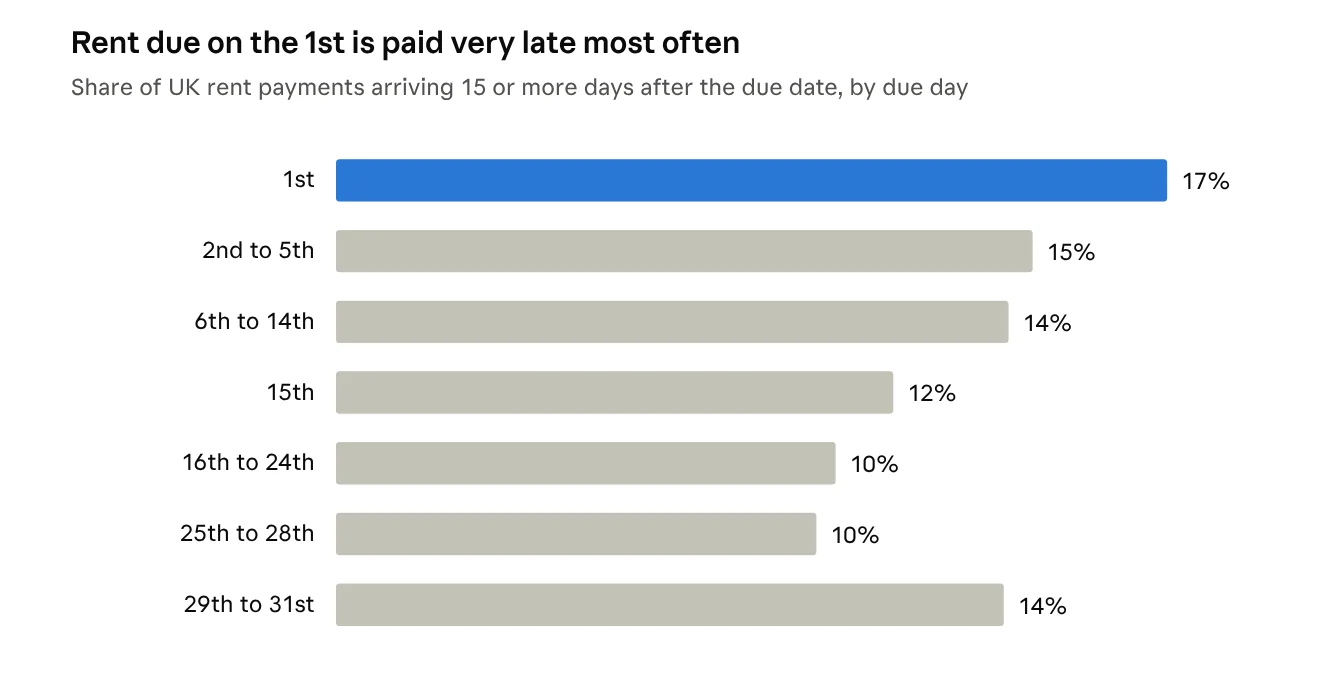
- The 1st: 17% of payments arrived 15+ days late, and 55% arrived on time.
- The 16th to the 28th: about 10% arrived 15+ days late, and 60% to 62% arrived on time.
- Early and mid-month: due dates from the 2nd to the 14th sit in between, at 14% to 15% very late.
Is it the date or the landlord?
The pattern holds for the same landlords.
We compared landlords with tenancies due on the 1st and others due later in the month. About 18% of their 1st-of-the-month rent arrived 15+ days late, against about 11% for tenancies due between the 16th and the 28th.
Rent level doesn't explain it either. Even after adjusting for rent, no due date's result moved by more than half a point.
The gap in on-time payments is smaller and less certain than the gap in very late ones. The safest reading: rent due on the 1st is more likely to go badly late.
Why does rent due on a weekend look late?

Because UK banks generally don't send standing orders at weekends. Rent due on a Saturday or Sunday arrived on time 48% of the time, against 62% to 65% on weekdays.
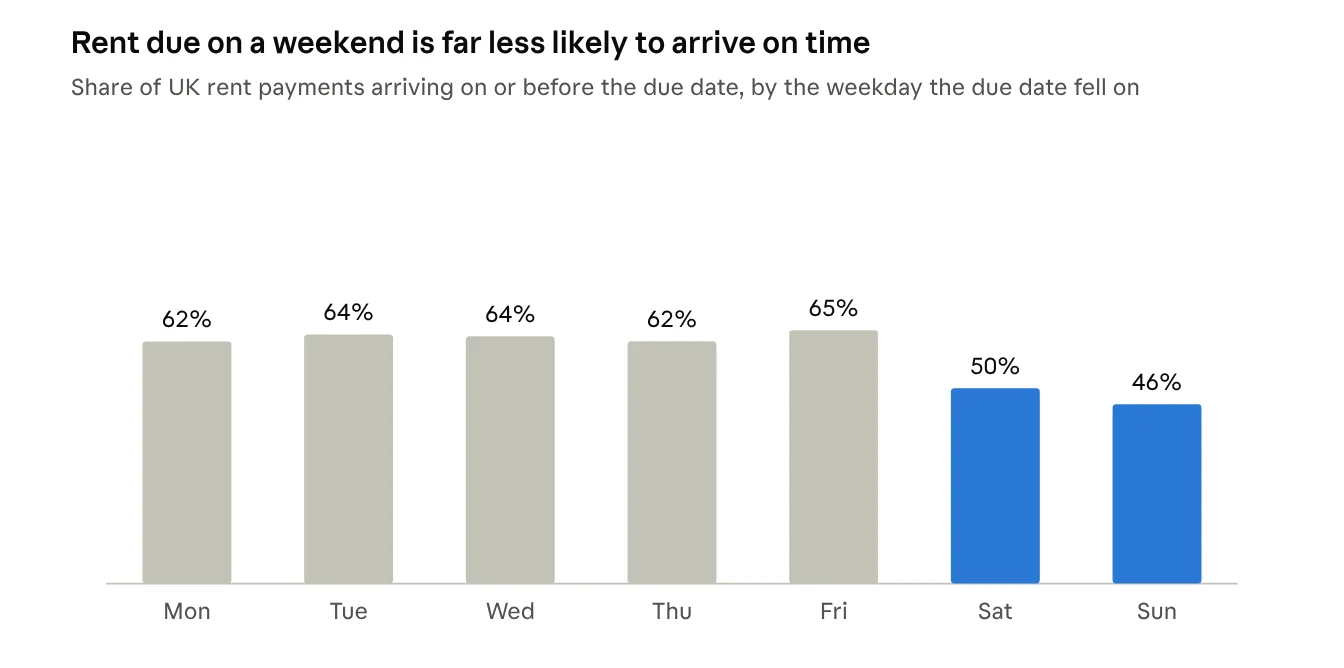
- Mostly a day or two late: the gap is almost all payments arriving one to three days late, a quarter to a third of weekend rent against 9% to 14% on weekdays.
- Very late rent is unchanged: 14% of payments arrived 15+ days late whether the due date fell on a weekend or a weekday.
- Banks move the payment: standing orders due on a weekend or bank holiday go out on the next working day, as Santander and Halifax both explain.
So if rent turns up on the Monday after a weekend due date, your tenant probably paid on time if they pay by standing order. Bank holidays work the same way.
Does it help to set rent around payday?
Possibly, but not in the obvious way.
Rent due on the 1st, just after the most common payday, did worst.
The last working day of the month is the most common payday for monthly payrolls, used by 34% of payroll teams in the Chartered Institute of Payroll Professionals' 2023 survey. The 25th and the 28th are close behind, at 30% each.
Rent due between the 16th and the 28th, on or just before those paydays, had the fewest very late payments, at about 10%. Rent due on the 1st had the most, at 17%, followed by the 2nd to the 5th at 15%.
Our data doesn't show when each tenant is actually paid, so treat payday as a guide, not a rule. Not everyone is paid monthly or at month end. Tenants on Universal Credit, for example, are paid on the same date each month, set by when they first claimed.
How should you choose or change a rent due date?
Check the rules, then start from the tenancy start date and your tenant's payday. These steps cover most cases:
- Check the rules first: tenancy law differs across England, Scotland, Wales and Northern Ireland, so check the current rules or take advice before changing anything.
- Use the tenancy start date: it's the UK norm and keeps the first payment simple, with no part-month to work out.
- Ask when your tenant is paid: set the due date when they'll have the money, rather than defaulting to the 1st.
- Allow for weekends and bank holidays: a standing order due on a non-working day arrives the next working day, so don't treat it as late.
- Agree any change with your tenant: moving the due date on a live tenancy should be agreed and recorded, so take advice on how to do it.
If rent does go late, our guide on how to handle late rent covers what to do next.
Is the 1st the right rent due date for your tenants?
Not necessarily. Rent due on the 1st was the most likely to go badly late in our data, and due dates later in the month did better. Whatever date you choose, a quick check that it suits your tenant's payday is worth more than following convention.
Landlord Studio's bank feeds (on the Pro plan) link your bank account and bring rent payments in automatically, so you can see when rent lands and spot late payments early. You can try Landlord Studio free for 14 days.
Methodology
This analysis uses tens of thousands of UK residential rent payments recorded in Landlord Studio and matched to a transaction in the landlord's bank feed, on tenancies with monthly rent.
- Due date: the date rent was due under the tenancy. Due-day groups use the day of the month set on the tenancy.
- Arrived: the date of the matching bank transaction, when the money reached the landlord's account.
- On time: the payment arrived on or before the due date.
- Very late: the payment arrived 15 or more days after the due date.
- Bank feed only: only payments matched to a bank feed are included, because hand-entered payment dates are less reliable.
Data is anonymised and aggregated. Figures show patterns, not cause and effect. This article covers UK tenancies. It is general information, not legal advice, and tenancy law differs across England, Scotland, Wales and Northern Ireland.