
Welcome! Where would you like to log in?

Sign up and get
PRO free for 14 days
Once your PRO trial is over you can continue using Landlord Studio GO completely free.
By continuing you agree to our Terms & Conditions.

How Much Do Letting Agents Charge? UK Fees Explained (2026)
UK letting agents charge 10% to 15% of rent for full management, plus 20% VAT. See 2026 fee ranges, what VAT really adds, and what self-managing saves.
.webp)
Written by
Ben Luxon
PUBLISHED ON
February 26, 2025
UPDATED ON
September 5, 2026
READ TIME
0 min


Read summarised version with:


Last updated: 10 August 2026. This guide covers England.
UK letting agents typically charge landlords 8% to 12% of the first year’s rent for tenant-find only, 3% to 12% of monthly rent for rent collection, and 10% to 15% of monthly rent for full management, rising to around 17% at the large national chains. Almost every agent adds VAT at 20% on top, so a headline 12% management fee actually costs 14.4% of your rent.
Three things to hold onto before the detail:
- Percentages are quoted before VAT. A 12% fee is 14.4% in practice, and residential landlords generally cannot reclaim it.
- The bases differ. Tenant-find is usually a percentage of annual rent. Management is a percentage of monthly rent. They are not comparable numbers.
- There is no official dataset. Every range on this page comes from named, dated trade sources and should be treated as indicative, not authoritative.
Letting a property comes with many responsibilities, and for landlords who prefer a hands-off approach, hiring a letting agent can be an attractive option. But how much do letting agents charge, and what exactly do these fees cover?
Understanding the fees charged by letting agents is essential before committing to a service. Average letting agent fees in the UK vary depending on the level of service, location, and agency, and they can significantly reduce a landlord’s profitability.
In this guide we break down typical property management fees, show what VAT adds to the headline rate, explain what agents can and cannot charge tenants under the Tenant Fees Act 2019, and set out what the Renters’ Rights Act changed on 1 May 2026. We also quantify what it costs to self-manage instead, using Landlord Studio’s UK pricing.
What are letting agent fees?
Letting agent fees are the costs landlords pay for professional letting and property management services. They are usually charged as a percentage of the rent, or as fixed one-off fees for specific tasks such as tenant sourcing or inventory preparation.
These are landlord-facing fees, and they are a separate matter from the tenant-facing fees restricted by the Tenant Fees Act 2019. That distinction matters, and it is covered further down this page.
How much do letting agents charge landlords in the UK?
Letting agents generally sell three tiers of service. The figures below are the headline rates before VAT unless stated otherwise.
- Tenant find only (let only): 8% to 12% of the first year’s rent, or a fixed fee of roughly £400 to £1,500. Some agents price it as around one month’s rent instead.
- Rent collection: 3% to 12% of monthly rent, where the agent collects payments and chases arrears but does not handle maintenance or compliance.
- Full management: 10% to 15% of monthly rent for independent agents, which is 12% to 18% including VAT. The large national chains cluster higher, at roughly 15% to 17% before VAT, or 18% to 20.4% including VAT.
The tenant-find and rent-collection ranges are taken from LettingaProperty.com’s letting agent fees guide, last updated 6 July 2026. The full-management figures come from The Independent Landlord’s July 2026 review of published agent fee schedules, which found fully managed services costing between 14.4% and 20.4% of gross rent including VAT.
For a property let at £1,200 per month, full management at 12% costs £172.80 per month, or £2,073.60 per year, once VAT at 20% is added. The table below sets out the common fees side by side. Every percentage in it excludes VAT unless the cell says otherwise.
.jpg)
| Service Type | Fee Structure | Typical Cost | Description |
|---|---|---|---|
| Tenant Find Only | 8% to 12% of first year's rent, or a one-off fixed fee | £400 - £1,500 before VAT | Covers marketing, viewings, and securing tenants. Ideal for landlords who manage the property themselves. |
| Rent Collection | 3% to 12% of monthly rent | Add VAT at 20% to the headline rate | Agent collects rent and handles arrears but does not manage property maintenance or compliance. |
| Full Management | 10% to 17% of monthly rent before VAT | £172.80/month or £2,073.60/year inc VAT (12% fee, £1,200 rent) | Comprehensive service covering maintenance, inspections, compliance, and tenant relations. |
| Tenant Referencing | Fixed fee per applicant | £50 - £150 per applicant | Background and affordability checks (cannot be charged to tenants due to Tenant Fees Act 2019). |
| Inventory Fee | One-off fee | £100 - £250 | Detailed inventory to protect against property condition disputes. |
| Section 13 Rent Increase | Fixed fee per notice | £0 - £300 inc VAT | Replaced tenancy renewal fees, which ended when the Renters' Rights Act abolished fixed terms on 1 May 2026. |
| Void Period Management | Fixed fee or % of potential rent | Varies | Covers property security and basic maintenance during vacancy periods. |
Why are some fees quoted on annual rent and others on monthly rent?
Because the industry uses two different conventions and rarely flags the switch. Tenant-find fees are normally quoted as a percentage of the first year’s rent, because the work is one-off. Rent collection and full management are quoted as a percentage of monthly rent, because they are ongoing.
This is the single most common reason landlords misread a fee schedule. A 10% tenant-find fee and a 10% management fee are wildly different amounts of money. On a £1,200 per month property, 10% of the first year’s rent is £1,440 once, while 10% of monthly rent is £120 every month for as long as the tenant stays. Always ask an agent which base they are quoting.
Why does VAT make a 12% fee cost 14.4%?
Because letting agent fees are subject to VAT at the standard rate of 20%, and almost all UK letting agents are VAT registered. Agents advertise the pre-VAT figure, so the number on the fee schedule is not the number that leaves your account.
Here is the arithmetic on a property let at £1,200 per month with a 12% full management fee:
- Fee before VAT: £1,200 × 12% = £144.00 per month
- VAT at 20%: £144.00 × 20% = £28.80 per month
- Total payable: £172.80 per month
- Annual cost: £172.80 × 12 = £2,073.60 per year
So the effective rate is 12% × 1.2 = 14.4% of your rent, not 12%. Ignoring VAT understates the annual cost of this arrangement by £345.60.
The reason this matters more for landlords than for most businesses is that residential rent is exempt from VAT. As The Independent Landlord’s July 2026 fee analysis puts it, most landlords cannot recover the VAT on agent fees, so it is not a pass-through, it is part of the price. When an agent says “12% plus VAT”, read it as 14.4% of every month’s rent.
Apply the same 1.2 multiplier to any quote you are given. A 15% headline fee is 18%. An 18% headline fee is 21.6%. When comparing two agents, insist both quote including VAT so you are comparing like with like.
What does each letting agent fee cover?
Tenant find fee (letting fee)
The letting fee covers marketing, property viewings, referencing, and setting up the tenancy. It suits landlords who are comfortable managing the property themselves but want help finding a tenant. Expect 8% to 12% of the first year’s rent, or a fixed fee of roughly £400 to £1,500 before VAT, depending on location and agent type.
Tenant referencing fee
Landlords and agents cannot charge tenants for referencing under the Tenant Fees Act 2019, so that cost moved to landlords. Some agents bundle it into the tenant-find fee; others charge separately, typically £50 to £150 per applicant.
Full management fee
Full management covers day-to-day work such as rent collection, arranging repairs, and inspections. It usually includes:
- Handling maintenance requests and instructing contractors
- Renewing safety certificates and keeping the property compliant
- Rent collection and chasing arrears
- Periodic inspections and end-of-tenancy check-out
- Acting as go-between on disputes and complaints
What it often does not include is worth asking about explicitly. The Independent Landlord’s July 2026 review of published fee schedules found agents charging separately for check-out inventories, deposit administration, and a mark-up on repair costs, and noted that mark-ups on larger works are common.
Inventory fee
A detailed inventory protects landlords in a deposit dispute. Agents typically charge £100 to £250 for an inventory and check-in report, with check-out reports often priced separately.
Section 13 rent increase fee
This one is new. Before 1 May 2026, agents commonly charged a renewal fee when a fixed term was extended, and used the renewal to raise the rent. The Renters’ Rights Act abolished fixed terms, so renewals no longer exist and renewal fees have gone with them.
The replacement is a charge for serving a Section 13 rent increase notice on Form 4A. The Independent Landlord’s July 2026 survey found large agents charging up to £300 including VAT for this, with some independents including it at no extra cost. Since rent can only be increased once every 12 months, a £300 fee can absorb the entire benefit of a modest increase, so it is worth negotiating out before you sign.
Compliance and regulation fees
Some agents now add a monthly “landlord regulation check” or “compliance fee” on top of the management percentage. The Independent Landlord’s July 2026 review found these ranging from around £11 to £48 per month including VAT, with many agents charging nothing at all. At £48 per month that is £576 a year on top of your management fee, so check for it and ask for it to be waived.
Void period management fee
Some letting agents charge to manage the property between tenancies, covering security and basic maintenance. This is usually a fixed fee or a percentage of the rent that would have been due.
What makes letting agent fees higher or lower?
Average letting agent fees vary considerably. The main drivers are:
- Location: London and other high-demand areas tend to have higher average letting agent fees, because rents are higher and competition for management stock is stronger.
- Agent type: The Independent Landlord’s July 2026 data shows quality independent agents at around 14.4% including VAT, while large national chains cluster between 18% and 20.4% including VAT for the same headline service.
- Service level: Full management costs several times more over a tenancy than a one-off tenant-find fee.
- Property size and type: Larger properties and HMOs (houses in multiple occupation) need more management, so they cost more.
- Extras and mark-ups: Two agents on the same headline percentage can differ by hundreds of pounds a year once compliance fees, Section 13 charges, and repair mark-ups are counted.
Where do these fee ranges come from?
There is no authoritative published dataset for what UK letting agents charge landlords. That is worth saying plainly, because most guides on this topic present a range as though it were a statistic.
Propertymark publishes fee-schedule templates and qualifications for agents, but not national fee benchmarks. Consumer research from bodies such as Which? and the HomeOwners Alliance covers estate agent commission on property sales, which is a different product with different economics. There is no equivalent official survey of letting and management fees paid by landlords.
What does exist is genuinely useful, and it is the agents’ own published fee schedules. Letting agents are legally required to publish a list of their fees on their website, and where they advertise on a third-party site such as Rightmove, Zoopla, or Facebook they must either list the fees in the advert or link to the list, as gov.uk guidance confirms.
So treat the ranges on this page as indicative, and treat the fee schedules of the three or four agents you are actually considering as the real numbers. The sources behind the figures here are:
- LettingaProperty.com, “Letting Agent Fees: A Comprehensive Guide for Landlords”, last updated 6 July 2026 for the tenant-find, rent-collection, and full-management spreads.
- The Independent Landlord (Suzanne Smith), “How much do letting agents charge for full property management?”, published 13 July 2026 for the inclusive-of-VAT full management figures, Section 13 charges, and compliance fees, all built from named agents’ published fee schedules with dates.
- gov.uk and legislation.gov.uk for every statutory figure, linked at the point it is used.
What can letting agents charge tenants in 2026?
In England, letting agents and landlords can only charge tenants payments on a closed statutory list set by the Tenant Fees Act 2019, as amended by the Renters’ Rights Act from 1 May 2026. Anything not on the list is a prohibited payment.
According to gov.uk guidance on fees you can charge as part of a tenancy, the permitted payments are:
- The rent, once you and the tenant have signed the tenancy agreement
- A refundable tenancy deposit, capped
- A refundable holding deposit to reserve the property, capped
- A payment to change the tenancy when the tenant requests it, capped at £50 unless higher costs can be evidenced
- A payment when the tenant does not give the correct amount of notice
- A payment towards utility bills, communication services, and council tax
- A fee for late payment of rent, capped at 3% above the Bank of England base rate and only once rent is at least two weeks overdue
- A fee for replacing a lost key or security device, capped at the reasonable cost incurred
How much deposit can a letting agent take?
The tenancy deposit cap depends on the annual rent, and there are two bands plus a scope exclusion:
- Annual rent under £50,000: maximum 5 weeks’ rent
- Annual rent of £50,000 or more: maximum 6 weeks’ rent
- Annual rent above £100,000: the Tenant Fees Act 2019 does not apply at all, so there is no statutory cap
One week’s rent means the annual rent divided by 52. On a property let at £1,200 per month, the annual rent is £14,400, so one week is £276.92 and the five-week cap is £1,384.62. These figures are set out in Schedule 1 of the Tenant Fees Act 2019 and confirmed in the gov.uk statutory guidance for enforcement authorities. Any deposit taken must be protected in a government-approved scheme.
How much can a holding deposit be?
A holding deposit is capped at one week’s rent, which is £276.92 on that same £1,200 per month property. Only one holding deposit can be held per tenancy at a time, and the standard period for holding it is 15 calendar days unless a different period is agreed in writing. It must be refunded unless the tenant fails a Right to Rent check, withdraws, stops responding, or gives false or misleading information that affects their suitability.
What are the penalties for charging a prohibited fee?
A first breach carries a financial penalty of up to £5,000. A second or subsequent breach within five years of a previous penalty can bring a penalty of up to £30,000 or prosecution, which carries an unlimited fine and is a banning order offence. Tenants can also apply to the First-tier Tribunal for the fee to be returned.
What did the Renters’ Rights Act change for letting agent fees?
Four things changed on 1 May 2026, and most guides on letting agent fees have not caught up with any of them. You can read our fuller coverage in the Renters’ Rights hub.
- Rent in advance is now a prohibited payment. Neither a landlord nor an agent can ask for, encourage, or accept rent before the tenancy agreement is signed. After signing and before the start date, the maximum is one month’s rent in advance. This ended the practice of asking for six or twelve months up front.
- Rental bidding is banned. If you advertise a property you must publish an asking price, and it is illegal to encourage offers above it or to accept them.
- Renewal fees have gone, and been replaced. Fixed terms were abolished and all tenancies became assured periodic tenancies, so there is no renewal to charge for. Rent can now only be increased once every 12 months using the Section 13 process on Form 4A, with at least two months’ notice, and many agents now charge for serving that notice instead.
- Fee transparency is reinforced. Agents must publish their fee list on their website, and adverts on portals such as Rightmove and Zoopla must either show the fees or link to them.
Just as important is what did not change. The Tenant Fees Act only ever regulated tenant-facing fees. Fees between a landlord and a letting agent are not capped and remain freely negotiable. If you have read that letting agent fees are now capped, that is a misreading of the Act. Nothing stops you negotiating your management percentage down, and the best time to do it is before you sign.
The two gov.uk sources for this section are the Renters’ Rights Act overview for landlords and the fees you can charge as part of a tenancy guidance, both published 1 May 2026.
How much can you save by self-managing?
On a property let at £1,200 per month, full management at 12% plus VAT costs £2,073.60 a year. Landlord Studio’s Pro plan costs £12 per month, or £144 a year, and covers up to three units with £1 per month for each additional unit. The MTD Go plan is free for up to three units.
That is a difference of £1,929.60 a year on a single property. Pricing was checked on the Landlord Studio UK pricing page on 10 August 2026.
Be honest with yourself about what that gap buys, though, because it is not a like-for-like swap. An agent conducts viewings, fields the 10pm boiler call, and instructs contractors. Software does not. What software replaces is the administrative half of the job: the bookkeeping, the rent chasing, the certificate reminders, the tax reporting, and the document storage. If you are willing to handle tenant contact and repairs yourself, the fee is largely avoidable. If you are not, a good agent earns their percentage.
Why landlords self-manage
- Save thousands per year: avoiding management fees goes straight to your net rental income.
- Direct control over tenants and maintenance: communicate directly with tenants and make sure maintenance is handled to your standard, with no mark-up on repairs.
- Full transparency over finances: no compliance fees, no Section 13 charges, no unexpected line items on a monthly statement.
Self-managing with Landlord Studio
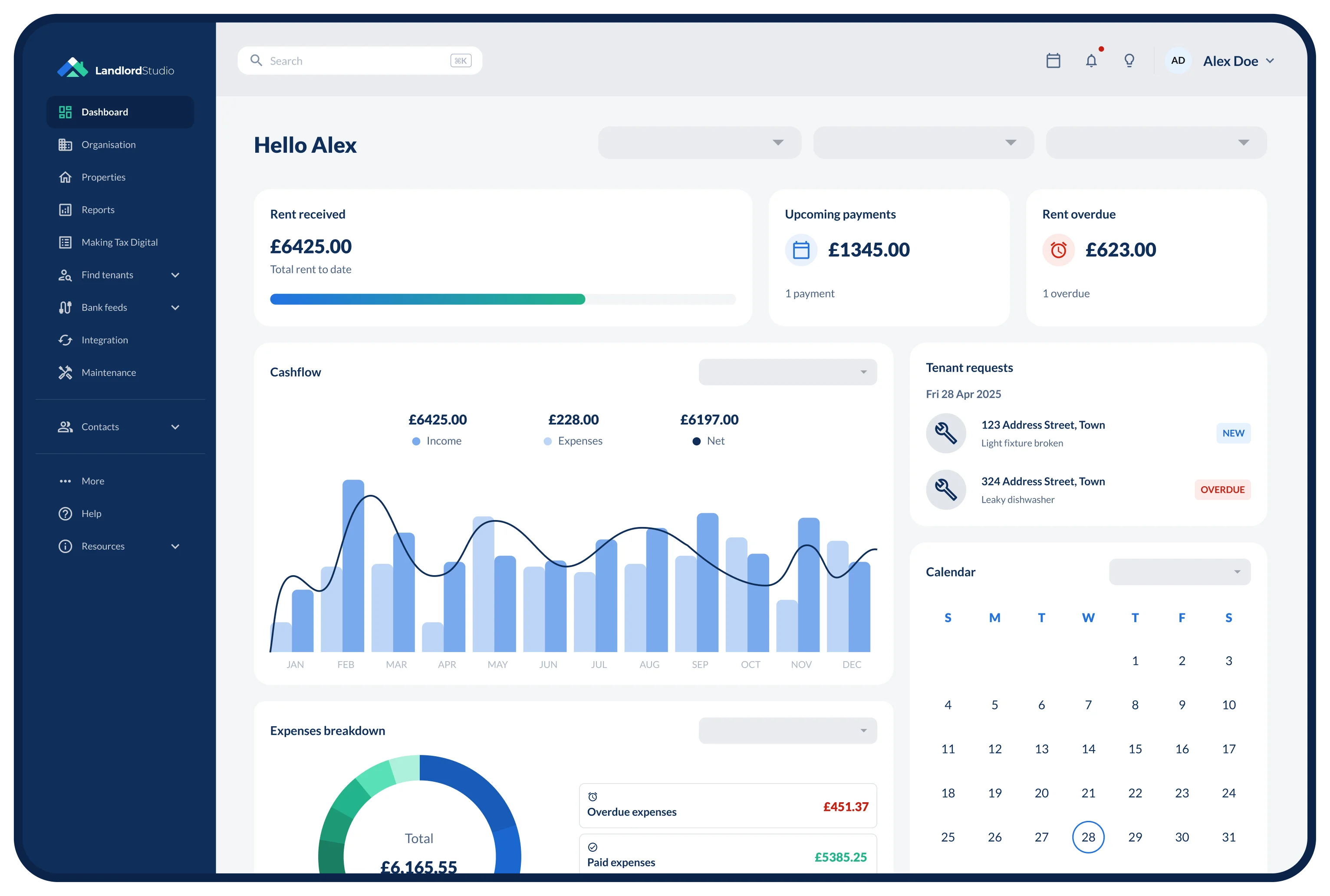
Landlord Studio is an all-in-one platform for landlords who want to cut letting agent fees without cutting corners. With Landlord Studio you can:
- Reduce late rent: stay on top of upcoming and overdue payments and send automated rent reminder emails.
- Track income and expenses: digitise receipts and automate income and expense tracking with bank feeds.
- Generate tax reports: simplify tax filing with customisable financial reports, and make sure you’re MTD-ready with digital record-keeping built for landlords.
- Store tenancy agreements and compliance certificates: keep every document in one place with renewal reminders.
- Manage maintenance requests: track, prioritise, and close out repairs efficiently.
- Import agent statements: if you keep an agent on some properties, pull their rental statements in automatically rather than retyping them.
Frequently asked questions
How much do letting agents charge for full management?
Independent letting agents typically charge 10% to 15% of monthly rent before VAT, which is 12% to 18% including VAT. Large national chains cluster higher, at roughly 15% to 17% before VAT, or 18% to 20.4% including VAT, according to The Independent Landlord’s July 2026 review of published fee schedules. On £1,200 per month rent, a 12% fee costs £172.80 per month including VAT.
Do letting agent fees include VAT?
Usually not. Agents advertise the pre-VAT rate and add VAT at the standard 20% rate on the invoice. Because residential rent is exempt from VAT, most landlords cannot recover it, so it is a real cost rather than a pass-through. Multiply any headline percentage by 1.2 to get the rate you will actually pay.
Can a letting agent charge a tenant fees in 2026?
Only payments on the closed statutory list in the Tenant Fees Act 2019, as amended by the Renters’ Rights Act from 1 May 2026. That means rent, a capped tenancy deposit, a capped holding deposit, capped tenancy-change and default fees, and contributions to utilities and council tax. Referencing, admin, inventory, and rent-in-advance charges are prohibited. A first breach carries a penalty of up to £5,000.
What is a typical tenant-find-only fee?
Between 8% and 12% of the first year’s rent, or a fixed fee of roughly £400 to £1,500 before VAT, according to LettingaProperty.com’s guide last updated 6 July 2026. Some agents price it as around one month’s rent plus VAT instead. Check which base is being quoted, because a percentage of annual rent and a percentage of monthly rent are very different sums.
Can I negotiate letting agent fees?
Yes. Landlord-to-agent fees are not capped by any legislation and remain freely negotiable. The strongest time to negotiate is before you sign, while the agent is still trying to win your business. Ask for compliance fees and Section 13 charges to be waived, ask what the repair mark-up is, and get any variation from the standard terms confirmed in writing.
How much can I save by self-managing?
On a £1,200 per month property, full management at 12% plus VAT costs £2,073.60 a year, while Landlord Studio’s Pro plan is £144 a year for up to three units, a difference of £1,929.60. That comparison covers the administrative side only. You will still be doing viewings, tenant contact, and repair coordination yourself.
Should you pay letting agent fees?
Understanding how much letting agents charge is invaluable to any landlord looking to protect their rental income. Agents provide real convenience, and a good one is worth paying for, but at 14.4% to 20.4% of rent including VAT the cost compounds over a long tenancy.
Before appointing an agent, it is worth:
- Getting every quote including VAT so you are comparing like with like.
- Asking for the full published fee schedule and highlighting anything you consider unreasonable, including compliance fees, Section 13 charges, and repair mark-ups.
- Weighing full management against tenant-find only, and being honest about how much of the work you are genuinely willing to do.
- Considering self-managing with Landlord Studio to remove the management percentage entirely.
So how much do letting agents charge in your area? If the answer is “too much”, try Landlord Studio today for a smarter way to manage your properties.
About Landlord Studio
.webp)
Landlord Studio is an easy to use MTD compliant property management and accounting software designed for UK landlords.
Track income and expenses, run reports,, find and prescreen tenants, manage property maintenance, and more.
.webp)