
Welcome! Where would you like to log in?

Sign up and get
PRO free for 14 days
Once your PRO trial is over you can continue using Landlord Studio GO completely free.
By continuing you agree to our Terms & Conditions.

What Landlords Need To Know About MTD for IT
MTD for Income Tax started on 6 April 2026. Here is who it applies to, the thresholds, the deadlines, and how to stay compliant.

Written by
Ben Luxon
PUBLISHED ON
August 28, 2024
UPDATED ON
September 18, 2026
READ TIME
0 min


Read summarised version with:


Making Tax Digital for Income Tax (MTD for IT) faced numerous delays, the most recent being announced on the 20th of December 2022 where the HMRC announced that the implementation of MTD had been pushed back again. MTD was phased in from the 6th of April 2026.
In the first year, sole traders and landlords with an overall income of over £50,000 had to make a dramatic change to how they keep their financial records and the tools they use. It means keeping up-to-date and accurate financial records in digital format throughout the tax year, as those in scope are required to submit quarterly summary updates of business income and expenditure to HMRC along with a final declaration.
In order to stay compliant with the MTD for IT rules, you will need to use MTD-compatible software or bridging software. Good software will help you streamline your entire record-keeping process and offer real-time financial insights allowing you to optimise elements of your business and improve profitability. The benefits could be significant and help you better manage your taxes.
Learn more about MTD for landlords in our comprehensive guide here
Are You Ready for MTD? Take The Quiz
Key Dates: MTD for IT
Regardless of how you have kept your records up to this point, Making Tax Digital started in April 2026, and landlords and self-employed individuals in scope need to keep accurate digital records and have access to HMRC-recognised MTD compliant software.
- All VAT-registered businesses have been required to comply with MTD since April 2022.
- Since April 2026 MTD has applied to landlords and self-employed individuals earning above the income threshold of £50,000.
- From April 2027 it will affect landlords and self-employed individuals earning above £30,000.
- From April 2028 it will affect those earning above £20,000.
If your own start date has not arrived yet, as with adopting any new system there can be teething issues. We recommend getting yourself prepared early by finding an accounting software that suits your needs now, so you can avoid any potential issues that might arise from such a dramatic shift in methodology.
The first thing to do is to find the software that’s both future-proof and right for you. One that will allow you to keep digital records in an efficient way. You will need to regularly update these records as well as digitise receipts and run key financial reports. As such the software you look for should offer cloud accounting, with a mobile app and receipt scanner.
What you don’t want to happen is to be scrambling for software last minute only to decide halfway through the year that you don’t like it and want to change it.
Finally, the software you choose needs to be MTD compatible. Landlord Studio is HMRC-recognised and MTD compliant, with direct HMRC integration, and also integrates seamlessly with Xero.
Speak to your accountant or bookkeeper if you are thinking about registering for MTD for IT (which you can do here).
Who is Affected by MTD for IT?
MTD for IT affects sole traders, self-employed individuals, and landlords with qualifying income above the £50,000 threshold since April 2026, dropping to £30,000 from April 2027 and £20,000 from April 2028 (unless you have an exemption – see below).
If you own multiple businesses, then the income earned from all of these combined contributes to this threshold.
However, those earning below the threshold can continue to use the old HMRC system for filing their returns.
MTD for IT Exemptions
The HMRC says that you can apply for an exemption from MTD IT if:
- it’s not practical for you to use software to keep digital records or submit them — this may be due to your age, disability, location or another reason
- you are a practising member of a religious society (or order) whose beliefs are incompatible with using electronic communications or keeping electronic records
Additionally, the latest MTD IT policy update indicates that the following taxpayers may also be able to obtain an exemption (at least from when it first comes into effect):
- Estates of deceased persons
- Trustees of registered pension schemes
- Trusts (including trusts with property income)
- Non-resident companies
What are the filing deadlines for MTD IT?
Quarterly updates cover the periods ending 5 July, 5 October, 5 January and 5 April, and each is due one month later — so the filing deadlines are 7 August, 7 November, 7 February and 7 May.
Those businesses with accounting dates of 31 March to 5th April will also file by these deadlines.
The first mandated MTD submission, for the first quarter to 5 July 2026, had to reach HMRC by 7 August 2026.
How to sign up for MTD for IT
To sign up, you must be registered to file Self Assessment tax returns. You’ll need the Government Gateway user ID and password you use to file returns.
You must have software that’s recognised by HMRC for Making Tax Digital for Income Tax before you sign up.
If you’re unsure how to proceed, you can ask your software provider, accountant, or bookkeeper how to sign up for MTD for IT.
When you sign up the HMRC will request the following information: business name, business start date, email address, national insurance number, accounting period, and accounting type to apply.
If you’re looking for more information, HMRC’s guidance on signing up is a handy resource.
Submitting returns under MTD for IT?
Once you are in scope, you will need to keep digital records of income and expenditure. There are two parts you’ll need to submit for MTD for IT:
- Quarterly updates, including a summary of business income and expenditure.
- Final Declaration. You’ll need to share details of all other taxable income by 31 January each year, including investments and savings interest.
The separate End of Period Statement (EOPS) was removed from the requirements following the 2023 Autumn Statement, because most of its information is now covered by the Final Declaration.
If your own start date has not arrived yet, it’s absolutely worth signing up early if you can, or talking to your accountant about how you can get prepared. Taking the time to get used to the digital tools now will undoubtedly make the transition smoother.
Landlord Studio and MTD for IT

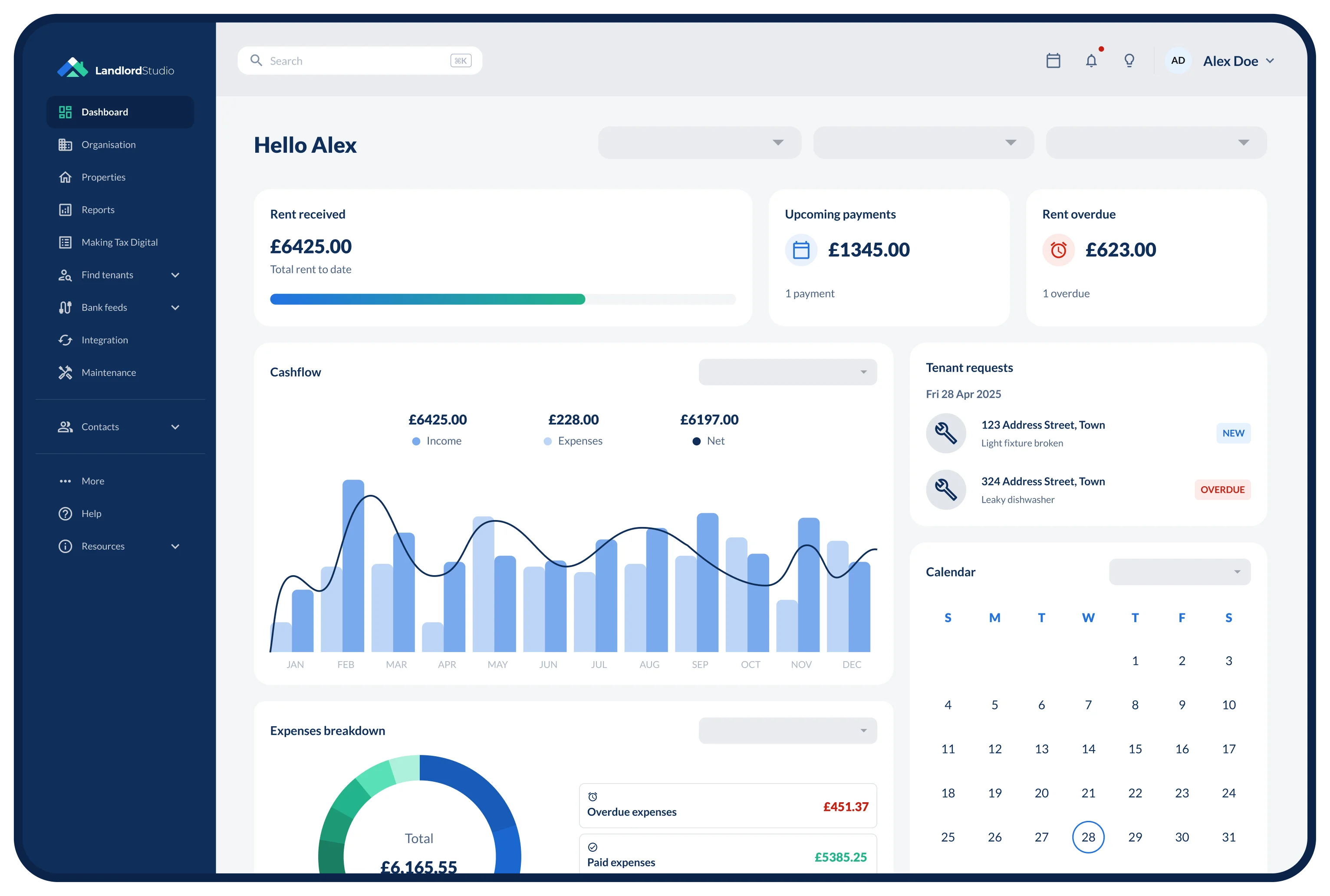
Landlord Studio is a cloud accounting designed specifically for landlords. Easily track income and expenses on the go, digitise receipts, and instantly generate financial reports.
- Save time with task automation, and features like integrated bank feeds and smart scan receipts.
- Cloud-based. Access your data on the go from any device, available on iOS, Android, and desktop.
- Everything is in one place. Store important documents set reminders for key dates and gain quick insights into your portfolio financials
Landlords can also pair Landlord Studio’s suite of property management tools and easy-to-use income and expense tracking features with Xero using our seamless Xero integration.
Our Xero integration automatically syncs all financial data entered into Landlord Studio with your connected Xero account. Enabling users to take full advantage of Xero’s industry-leading accounting features and stay MTD compliant.
Landlord Studio is HMRC-recognised and MTD compliant, with direct HMRC integration.
About Landlord Studio
.webp)
Landlord Studio is an easy to use MTD compliant property management and accounting software designed for UK landlords.
Track income and expenses, run reports,, find and prescreen tenants, manage property maintenance, and more.
.webp)