



Read summarised version with:

ChatGPT

Gemini

Claude

Grok

Add as preferred on Google
Yes, in most cases.
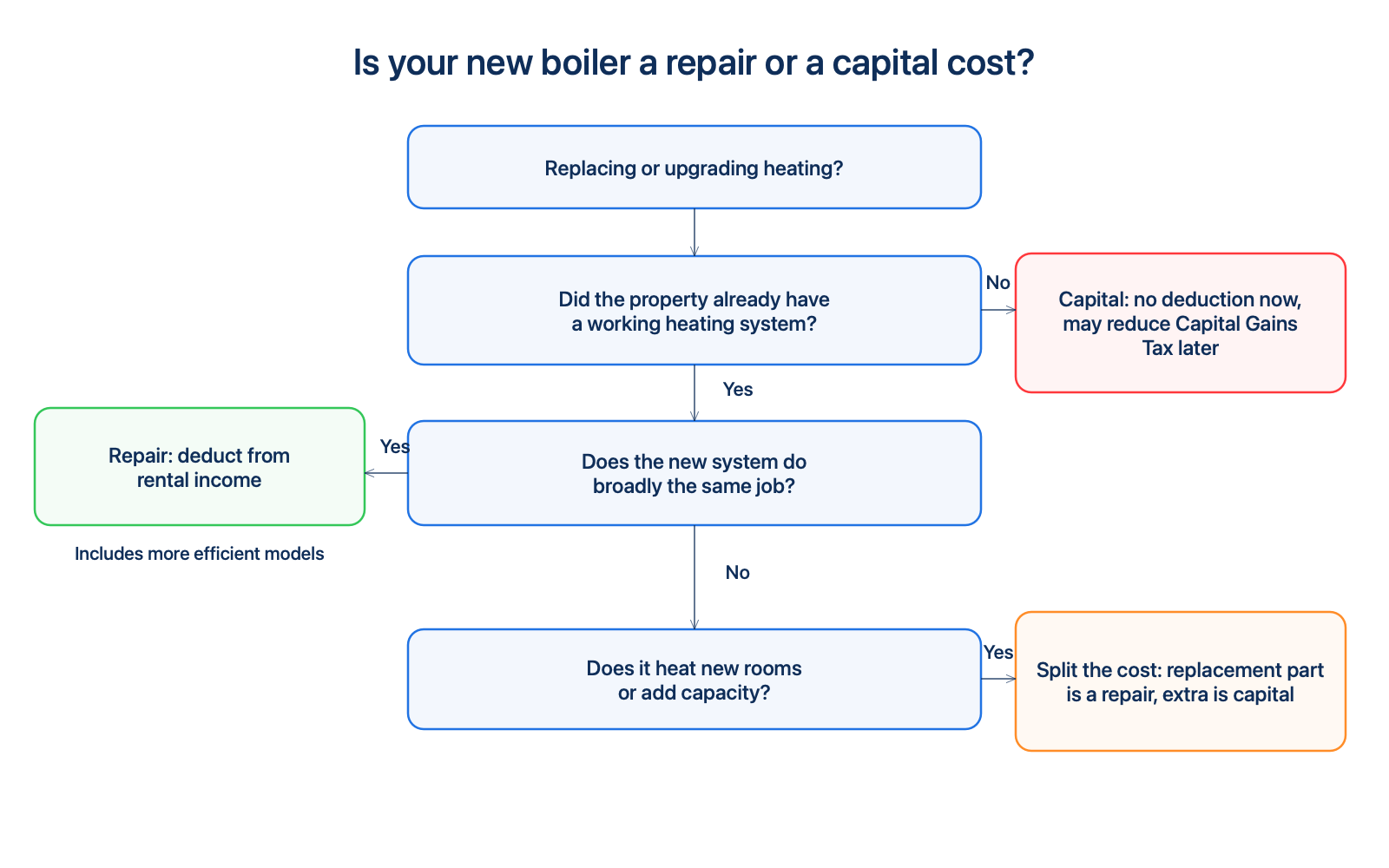
If you replace a broken or worn-out boiler in a rental property with a similar modern model, HMRC treats the cost as a repair. You can deduct it from your rental income in the tax year you pay for it. This still applies if the new boiler is more efficient, as long as it does broadly the same job.
Installing heating for the first time, or significantly improving the existing system, can be a capital improvement. The treatment depends on the nature and context of the work.
Examples are central heating in a home that had none, or a major upgrade that heats new rooms. That cost cannot come off your rental profits, but it may reduce your taxable gain when you sell, if the improvement is still reflected in the property.
HMRC briefly told landlords the opposite in 2023, which is why advice online still conflicts. Timing matters too: in Landlord Studio's data, 40% of UK landlords' boiler spending lands between November and February.

Which boiler costs can you claim?
Day-to-day boiler costs and like-for-like or more efficient replacements are allowable expenses. New heating, or a significant improvement to the existing system, can count as capital.
When do boiler costs hit landlords?
Boiler bills peak in November.
In Landlord Studio's data, November holds 11.7% of UK landlords' yearly boiler spending, and 40% lands between November and February, against 33% if it were spread evenly. May (10.2%) and February (10.1%) are the next highest months; July is the lowest (5.5%).

- Boilers take a bigger share of winter repair budgets: 5.2% of named maintenance spending in December to February, against 3.5% in June to August.
- The average (mean) boiler expense was about £360: most entries are repairs and servicing, and a new boiler costs several times that.
Booking the annual service and gas safety check in late summer or early autumn gets the boiler checked before the November rush, when engineers are busiest.
How we measured this: anonymised repair and maintenance expenses logged by UK landlords in Landlord Studio from January 2023 to December 2025, from landlords who logged expenses in at least 10 months of each year. Boiler costs are entries whose description or category mentions a boiler. Capital expenses, costs paid by tenants, short-term rentals and single items over £25,000 are excluded.
Is a replacement boiler a repair or an improvement?
A replacement boiler is a repair when it puts back what the property already had: a working heating and hot water system. HMRC's own guidance for landlords lists "replacing a broken-down boiler" as an example of a repair. A more efficient model is still a repair if the improvement is incidental to replacing the old one.
What does HMRC's guidance say about replacing a boiler?
Three HMRC sources treat a like-for-like or modern-equivalent boiler as a repair:
- GOV.UK landlord guidance: HMRC's guidance on working out rental income lists "replacing a broken-down boiler" as a repair, and says the "nearest modern equivalent is still a repair if the improvement is incidental to the repair".
- PIM2030: HMRC's Property Income Manual says changes "due to advancements in technology are generally treated as an allowable repair", with single to double glazing as its example.
- PIM3210: boilers are fixtures, and replacing a fixture "may be an allowable expense as a repair to the building", unless the whole "entirety" is replaced.
Why do some sources say a new boiler is capital?
Because HMRC said so in "one-to-many" letters sent to landlords from December 2023. In 2024 it sent a correction saying the letter "included misleading advice and was not accurate", as Ross Martin reported. An upgrade due to an advance in technology, where the new boiler does broadly the same job, is an allowable repair.
If you took a boiler out of an earlier return because of that letter, you may be able to claim it back. You can amend a Self Assessment return within 12 months of the 31 January filing deadline for that year. For older years, ask your accountant about an overpayment relief claim (generally up to four years after the end of the tax year).
How much tax does a new boiler save? Six worked examples
These are example costs, not quotes. Tax saved assumes a higher-rate landlord at 40% (England, Wales and Northern Ireland); a basic-rate landlord saves 20%. The savings also assume the whole deduction reduces profits otherwise taxed at that rate. If it creates or increases a loss, the saving comes later, when the loss is used.
The general guidance does not settle the treatment of a heat pump replacing a gas boiler, so get advice before claiming one. The grant paid part of the cost, so that part was never your expense, but subtracting it doesn't by itself make the rest a deductible repair. In examples 4 and 5, the capital amounts may reduce your taxable gain when you sell, if the improvement is still reflected in the property.
How do you claim boiler costs on your tax return?
Boiler costs go in the property repairs and maintenance box on the property pages of your Self Assessment return (SA105). If you are in Making Tax Digital for Income Tax, HMRC's digital record-keeping scheme for landlords with income over £50,000, record the expense digitally and include it in your quarterly updates, with any adjustments made before you submit your annual tax return.

You claim in the tax year you pay, if you use the cash basis (the default for most individual landlords). On the accruals basis, you claim in the year the work is done.
Keep the invoice and the Gas Safe engineer's paperwork. If HMRC asks, a note of why the old boiler was replaced (broken, beyond economic repair, failed safety check) supports the repair treatment.
Can you claim if the property is empty or between tenants?
Yes, as long as you are still letting the property, or getting it ready to let again. A boiler replaced during a void period is a repair to your rental business. A boiler replaced just before you move back in yourself is not.
What if your new boiler counts as a capital improvement?
Capital spending on heating cannot be deducted from your rental income. It is not necessarily lost, though: if the improvement is still reflected in the property when you sell, it may reduce your taxable gain.
- No domestic items relief: boilers are fixtures, so Replacement of Domestic Items Relief never applies; it covers items like washing machines instead.
- No capital allowances: they are not available for plant inside a residential dwelling.
- Capital Gains Tax: improvement costs still reflected in the property when you sell may reduce your gain, as our guide to reducing Capital Gains Tax on rental property explains.
Do the same rules apply to holiday lets and limited companies?
Yes. The furnished holiday lettings regime was abolished from 6 April 2025 for individuals and 1 April 2025 for Corporation Tax, so a holiday home you let follows the same repair and capital rules as any other rental. Capital allowances are no longer available for new spending on former holiday lets.
Limited company landlords use the same repair or capital test for Corporation Tax.
What are a landlord's boiler responsibilities?
In England, you must keep the heating and hot water system in repair and proper working order, and have gas appliances safety-checked every year. The gas safety rules apply across Great Britain; Wales and Scotland set the repair duty in their own laws, and Northern Ireland has its own gas safety regulations.
- Landlord and Tenant Act 1985, section 11: you must keep "in repair and proper working order the installations in the dwelling-house for space heating and heating water", at your own cost.
- Gas Safety (Installation and Use) Regulations 1998: a Gas Safe registered engineer must check every gas appliance and flue each year; tenants get the record within 28 days (new tenants before they move in), and you keep it for two years.
An annual boiler service is not the same as the gas safety check. The Health and Safety Executive (HSE) recommends servicing in line with the manufacturer's instructions, or yearly if there are none, and many engineers do both in one visit.
For the wider picture, see our guide to landlord responsibilities for repairs.
How quickly must a landlord fix a broken boiler?
The law sets no fixed deadline for private landlords. Section 11 names no timescale, so you must act within a reasonable time once you know about the fault. Treat no heating or hot water in winter as an emergency and aim to get an engineer out within 24 hours.
Awaab's Law has applied to social landlords in England since 27 October 2025: they must investigate and make emergency hazards safe within 24 hours, though permanent repairs can take longer. The government is consulting on extending it to private renting, and no start date has been set.
While you wait for parts, provide electric heaters and cover the extra electricity if you can. It keeps the tenant warm and shows you acted reasonably.
Can a tenant refuse to pay rent if the boiler is broken?
Not as a protest: rent held back is still arrears. But a tenant who told you about the fault, gave you a reasonable chance to fix it and then paid for the repair themselves may be able to deduct the reasonable cost from future rent, if they follow the correct legal procedure.
A tenant left without heat can also report the property to the council, which can act on excess cold, or claim compensation for disrepair. Fixing the boiler quickly, and agreeing a rent reduction for a long delay, avoids both.
Do landlords have to replace old boilers?
No. No law makes you replace a boiler because of its age, only repair or replace it when it is unsafe or stops heating the home. Energy efficiency rules may push you to upgrade sooner.
- Higher EPC standard by 2030: the government has confirmed plans to require privately rented homes in England and Wales to meet a higher Energy Performance Certificate (EPC) standard by 1 October 2030, measured with new EPC metrics and subject to legislation, with required spending capped at £10,000 per property.
- No forced heat pumps: landlords are "in no circumstances required to replace working heating systems with heat pumps".
- Boiler Upgrade Scheme: landlords in England and Wales can get grants of £7,500 towards an air or ground source heat pump (£2,500 for air-to-air), with a temporary extra £1,500 until March 2027 for homes heated by oil or LPG with no mains gas, or £5,000 towards a biomass boiler. These grants do not count towards the £10,000 cap.
Our guides to improving your EPC rating and EPC grants for landlords cover the other upgrades that count.
Will you have the paperwork when HMRC asks?
A boiler is often a landlord's biggest single repair bill, and the claim rests on a few records: the invoice, the engineer's notes on why the old boiler was replaced, and the gas safety record. Keep them with the property, not in an inbox.
With Landlord Studio's rental accounting software, you can upload the invoice, record the expense against the right property, and have it ready for your Self Assessment or Making Tax Digital quarterly updates. If the boiler counts as capital, keep the invoice on file until you sell.
Frequently asked questions
Can I claim a new boiler in a property I have just bought?
It depends on the facts, and HMRC looks at each case on its own. Replacing a worn boiler soon after you buy is often a repair, and a price that simply reflects ordinary wear and tear doesn't stop you deducting it. The cost is more likely to be capital if the property couldn't be used or let until the work was done. Get an accountant's view if the boiler was part of the reason you paid less.
Does a new boiler need a landlord gas safety certificate?
It needs one within 12 months. HSE guidance says a newly installed appliance must have its first landlord gas safety check within 12 months of installation, then every year after that. The installer's Building Regulations compliance certificate is not a landlord gas safety record, so add the new boiler to the property's annual check. Our gas safety certificate guide covers what it involves.
Can I claim a boiler my tenant paid for?
No. You can only deduct costs you paid. If you refund the tenant, the refund is your expense and you can claim it.
Does landlord insurance cover a broken boiler?
Not usually. Standard landlord buildings insurance covers damage from events like a burst pipe, not a boiler that wears out. Breakdowns need boiler cover or home emergency cover, which our buy-to-let landlord insurance guide compares.
This guide covers the general rules. Get advice from an accountant on a specific claim, especially for heat pumps or mixed jobs.