





Read summarised version with:

ChatGPT

Gemini

Claude

Grok

Add as preferred on Google
For years, student lets ran on a simple cycle: a twelve-month fixed term assured shorthold tenancy, roughly matching the academic year, ending neatly each summer. Sign the group up a year ahead, take the rent up front, get the house back in June.
That model is gone.
Since 1 May 2026, Section 21 has been abolished, fixed terms no longer exist for new tenancies, and a student can hand in two months' notice at any point in the year.
Ground 4A is the mechanism that replaces the old summer changeover. It is a mandatory possession ground built specifically for student HMOs, and it works. But it only works if you meet every condition, and one of those conditions has to be satisfied before the tenancy even starts. Get it wrong and you cannot use the ground at all for that let.
This guide covers exactly what Ground 4A requires, how to time it, the two traps that catch most student landlords, and what to do if the ground is not available to you.
What changed for student lets on 1 May 2026
Three changes matter most if you let to students.
Section 21 is abolished
You can no longer end a tenancy with a no-fault notice. Even if your old agreement still mentions Section 21, the clause is unenforceable. To recover possession you now need a valid ground under Section 8.
Fixed terms are gone
New tenancies are open-ended assured periodic tenancies. The traditional twelve-month student contract that ends in June no longer exists, and attempting to let for a fixed term is itself a breach that can attract a civil penalty.
Tenants can leave whenever they want
A tenant can give two months' notice at any point, with no minimum period. In principle a student could move in during September and serve notice the same week. Their notice needs to expire at the end of a rental period, which often makes it slightly longer in practice, but the exposure is real and it is new.
One exception: purpose-built student accommodation and university halls operating under an approved code can still offer fixed terms. If you are a private landlord letting a house or flat to students, the new rules apply to you in full.
What is Ground 4A?
Ground 4A is a new mandatory possession ground inserted into Schedule 2 of the Housing Act 1988 by the Renters' Rights Act. It allows a landlord of a student HMO to recover possession in time for the next academic year.
Key features:
- Mandatory ground - if you prove the conditions, the court must grant possession. There is no judicial discretion.
- Student HMOs only - it is not available for one- or two-tenant student lets.
- Four months' minimum notice on a Section 8 notice.
- Seasonal window - the possession date must fall between 1 June and 30 September.
- Advance written notice required - before the tenancy is entered into.
A note on notice periods, because a lot of the guidance published earlier in 2026 is now out of date. There was a time-limited concession allowing two months' notice for tenancies signed before 1 May 2026, to smooth the first changeover.
That window closed on 31 July 2026. Four months is now the standing requirement.
The conditions you must meet
Every one of these has to hold. Miss any of them and Ground 4A is unavailable for that tenancy.
1. The property must be an HMO
Three or more people forming two or more households, meeting the HMO definition under the Housing Act 2004. A two-bedroom flat let to two students does not qualify.
2. Every tenant must be a full-time student
A single non-student occupant defeats the ground entirely. This has real consequences for mixed groups, mature students, postgraduates who have finished, and student-plus-partner arrangements.
Guidance varies on exactly when the student test must be satisfied - at the start of the tenancy, at the point notice is served, or both. The safe approach is to verify and record full-time student status at signing, and again before you serve notice, and keep the evidence.
3. You must have given written notice before the tenancy started
Before the tenancy is entered into, you must notify the tenants in writing that you may seek possession under Ground 4A. This is the condition that catches people out, and it is covered in its own section below.
4. You must intend to re-let to students
The purpose of the ground is to make the property available to the next cohort. You need to intend to let it to a new group who meet the student test.
5. Possession must fall between 1 June and 30 September
The notice period has to end inside that window. Outside it, the ground is not available regardless of everything else.
6. The tenancy must not have been signed more than six months before it begins
The six-month rule. Covered below, because it is the single biggest change to how student landlords have to operate.
The condition most landlords will miss
Ground 4A requires you to tell the tenants, in writing and before the tenancy is entered into, that you may need possession under Ground 4A.
The practical implication is that this cannot be fixed later. If you sign a group in August and only realise in January that the statement was never served, you have almost certainly lost Ground 4A for that entire tenancy. Your options at that point are to negotiate a surrender, hope the group leaves voluntarily, or find another ground that fits - and there may not be one.
So bake it into the agreement itself. Use a Renters' Rights Act-ready student tenancy agreement with the Ground 4A statement built in, and make serving it part of your standard pre-tenancy pack rather than something you remember to do.
The six-month rule and the end of signing a year ahead
You cannot sign next year's tenancy more than six months before it is due to start. If you do, you keep the tenancy but you lose access to Ground 4A for that let.
This overturns the long-standing habit of signing student groups up in the autumn for the following September. A tenancy starting on 1 September can be signed no earlier than 1 March.
Two things this does not stop you doing. You can still advertise the property whenever you like. And you can still agree a tenancy more than six months ahead if you want to - you simply forfeit Ground 4A on that tenancy, which for most student landlords is not a trade worth making.
The rule exists because students were routinely being pushed into signing for houses before they had settled on a group or seen much of the market. Whatever you make of the policy, it means your letting calendar has to move.
How do you manage timing for Ground 4A?
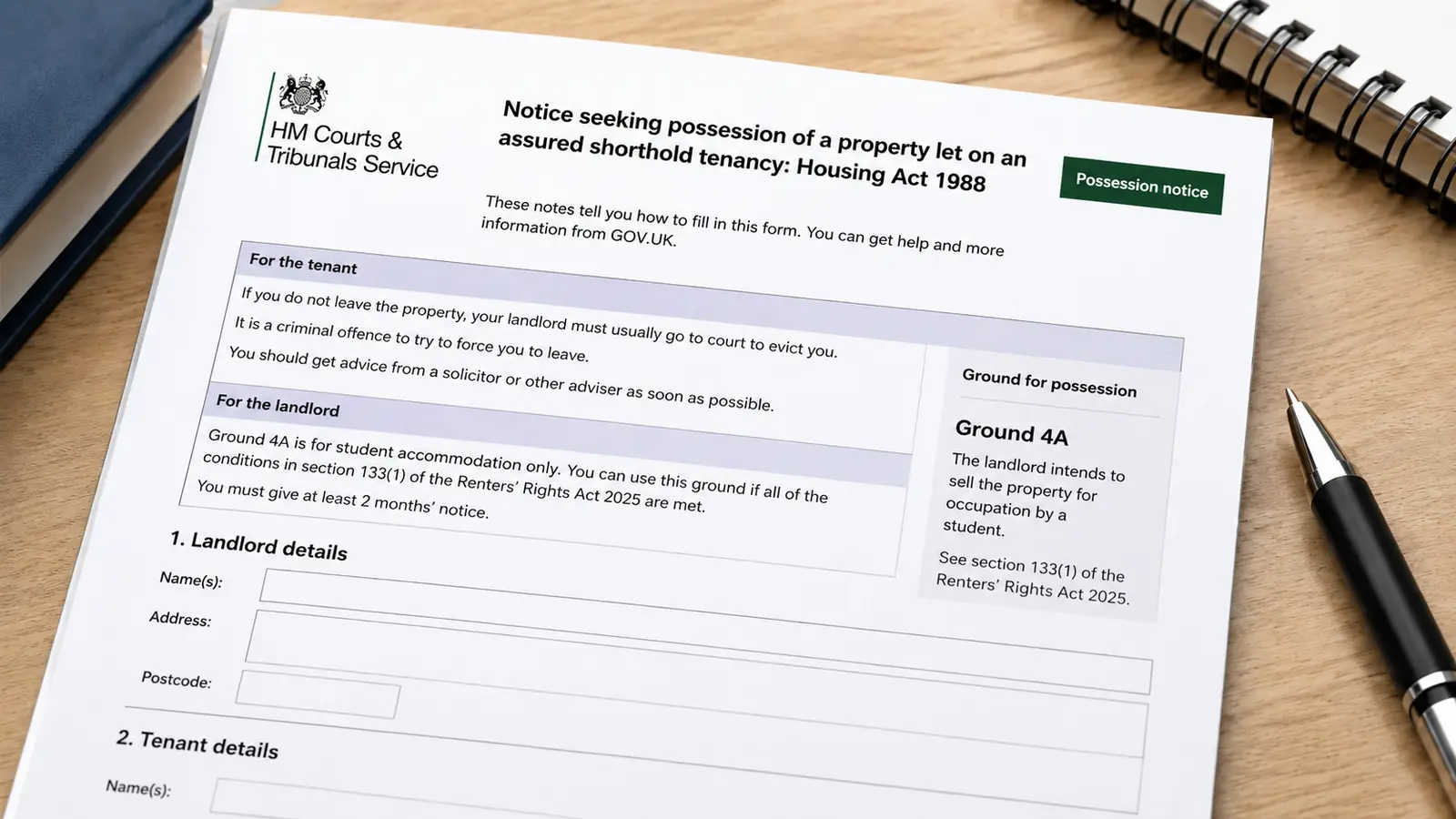
Ground 4A is fundamentally a diary exercise. Decide when you need the property empty, then count back four months.
A worked example for a standard September changeover:
- Target possession date: 1 July 2027, giving you the summer to turn the property around.
- Latest date to serve the Section 8 notice: 1 March 2027.
- Earliest date you can sign the 2027/28 tenancy: six months before it starts, so 1 March 2027 for a 1 September start.
Those two dates landing in the same week is not a coincidence - it is the new shape of the student letting year. Serving notice on the outgoing group and signing the incoming group now happen at roughly the same time, rather than nine months apart.
Build in margin. If the tenants do not leave at the end of the notice period you will need a possession order, and the court process adds time you cannot control.
Do not serve a ground you cannot rely on
If you serve notice on a ground that does not actually apply and the tenants leave as a result, you are exposed. The Renters' Rights Act created a list of prohibited conduct around possession and tenancy reforms, enforceable by local authorities with civil penalties of up to £7,000 for a first breach and up to £40,000 for serious or repeated breaches. Rent Repayment Orders are also available to former tenants in some circumstances.
The accuracy protects you as much as it protects them. Before you serve, confirm in writing that the property is an HMO, that every tenant is a full-time student, that the Ground 4A statement was served before the tenancy started, that the tenancy was signed within the six-month window, and that your possession date falls between 1 June and 30 September.
What if Ground 4A is not available to me?
Several common situations fall outside it.
You let to one or two students. Ground 4A only applies to HMOs, so a studio, one-bed or two-bed student let is out. You would need a different ground - Ground 1 if you or a family member intend to move in, or Ground 1A if you intend to sell. Take advice on which, if any, fits.
The group is mixed. One non-student occupant defeats the ground. If a group forms with a non-student in it, you need to know before they move in, because it changes your position for the whole tenancy.
You missed the written statement. Speak to a solicitor about your options on that tenancy, and make sure the statement is in every future agreement.
You run purpose-built student accommodation. PBSA and university halls under an approved code can still use fixed terms and sit outside this regime entirely.
Your before move-in checklist
Six things to complete before your next group moves in.
- Use a Renters' Rights Act-ready tenancy agreement. Old AST templates are not fit for purpose.
- Make sure the Ground 4A written statement is in the agreement and served before the tenancy is entered into. This is your route to getting the property back next summer.
- Confirm and record that every tenant is a full-time student at signing, and keep the evidence.
- Set your guarantor policy and get deeds of guarantee signed and returned before move-in. Chasing them afterwards is a headache, and rent in advance is no longer available as a fallback - you cannot require rent before signing, and only one month's rent after it. Students can pay more voluntarily, but you cannot require or enforce it.
- Take a compliant deposit and protect it. Still capped at five weeks' rent where annual rent is under £50,000, with holding deposits capped at one week. Protect it in a government-approved scheme within 30 days and serve the prescribed information. Miss this and you can be blocked from relying on possession grounds later.
- Serve your required documents and keep proof. EPC, gas safety certificate, EICR, How to Rent guide and deposit paperwork. If a tenant later claims they never received something, the proof is what protects you.
You can use our move-in / move-out checklist to help.
Managing the tenancy through the year
Four things to keep an eye on once the group is in.
Mid-year exits - tenancies are periodic, so a student can give two months' notice and leave. Have a plan for a gap or a replacement.
Joint tenancies - in a joint tenancy, notice from one tenant can end the tenancy for everyone. In a student house where one person drops out, that is a significant shift, and it is worth taking advice on whether individual room agreements or a single joint tenancy suits your property and your appetite for turnover risk.
Rent collection - several tenants, possibly several guarantors, different pay dates. This gets fiddly quickly across multiple properties.
Rent increases - once a year only, not in the first twelve months, using the prescribed Form 4A under the Section 13 procedure with two months' notice. Rent review clauses in the agreement have no effect. Tenants can challenge an increase at the First-tier Tribunal if they believe it exceeds market rent.
How Landlord Studio helps
Ground 4A is a documentation problem as much as a legal one. You need to prove the statement was served before the tenancy started, that every tenant was a full-time student, that compliance documents were sent, and that your notice dates line up.
Landlord Studio lets you set properties up as HMOs with individual rooms and tenancies, track rent per room including part-payments and arrears, and send compliance documents from inside the system so you get a timestamped record of what was sent, to whom, and whether it was opened. If a tenant later says they never received the How to Rent guide, the audit trail answers it.
Ground 4A FAQs
I only let to one or two students. Does Ground 4A apply to me?
No. Ground 4A applies only to HMOs, meaning three or more unrelated tenants. For smaller lets you would need a different possession ground, and it is worth taking advice on which one fits your circumstances.
I forgot to put the Ground 4A statement in the agreement. What can I do?
You likely cannot rely on Ground 4A for that tenancy. Speak to a solicitor about your options, and make sure the statement is included in every future agreement.
Can I still ask an international student without a UK guarantor for rent up front?
No. Requiring rent in advance is no longer permitted. You cannot ask for rent before the agreement is signed, and after signing you can only require one month at a time. Point students without a UK guarantor towards guarantor insurance services or their university's guarantor scheme instead.
A student has offered to pay a term's rent voluntarily. Is that allowed?
Voluntary payment after the tenancy agreement has been signed is not an offence. What you cannot do is require it, invite it, encourage it, or write it into the agreement. The line between offering and encouraging is narrow, so take a short piece of legal advice before accepting.
What if one student in the group wants to leave mid-year?
In a joint tenancy, one tenant's notice can end the tenancy for everyone. This is a structural risk that depends on how you set the let up, and it is worth deciding deliberately rather than by default.
Is purpose-built student accommodation affected?
PBSA and university halls operating under an approved code can still offer fixed terms. Typical private student houses cannot.
When is the earliest I can sign next year's group?
Six months before the tenancy starts. For a 1 September start, that is 1 March. Sign earlier and you lose Ground 4A for that tenancy.
Can I get possession outside 1 June to 30 September?
Not using Ground 4A. The possession date must fall within that window. Outside it you would need a different ground.
The information in this article is general guidance and should not be relied on as legal advice. Possession claims are fact-specific and the post-Renters' Rights Act enforcement landscape continues to develop. If you are planning to rely on Ground 4A, take advice from a qualified housing solicitor before serving notice.