



.jpeg)
Read summarised version with:

ChatGPT

Gemini

Claude

Grok

Add as preferred on Google
As a UK landlord, one of the biggest levers you have available to you for improving your profitability is claiming all of your allowable expenses. It doesn’t matter how great your service is; if you’re not claiming, you’ll be out of pocket.
However, tax rules are rarely straightforward. In the tax year 2023-2024, an impressive 87.7% of unincorporated landlords declared some form of allowable expenses to HMRC. Yet, the most commonly claimed categories, such as repairs and maintenance (66.1%) and insurance (66.2%), suggest that many are missing the smaller, yet still valuable, deductions.
Worryingly, 12.3% of landlords did not claim any expenses at all, leaving potential savings unclaimed.
If you’re stuck on the question of ‘what expenses can I claim as a landlord’, this guide will clarify everything you need to know to ensure you are maximizing your tax relief and keeping every penny you are legally entitled to.
Is It Deductible For Your Rental? The Golden Rule: Wholly and Exclusively
Before you claim anything, you must meet HMRC’s primary test: the expense must be incurred wholly and exclusively for the purposes of renting out the property.
That "exclusively" part is what trips most people up. What about your mobile phone, your car, or your home internet? You use them for your property business, but also for your personal life.
HMRC is pretty fair on this. You can't claim the whole bill, but you can claim the "business proportion."
You just need to find a reasonable way to split the cost. For example, if you reckon you use your phone 30% of the time for ringing tenants and tradespeople, you can claim 30% of your monthly bill.
The same logic applies to any tool or service. If you buy a drill for both home DIY and property repairs, you'd just make a sensible estimate of the business use and claim that portion.
Just be realistic and be prepared to explain your maths if HMRC ever asks.
Related: Complete Guide to Allowable Expenses for Landlords in 2025
What Expenses Can You Claim As A Landlord?
There are several kinds of expenses that qualify as allowable rental property deductions. We’ve broken them down below.
Category 1: Operating Costs
These are the essential, ongoing costs you pay to keep your rental business running and compliant.
- Agent and Management Fees: If you use a letting agent, all their charges are deductible. That includes tenant-finding fees and your monthly management percentage.
- Insurance: This is a big one. You can fully claim buildings insurance, contents insurance (if you're letting it furnished), landlord liability cover, and even rent guarantee insurance.
- Leasehold Costs: For leasehold properties, the ground rent and any service charges you pay to the freeholder are fully claimable.
- Bills During Voids: Any council tax or utility bills (gas, water, electric) that you have to pay yourself during void periods are claimable.
- Professional Fees: This is a key one with a catch. The cost for your accountant to prepare your rental accounts is a claimable expense. The same goes for legal fees related to tenancy renewals (under a year) or debt collection. Just remember you can't claim the solicitor fees from when you first bought the property. HMRC sees that as a capital cost.
Category 2: Repairs vs. Improvements
The distinction between repairs and improvements is one of the most common areas of confusion for UK landlords, and getting it right is critical for both compliance and tax efficiency.
Repairs
A repair restores the property to its original condition and does not materially enhance its value or extend its useful life. Examples include fixing a leaky tap, repainting, replacing a broken roof tile, or replacing a broken boiler with a modern equivalent.
HMRC explicitly allows a modern equivalent as a repair. A replacement does not become a capital improvement merely because it is newer, more efficient, or more expensive due to modern standards.
Allowable repairs are deductible from rental income in the year they are incurred.
See HMRC’s Property Income Manual (PIM2030) on repairs and improvements.
Improvements
An improvement (capital expenditure) enhances the property beyond its original condition, upgrades it substantially, or creates something that was not previously there. Examples include:
- Installing an entirely new heating system where one did not exist before.
- Replacing single glazing with double glazing (this is sometimes treated as an improvement depending on context but is often accepted as a repair because double glazing is the modern equivalent; nuance is required).
- Converting a loft or adding an extension.
- Installing higher-spec fixtures that significantly increase the property's value or utility beyond a normal replacement.
Unlike repairs, capital improvements are not deductible against rental income.
Instead, they must be tracked separately because they can be added to the property’s cost basis and claimed against Capital Gains Tax (CGT) when you eventually sell the property.
Category 3: The Overlooked Deductions
Don't forget these smaller, but highly claimable costs:
- Travel and Mileage: You can claim travel costs (45p per mile for the first 10,000 miles, or actual costs) for trips to your rental property for inspections, maintenance, or meetings with contractors. This is a huge, often-missed deduction.
- Administrative Costs: The business portion of your phone and broadband bill, stationery, postage, and costs of advertising for new tenants are all claimable.
- HMO Licence Fees: Fees paid for Houses in Multiple Occupation (HMO) licenses or selective licensing schemes are fully deductible.
For many new landlords, figuring out what expenses belong in each category can be overwhelming. As one landlord on Reddit asked when filing their first return:
"All I want to know is what expenses you personally deduct? I’m thinking like landlord registration, landlord insurance, a new oven, tenant credit check etc. I want to be sure I’m not missing anything!"
These are the common, everyday expenses that make the difference between an accurate return and a missed opportunity.
If you want to make sure you are claiming every allowable expense, you need to make sure you track every receipt, mileage log, and agent invoice. This makes the difference between keeping your tax low and overpaying HMRC. If you’re using spreadsheets, you’re likely leaving money on the table or getting the Capital vs. Repair rules wrong.
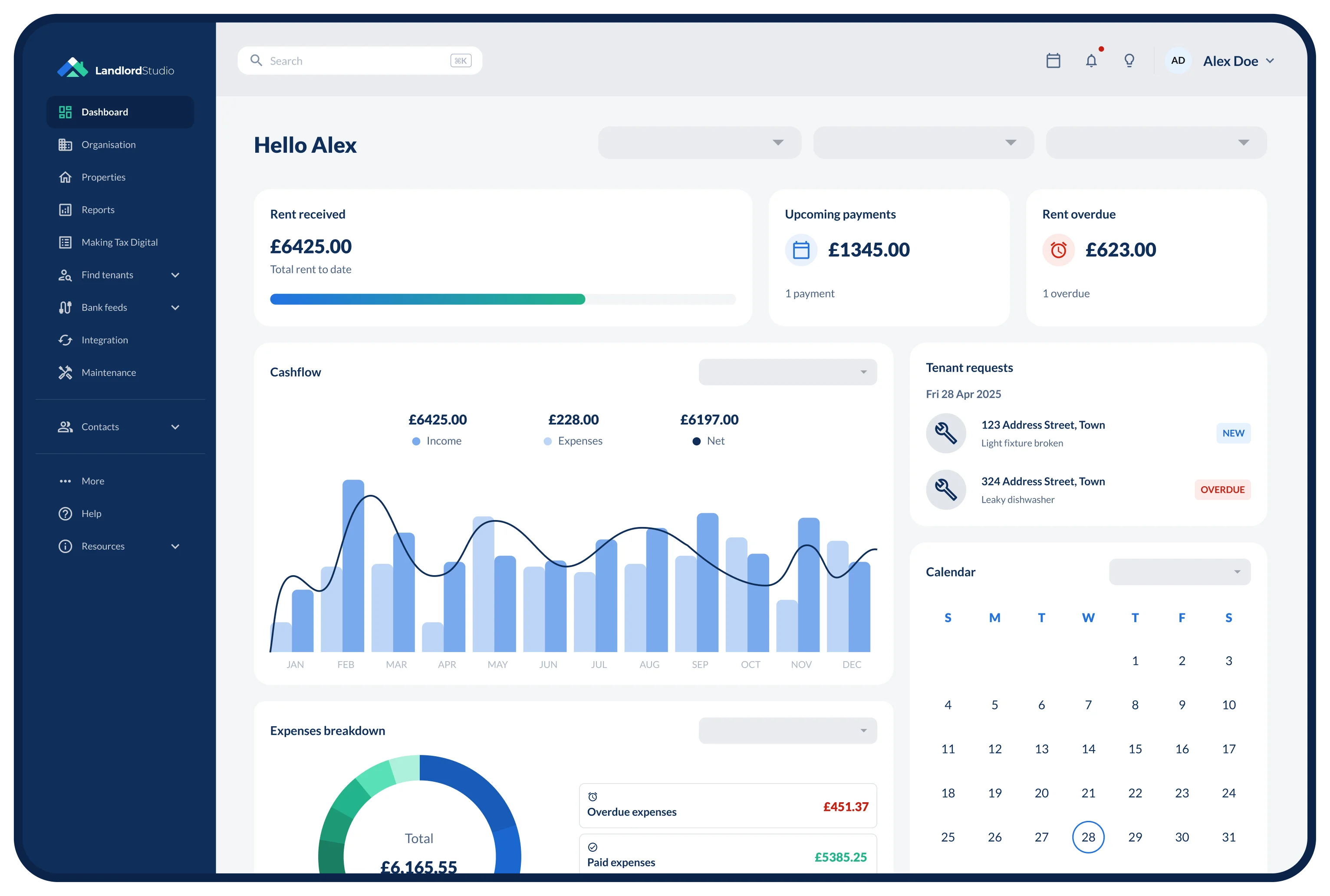
Dedicated property accounting software makes this process simple. It categorizes your spending automatically, ensuring you never miss a deduction.
What You Absolutely Cannot Claim
- Mortgage Capital Repayments: You can never claim the portion of your mortgage payment that goes towards paying down the principal loan.
- Mortgage Interest: You can no longer deduct mortgage interest from your rental income. Instead, you receive a 20% tax credit on the interest portion of your loan.
- Initial Purchase Costs: Stamp Duty, solicitor fees, and survey costs incurred when you first buy the property are capital costs, not revenue expenses. They are factored into Capital Gains Tax when you eventually sell.
- Replacement of Domestic Items: The initial cost of buying new furniture or white goods is not an allowable expense. However, you can claim Replacement of Domestic Items Relief when you replace old items with similar ones.
Final Words: What Expenses Can You Claim As A Landlord?
Don't guess with your tax return. Getting your expense classification wrong can lead to underpaying tax and incurring penalties, or overpaying and costing yourself money.
Landlord Studio is built to handle the complexities of UK property tax, helping you correctly categorize every expense and track your mileage automatically. Stop scrambling through invoices at the end of the year and start seeing your true profit today.
Take control of your tax liability. Create your free Landlord Studio account today.