



Read summarised version with:

ChatGPT

Gemini

Claude

Grok

Add as preferred on Google
At the end of the tax year, you will need to report your total taxable income for the year (including not just your rental income but other streams of income as well) to the HMRC. For example, if you operate as a sole trader you would need to declare income from your business operations, if you realised capital gains you will need to report this income as well.
Additionally, in your income tax self-assessment, you will report the allowable expenses which you can legally deduct. This will help you mitigate the overall tax bill and reduce your tax liability.
What income do landlords need to pay taxes on?
There are a variety of income sources that as a landlord you may need to pay taxes on.
These include:
- Tax on rental income,
- National Insurance contributions,
- Stamp duty land tax,
- Capital gains tax.
Not all of these are paid through a self-assessment. For example, you will only need to pay the stamp duty land tax and capital gains tax when buying or selling a property. Income tax and National Insurance contributions are paid annually and based on the income you make from renting out your properties.
In order to pay the income tax associated with your rental income, you will need to register for self-assessment and complete your tax return each year.
When do landlords need to pay income tax?
According to the HMRC, you get a £1,000 tax free rental income tax allowance each year. You can claim this on your tax return. However, most landlords will make more than £1,000 of taxable income from their properties in any one year and if you use this £1,000 property allowance, you can’t claim other expenses which will likely equate to a greater amount.
You report rental income on a Self Assessment if it’s:
- £2,500 to £9,999 after allowable expenses
- £10,000 or more before allowable expenses
Your self-assessment for rental income will need to be filled out and completed by the 31st of January the following year if you file online. Any owed taxes will need to be paid by this same deadline.

Do landlords pay national insurance on income tax on rental income?
Landlords have to pay Class 2 National Insurance if their profits are £6,515 a year or more and what you do counts as running a business.
As a way of working out whether renting out your property counts as running a business, gov.uk says the following should apply:
- being a landlord is your main job
- you rent out more than one property
- you’re buying new properties to rent out
If you’re not renting out property as a business, you don’t pay National Insurance – even if you manage your property yourself.
About the landlord tax return process
Register: self-assessment for rental income
The first thing to do is to register for self-assessment. You will usually need to do this by the 5th of October in the tax year you started receiving rental income. If you don’t register by the deadline you could be liable for a fine from the HMRC.
When you register you’ll get a government gateway user ID and password. With this, you can set up your personal tax account which lets you manage your taxes online.
File Your Taxes
Now that you’re registered, you can file your tax return simply by filling out the self-assessment tax return form online or on paper.
It is important to note that this process is changing with Making Tax Digital (MTD) for Income Tax, which started on 6 April 2026 for landlords with qualifying income over £50,000. It extends to those over £30,000 from 6 April 2027, and over £20,000 from 6 April 2028. If you are in scope, you keep digital records and submit quarterly updates to HMRC using a HMRC-recognised software solution, in line with MTD regulations, rather than filing a single annual return.
For more information about making tax digital read this article.
Landlord tax deadlines
The deadline for submitting your self-assessment for rental income for each financial year is the 31st of January for online tax returns and for paper tax returns it’s usually the 31st of October. Once you fill out your tax return, you will need to pay the tax you owe. The deadline is the same as the final date for online self-assessment tax returns, the 31st of January the following year. Missing any of these deadlines could make you liable to fines from the HMRC.
Ensure you keep accurate financials throughout the tax year
In order to fill out an accurate self-assessment for rental income, you will need a variety of details and information. As such it’s important to keep accurate records of all of your income and expenses throughout the tax year so you can easily find them when you need them for tax time.
As part of these records, you will need:
- the dates you let out your property.
- All the money spent managing your property, including cash, check, credit, and debit card transactions.
- The rental income received.
Alongside these detailed records, you should keep a variety of records to act as proof. The documents you should keep in support of your records include:
- The tenancy or letting documents
- Your rental accounting books
- All receipts of related transactions
- All invoices of related transaction
- Bank statements
- Mileage logs, the cost vehicle used for property business, and its CO2 emissions.
- All documents relating to when you bought the property
- and for furnished holiday lettings and commercial properties the cost of any other capital items used in the property
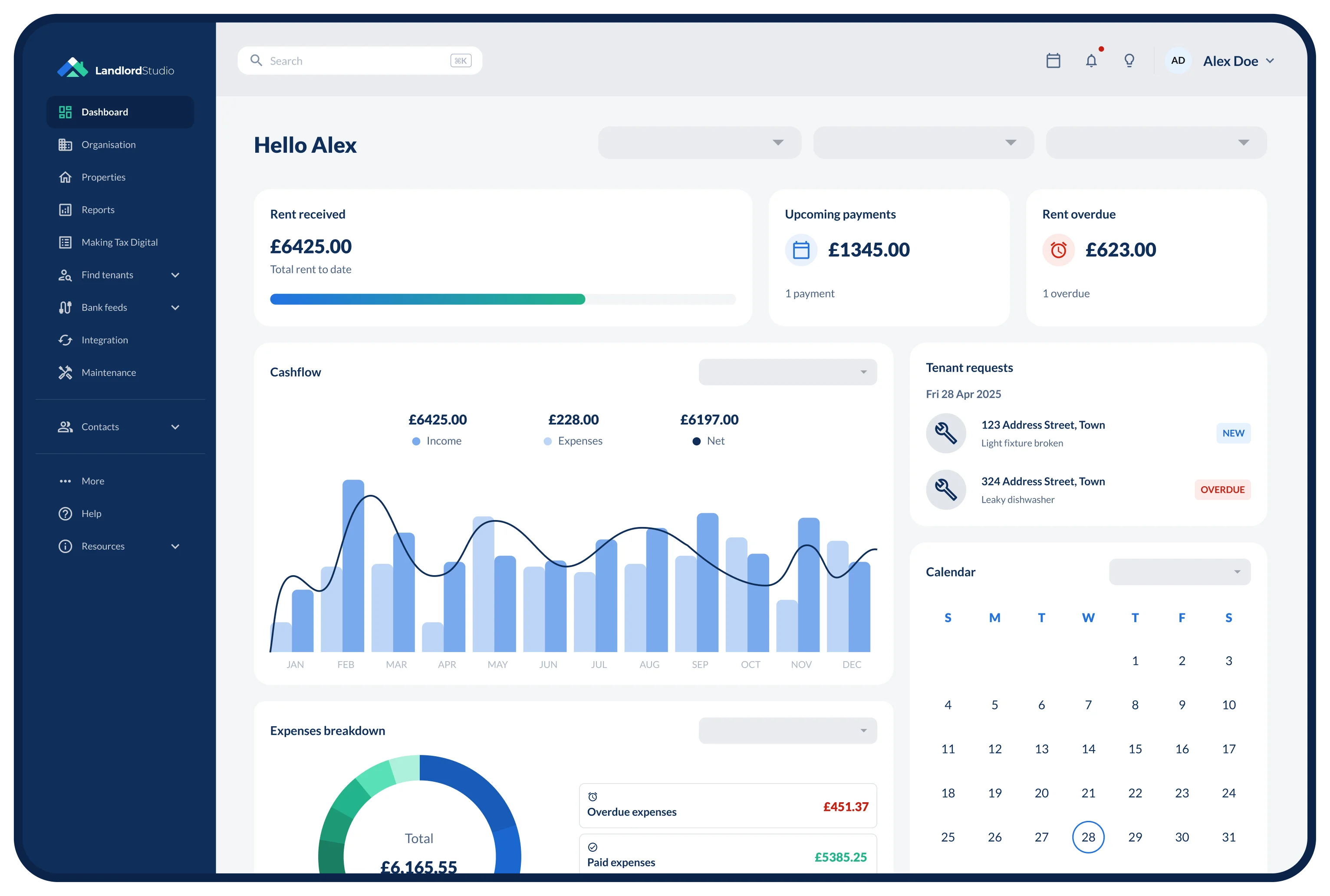
The best way to manage and store all of these records is to use software designed for the purpose. Landlord Studio, for example, is an accounting and property management software that allows you to track income expenses accurately on the go and instantly generate over 15 accountant-approved reports for tax time including a profit and loss statement and the income and expense statement.
An additional benefit of utilising software for this purpose is that it keeps you MTD ready. Digitise and store all your receipts, and keep accurate detailed digital records of all of your income and expenses.
Allowable tax deductions
As a landlord, you are allowed to deduct the cost of certain expenses from your rental income. This is an important step that you must take in order to maximise your rental property cash flow. As a general rule, your expenses need to be wholly and exclusively used for the purpose of renting out your property.
Some of the main allowable expenses include:
- Repair and maintenance costs (not improvements).
- Replacement of domestic item relief
- Accounting and letting agent fees
- Landlord insurance
- General operational costs
An important note is that since the introduction of Section 24, mortgage interest is no longer fully deductible. Instead, it has been replaced by a 20% tax credit on your mortgage interest repayments.